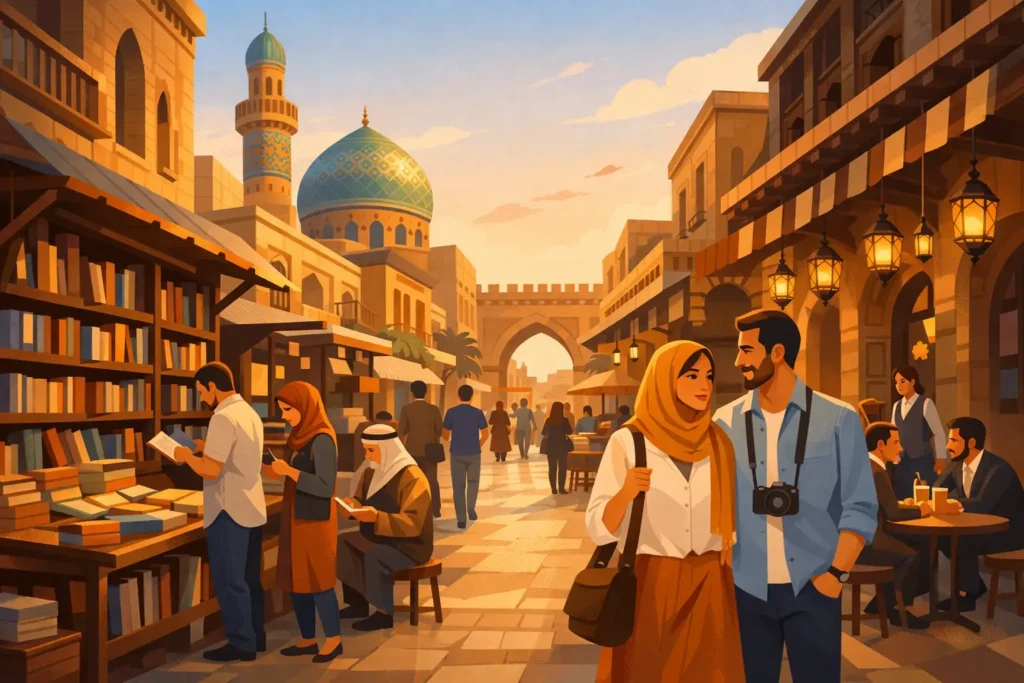
On a Friday morning, Mutanabbi Street does not feel like a place to rush through. Books spill from pavement stalls, friends gather over tea, and the conversations around you may move from poetry and politics to family news and football within minutes. Knowing how to explore Mutanabbi Street means allowing time for that rhythm. This is Baghdad’s literary heart, but it is also a living social space where visitors are welcomed best when they arrive curious, unhurried and respectful.
Named after the celebrated tenth-century poet Abu al-Tayyib al-Mutanabbi, the street has long been associated with books, publishing and Baghdad’s intellectual life. Its appeal is not limited to collectors or Arabic readers. For travellers, it offers a direct and human introduction to the city: the pleasure of browsing, the generosity of conversation and the sense that culture here belongs in the street, not behind museum glass.
How to explore Mutanabbi Street at the right pace
Friday is usually the most rewarding day to visit. The street is livelier, more stalls are open and local visitors come specifically to browse, meet friends and spend time in the nearby cafés. Arrive in the morning, ideally before the busiest midday period, when you can look at the book displays with more space and enjoy the atmosphere building gradually.
If your schedule only allows a weekday, Mutanabbi Street can still be meaningful, but expect a quieter experience and fewer informal stalls. The difference matters: Friday reveals the street as a gathering place, while a weekday visit is better for a calmer look at its bookshops and historic surroundings.
Start slowly rather than setting yourself a shopping mission. Walk the length of the street, notice which tables draw readers, and pause at displays that interest you. You may find Arabic novels, religious works, children’s books, university texts, old magazines, maps, poetry collections and second-hand editions whose covers tell a story before you open them. Some sellers specialise; others carry an eclectic mix shaped by what has passed through their hands.
Do not be discouraged if you cannot read Arabic. Many vendors are used to visitors and may help you identify English-language titles, bilingual books, Iraqi history, art books or attractive editions to take home. A book can be a thoughtful souvenir, but the exchange with the seller is often the more memorable part. Ask what they recommend, explain what interests you, and be open to a title you would not have chosen alone.
Browse with curiosity, not urgency
Book buying on Mutanabbi Street is usually informal. Prices may be clearly stated, or they may be discussed after you have spent time looking. Polite bargaining can be appropriate, especially for older or multiple books, but it should remain light and good-natured. If a price feels fair, paying it without pressing for a small reduction is often the best way to show appreciation for a specialist seller’s knowledge.
Handle older volumes carefully and ask before photographing a stall or taking close-up images of books. Most people respond warmly to genuine interest, yet it is courteous to seek permission, particularly when photographing vendors or customers. A simple greeting in Arabic goes a long way: salaam alaikum is widely understood and warmly received. Thank you is shukran.
The street rewards observation as much as purchasing. Look for handwritten notes inside used books, ageing publisher marks, illustrated covers and stacks of titles arranged by instinct rather than strict catalogue logic. This is not a polished retail district, and that is part of its character. The pleasure lies in the unexpected find and the chance to see Baghdad’s reading culture in action.
Make time for Shahbandar Café and the nearby landmarks
A visit to the historic Shahbandar Café is a natural part of the experience. Long associated with Baghdad’s writers, artists and regular conversationalists, it offers a chance to sit, order tea and absorb the room rather than merely tick off a landmark. If a table is available, take it. A quiet hour here can reveal more about the social life of the street than a hurried photograph ever could.
Café etiquette is simple. Dress modestly, keep your voice measured and ask before taking pictures indoors. Visitors should also remember that a café is first a place for local people to meet. Be present, order something, and treat the setting with the same consideration you would offer a neighbourhood institution at home.
From Mutanabbi Street, allow time to explore the surrounding historic quarter on foot. The nearby Qishla building and the riverside area provide a useful sense of Baghdad’s urban layers, where Ottoman-era architecture, civic spaces and the Tigris all sit close to the book market. Depending on access, opening arrangements and your interests, you may also wish to include nearby heritage sites in a wider central Baghdad itinerary.
This is one reason Mutanabbi Street works best as part of a half-day rather than a quick stop. Spend the morning browsing, pause for tea, walk towards the river, then have lunch nearby or continue to another cultural site with a local guide. The street itself is compact, but the experience becomes richer when you let its surroundings add context.
Practical planning for your Mutanabbi Street visit
Central Baghdad traffic can be busy, particularly around Friday gatherings and major city events. Agree your transport plan in advance with your hotel, driver or trusted local contact, and arrange a clear pick-up point for later in the day. Taxi and ride arrangements are often easier when someone local helps communicate the exact location, especially if you are unfamiliar with Baghdad’s streets.
Wear comfortable shoes suitable for uneven pavements and standing while browsing. In warmer months, carry water, use sun protection and plan your most active walking for the morning. During cooler months, a light layer is useful for early starts and shaded café interiors. Baghdadi hospitality is generous, but practical preparation makes any city visit more comfortable.
Carry cash in small denominations for books, tea and modest purchases. Some larger businesses may have other payment options, but cash remains the simplest choice for market-style browsing. Keep valuables secure and avoid carrying more than you need for the day. As with any busy public place, stay aware of your belongings without letting caution distract from the experience.
For international visitors, local guidance can be especially valuable on a first visit. A knowledgeable guide adds historical context, helps with introductions and can shape the wider day around your interests, whether that is architecture, photography, literature or Iraqi food. Independent travellers can enjoy the street too, but should confirm current access arrangements through their accommodation or trusted local contacts before setting out, as timings and local conditions can change.
Dress and behave with cultural awareness
Mutanabbi Street welcomes a broad mix of students, families, scholars, artists and visitors. Modest, neat clothing is the most comfortable choice and helps you move through the area with ease. For women, loose-fitting clothing that covers shoulders and knees is a sensible baseline; carrying a light scarf can be useful when visiting religious or more conservative settings elsewhere in the city. For men, shorts are best avoided in this context.
The most valuable etiquette is attentiveness. Do not interrupt a conversation simply to ask for a photograph. Avoid treating people or everyday life as a backdrop for content. If someone starts a discussion about where you are from or why you came to Iraq, respond openly and listen in return. Many visitors find these exchanges to be the point at which Baghdad becomes personal rather than simply historical.
Photography is possible in many public areas, but permissions matter. Ask before photographing individuals, book vendors, security personnel or sensitive buildings. When in doubt, put the camera away. A respectful approach creates better encounters and often leads to more meaningful invitations to photograph later.
Let the street shape the rest of your Baghdad trip
Mutanabbi Street is a powerful first encounter with Baghdad because it replaces distance with familiarity. You are not observing Iraqi culture from behind a barrier; you are standing among readers choosing books, friends sharing tea and shopkeepers preserving a tradition that continues to evolve. It shows why Iraq is not only a destination of ancient sites, but a country of active ideas, hospitality and everyday cultural confidence.
For a well-paced visit, pair the street with a stay in central Baghdad so you are not spending the best part of the day in traffic. Stay In Iraq can help travellers begin planning accommodation around the city’s key cultural areas, leaving more time for the places that cannot be hurried.
Leave room in your bag for a book, but leave room in your itinerary for an unscripted conversation too. On Mutanabbi Street, that may be the souvenir you remember most clearly.