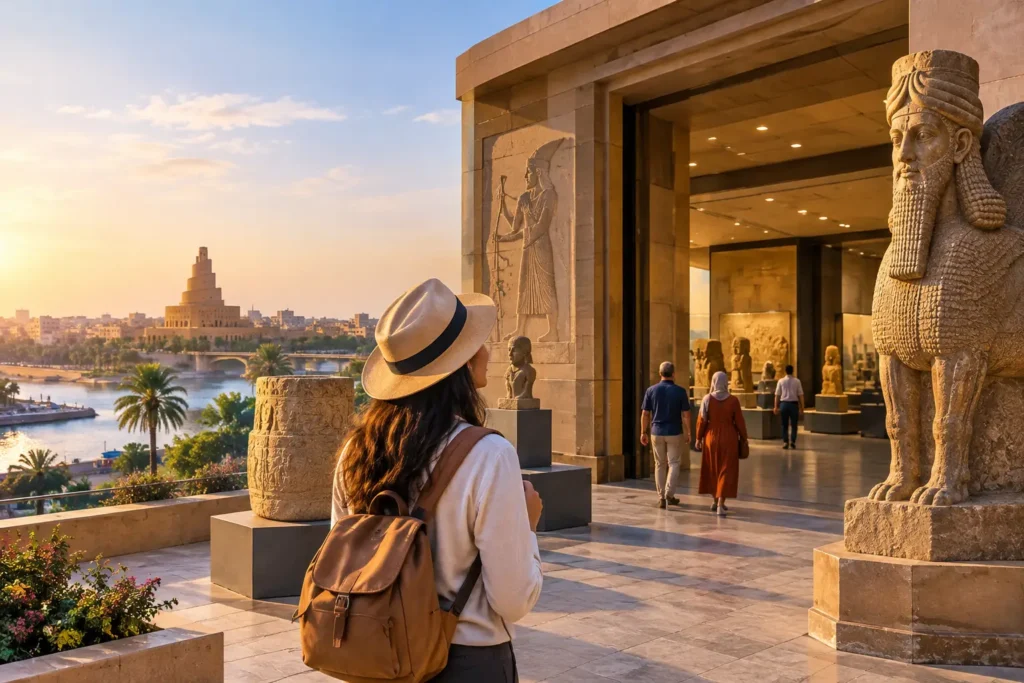
A carved Sumerian face, a tablet impressed with the first forms of writing, a guardian from an Assyrian palace: in Iraq, these are not distant chapters from a textbook. They are part of the country’s living cultural landscape. The best Iraq archaeological museums offer travellers a rare way to meet the civilisations of Mesopotamia before stepping out to the cities, temples and ancient sites that shaped them.
For heritage-minded visitors, museums are also a sensible starting point. They give context to Babylon, Ur, Nimrud, Hatra and the old cities of the north, turning a journey through Iraq into something more personal and far more legible. Collections and opening arrangements can change, so build flexibility into your itinerary and confirm local access details shortly before you travel.
The best Iraq archaeological museums for travellers
1. The Iraq Museum, Baghdad
The Iraq Museum is the essential first stop for anyone interested in the archaeology of Mesopotamia. Its galleries trace millennia of human achievement, from prehistoric settlements and Sumerian city-states to the Assyrian, Babylonian and Islamic eras. Few museums anywhere offer such a concentrated encounter with the foundations of urban life, writing, law, art and organised religion.
Allow time rather than treating it as a quick stop between Baghdad landmarks. The Sumerian, Akkadian, Babylonian and Assyrian material rewards slow looking, especially the sculptures, cuneiform tablets, seals and objects associated with royal and temple life. It is also the best place to understand how varied Iraq’s ancient cultures were, rather than reducing the country to a single civilisation or period.
For first-time visitors, the museum pairs naturally with Baghdad’s historic quarters, book markets and riverside atmosphere. The contrast is part of the experience: the past feels immense, yet it sits within a capital that remains creative, welcoming and full of daily life.
2. Sulaymaniyah Museum
Sulaymaniyah Museum is one of Iraq’s most rewarding regional museums and deserves a place on any archaeology-focused route through Iraqi Kurdistan. Its collection includes artefacts from across the north and east of the country, offering valuable context for the region’s caves, tells, mountain passes and ancient settlements.
The appeal here is not only famous objects. The museum helps visitors see archaeology as a record of ordinary lives as well as kings and empires. Pottery, tools, figurines and inscriptions reveal how communities farmed, traded, worshipped and adapted across thousands of years.
Sulaymaniyah itself is an excellent base for travellers who enjoy a more relaxed urban rhythm. Combine the museum with the city’s cafés, markets and cultural spaces, then allow additional time for nearby landscapes. It is a strong choice for visitors seeking both historical depth and a contemporary Kurdish city experience.
3. Erbil Civilisation Museum
Erbil is among the world’s oldest continuously inhabited cities, and the Erbil Civilisation Museum provides an accessible introduction to the region’s long human story. Its archaeological displays cover eras that connect directly to the wider history of northern Mesopotamia, making it particularly useful before visiting the Citadel and other heritage locations around the city.
The museum is not as vast as Baghdad’s national collection, but that is part of its strength. It offers a clearer, more manageable visit for travellers with limited time, families, or those beginning to build their understanding of Iraq’s past. Look for material that reflects the region’s changing communities and the cultural exchanges that passed through this important crossroads.
Pair it with a walk around Erbil Citadel, where layers of settlement are visible in the very shape of the mound. The museum supplies the archaeological framework; the Citadel makes that framework tangible.
4. Basra Museum
Basra Museum brings archaeology into a city better known to many visitors for its waterways, literary heritage and Gulf-facing identity. Housed in a historic building, the museum presents material connected to southern Iraq, where some of the earliest urban civilisations took root.
Its value lies in perspective. Baghdad’s museum can feel encyclopaedic; Basra helps travellers connect the story of ancient Mesopotamia with the geography of the south, including the lands between the Tigris and Euphrates and the wider networks that linked Iraq with the Gulf. Displays may vary, so approach it as a cultural stop with the potential for discovery rather than expecting every gallery to be open at all times.
A visit works especially well for travellers continuing towards the marshlands or planning an archaeology route towards Ur. It is a reminder that southern Iraq is not simply the backdrop to early civilisation – it remains a place of extraordinary culture, food, hospitality and water-based life.
5. Mosul Museum
Mosul Museum holds major significance for understanding the archaeology of northern Iraq, particularly the heritage of ancient Nineveh and the Assyrian world. The museum’s story has also become closely associated with the care, restoration and protection of cultural heritage, giving a visit added emotional weight for travellers interested in how history is preserved for future generations.
Access, gallery availability and visiting procedures may be subject to change while restoration work and cultural programmes continue. If it is open during your stay, it can be a powerful complement to visiting the archaeological landscape around Mosul. If arrangements are limited, do not see that as a reason to skip the city. Mosul’s old quarters, religious heritage, markets and remarkable human warmth make it one of Iraq’s most meaningful destinations.
6. Babylon’s Site Museum and Archaeological Landscape
Babylon is often approached as an archaeological site rather than a conventional museum visit, but its on-site interpretation and museum spaces can help make sense of what you are seeing. The scale of Babylon can be difficult to grasp without context: walls, processional routes, palace remains and reconstructions belong to several periods and have complex histories of excavation and conservation.
Treat any museum component here as an introduction rather than a substitute for walking the site itself. A knowledgeable local guide can be particularly valuable, explaining which features belong to ancient Babylon, which areas have been reconstructed, and why conservation requires care. This is one of the places where archaeology becomes spatial – you are no longer looking at an object in a case, but standing within the footprint of an ancient capital.
7. Duhok’s Regional Heritage Collections
Duhok and the wider north-western region offer an increasingly compelling route for travellers interested in archaeology, mountain cultures and the historical meeting point of Mesopotamia and Anatolia. Local museums and heritage collections can be smaller than the national institutions, but they often provide the regional detail that broad surveys miss.
This is a destination where expectations should be practical. Exhibition scale, labels and opening hours may differ from one institution to another, and arranging a visit through a local guide or hotel can be helpful. In return, visitors can gain a more intimate understanding of the landscapes that connected ancient settlements, trade routes and faith communities across northern Iraq.
8. The museums around Nasiriyah and Dhi Qar
For travellers drawn to Ur, Eridu and the deep history of Sumer, the Dhi Qar region is indispensable. Museum provision and visitor access in the area can evolve, but local cultural institutions, archaeological displays and site interpretation add valuable context to journeys through the south.
The real advantage of including this region is proximity. After seeing tablets, votive figures and ceramics in Baghdad or Basra, you can travel towards the places where many of those cultures flourished. Ur’s monumental ziggurat is the defining sight, yet the surrounding landscape matters just as much. It helps explain why rivers, canals, agriculture and trade were central to the rise of the earliest cities.
How to plan an archaeology museum route in Iraq
The most satisfying itinerary usually combines Baghdad with one regional museum city and at least one major archaeological site. Baghdad and Babylon suit a shorter central Iraq journey. Baghdad, Basra and Ur create a stronger southern route. Erbil or Sulaymaniyah work well for travellers exploring Iraqi Kurdistan, while Mosul adds depth for those focused on Assyrian heritage.
Museums in Iraq are working cultural institutions, not always fixed tourist products. Hours can change around public holidays, religious occasions, conservation activity and local events. Carry your passport or an accepted form of identification where requested, dress respectfully, and ask before photographing exhibits. Some galleries prohibit photography, while others welcome it without flash.
A local guide is worthwhile when your schedule includes ancient sites, especially Babylon, Ur, Nineveh or Hatra. Museum labels establish the historical timeline; a good guide connects that knowledge to place, community and the practical realities of travel. Stay In Iraq can help travellers build accommodation and city plans around a heritage route rather than treating museums as isolated stops.
The greatest reward is leaving with more than photographs of ancient objects. Give each museum enough time to change the way you see the next city, site or conversation. In Iraq, the past is never only behind glass – it is present in the landscape, the language of hospitality and the enduring pride people take in sharing their home.