Packing for Iraq is less about strict rules and more about reading the setting well. If you are wondering how to dress in Iraq, the short answer is this: aim for modest, comfortable clothing that respects local norms, works in the heat, and can adapt to different places such as city streets, holy shrines, historic sites and family-friendly cafés.
For most travellers, Iraq feels more welcoming than expected, and that extends to clothing too. You do not need to erase your personal style. You do, however, need to dress with cultural awareness. In practice, that usually means covering shoulders and knees, avoiding very tight or revealing pieces, and choosing outfits that feel neat rather than beachwear-casual.
How to dress in Iraq without overthinking it
A good rule is to dress conservatively by European city-break standards, while staying practical for long days of walking and changing weather. Iraq is diverse, and what feels normal in one setting may feel out of place in another. Baghdad, Basra, Najaf, Karbala, Erbil and Mosul each have their own rhythm, and religious sites require more formality than hotel lounges or modern shopping centres.
The easiest approach is to build outfits around lightweight layers. Loose trousers, long skirts, breathable shirts, midi dresses, light jackets and scarves will take you almost anywhere. These choices help with comfort, sun protection and cultural respect at the same time.
If you arrive dressed thoughtfully, you are more likely to feel at ease, and so are the people welcoming you. In a destination where hospitality matters deeply, making that effort is noticed.
What women should wear in Iraq
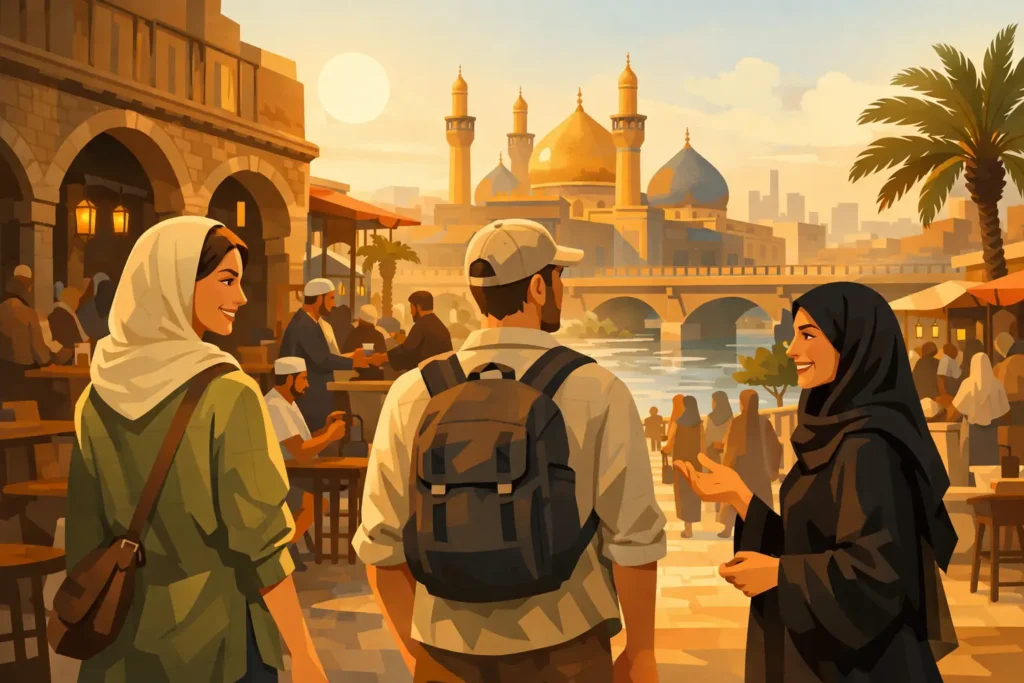
For women, modest dress is the safest and most versatile choice across the country. This does not mean you must wear the same thing everywhere, but it does mean avoiding clothes that are very short, low-cut, sheer or body-hugging. Trousers, wide-leg linen styles, maxi skirts and long-sleeved or elbow-length tops are all sensible options.
In many parts of Iraq, especially in religious cities, women often cover their hair. International visitors are not always expected to do so in every public setting, but carrying a scarf is strongly recommended. It becomes essential when entering mosques, shrines and some religious neighbourhoods. Even outside these places, a scarf can be useful if you want to dress more discreetly or protect yourself from dust and sun.
A loose midi or maxi dress can work well if the fabric is not transparent and the cut is not tight. If sleeves are short, adding a light layer usually solves the problem. Leggings on their own are better avoided, but under a long tunic or dress they can be practical.
Some women travellers feel most comfortable packing a few modest co-ords in neutral colours, while others prefer flowing dresses and a scarf in their bag. Both can work. The key is not fashion uniformity – it is respect for the environment you are in.
Do women need to cover their hair everywhere?
No, not everywhere. In many everyday public settings, especially in parts of the Kurdistan Region and some modern urban areas, you will see variation. Local women may wear hijab, abaya, modest Western clothing or a mix depending on the city and context.
That said, at shrines and mosques, hair covering is generally expected. In Najaf and Karbala in particular, visitors should plan for a more conservative standard. If in doubt, observe the entrance rules and the people around you. A lightweight scarf is one of the simplest things you can pack, and it helps you move respectfully between different spaces.
What men should wear in Iraq
For men, the expectations are usually straightforward. T-shirts, shirts, polo tops and lightweight trousers are widely acceptable. Shorts are where travellers should be more careful. In some hotel settings or very casual environments they may pass without comment, but in most public places long trousers are the better choice.
This is especially true in religious areas, traditional markets and when visiting shrines or meeting local families. A collared shirt is not required everywhere, but it can be useful if you want to look more polished. Iraq is a place where appearing presentable often matters more than following fashion trends.
Very sleeveless tops, gym wear and beach-style clothing are best left for elsewhere. Even when temperatures rise, loose cotton or linen trousers are usually more comfortable and appropriate than very short clothing.
Dressing for religious sites and pilgrim cities
This is where visitors should be most attentive. Cities such as Najaf, Karbala, Kadhimain and Samarra carry deep spiritual significance, and the dress standard reflects that. Clothing should be modest, clean and intentionally respectful.
Women should expect to cover their hair and wear clothing that covers arms and legs fully. In some shrine settings, an abaya may be preferred or provided, depending on the site. Men should wear long trousers and avoid sleeveless tops or anything too casual.
Even if you are not visiting for religious reasons, dressing properly in these places shows understanding of their importance. It is not simply about access rules. It is about entering spaces that matter profoundly to millions of people.
Seasonal advice on how to dress in Iraq
Iraq’s climate can surprise first-time visitors. Summers are intensely hot in many parts of the country, while winters can be cold, especially in the north and in the evenings. Dressing well means planning for the season, not just the social setting.
From late spring to early autumn, breathable natural fabrics are your best friend. Loose cotton and linen help far more than synthetic sportswear, which can trap heat. Light colours are often more comfortable under strong sun, though darker modest pieces remain common locally.
In autumn and winter, layering matters. A light jumper, cardigan or jacket is useful in Baghdad and the south, while northern areas may require a proper coat, particularly at night. If your trip includes both the Kurdistan Region and southern cities, prepare for noticeable differences.
Dust can also shape what feels comfortable. Closed shoes, sunglasses and a scarf can be more useful than travellers expect.
Shoes, accessories and practical details
Comfortable footwear matters because many visits involve walking on uneven pavements, through heritage areas or across large shrine complexes. Smart trainers, loafers, walking shoes and flat sandals with good support usually work well. Very flimsy flip-flops rarely make sense outside private leisure settings.
Accessories should stay practical. A scarf is useful for women and sometimes handy for men too in dusty conditions. Sunglasses, a hat and a cross-body bag can all make long days easier. Jewellery and luxury accessories are a personal choice, but understated is often more practical for travel.
It is also worth remembering that air conditioning indoors can be strong even when it is hot outside. A thin outer layer helps more than many visitors expect.
What not to wear in Iraq
Most clothing mistakes come from misjudging context rather than breaking a hard rule. Very short shorts, crop tops, sheer garments, low necklines and tight club-style outfits are generally poor choices. Clothing with offensive slogans or overly political messages should also be avoided.
Sportswear is fine for transit days or private exercise, but full athletic looks can feel too informal in ordinary public settings. The same goes for beachwear. Iraq has rivers, resorts and hotels, but public dress is not built around resort culture.
There is also a difference between technically allowed and socially comfortable. You may be able to wear something in one part of a city and still feel conspicuously underdressed. Travellers usually enjoy Iraq more when they aim to blend in respectfully rather than test boundaries.
City differences and why context matters
One reason travellers ask how to dress in Iraq is because they hear mixed advice. That is usually because Iraq does not have one single dress code. Urban business districts, old souqs, shrine entrances, university areas and family restaurants can all feel different.
In Erbil and some parts of the Kurdistan Region, you may notice slightly more flexibility in everyday dress, especially in modern commercial spaces. In Najaf or Karbala, the atmosphere is more conservative. Baghdad often sits somewhere in between, depending on the neighbourhood.
The best travellers are not the ones who memorise a rigid set of rules. They are the ones who notice where they are, dress with care and adjust when needed. That approach works almost everywhere.
If you are still unsure while packing, choose the more modest version of an outfit. It is far easier to remove a layer, loosen a scarf or adapt to a relaxed setting than it is to arrive somewhere important feeling underprepared. In Iraq, dressing well is not about formality for its own sake. It is one of the simplest ways to show respect, travel comfortably and step into the country’s warmth with confidence.