
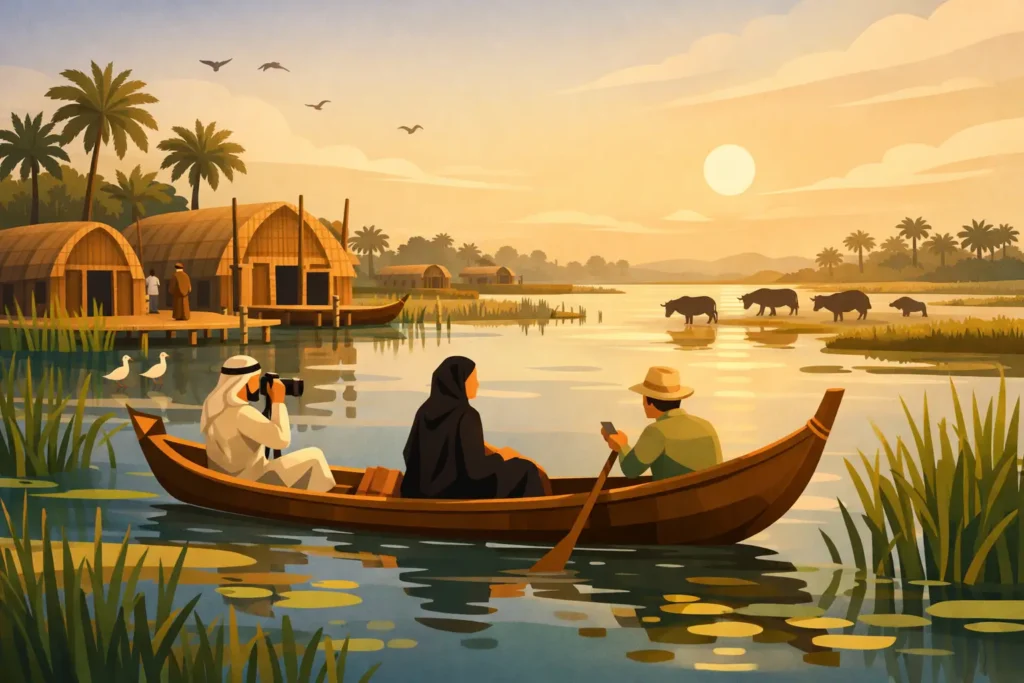
The first thing most travellers notice in the Iraqi Marshes is the quiet. After the roads and cities of southern Iraq, the landscape opens into channels, reed beds, water buffalo, and low, golden islands of woven grass. If you are wondering how to visit the Iraqi Marshes, the good news is that it is entirely possible with the right planning – and it can become one of the most memorable parts of a journey through Iraq.
This is not a destination for rushed sightseeing. The marshes are best approached with patience, local guidance, and an interest in the people who live there as much as the scenery itself. They offer something rare in the region: a living cultural landscape where nature, heritage, and hospitality still feel closely connected.
Why the Iraqi Marshes are worth the journey
The Iraqi Marshes, often referred to as the Mesopotamian Marshes, lie mainly in southern Iraq near Basra, Nasiriyah, and Amarah. They are one of the country’s most distinctive environments and one of its most historically meaningful. For many visitors, they are compelling not only because of their natural beauty, but because they represent a way of life shaped by water, reeds, fishing, boat travel, and deep continuity with the wider story of Mesopotamia.
This is also a place that rewards travellers who want more than monuments. You are not arriving to stand in a queue, take one photograph, and leave. You are entering an inhabited environment where daily life matters. That changes the experience. It feels less like ticking off a site and more like being welcomed into a landscape.
How to visit the Iraqi Marshes without complications
For most international travellers, the easiest way to visit is from Basra or Nasiriyah. Both cities can serve as practical bases, depending on your wider itinerary. Basra is often the better option if you are arriving in southern Iraq by air and want a city with broader hotel choice. Nasiriyah can make more sense if you are combining the marshes with visits to nearby heritage sites in Dhi Qar.
The most straightforward approach is to arrange a local driver or guided day trip in advance. Public transport can get you part of the way in southern Iraq, but it is not the ideal method for reaching the marshes themselves. Routes vary, signage is limited, and the final stretch usually requires local knowledge. A trusted local organiser removes a lot of uncertainty and usually means you will also have access to a boat operator and someone who can explain what you are seeing.
Independent travellers can sometimes hire a taxi for the day, but that depends on your Arabic, your confidence with flexible travel logistics, and whether the driver knows the right access point. In practice, the marshes are easier to enjoy when someone local handles the details.
Which part of the marshes should you visit?
There is no single gate or central visitor hub. The marshlands are spread across a broad area, and access points differ. Chibayish is one of the best-known places for visitors and is often used as a starting point for boat trips. It is particularly convenient from Nasiriyah and has become one of the more recognisable centres for marsh tourism.
If your time is limited, Chibayish is usually the most practical choice. If you have more flexibility and a strong interest in ecology, photography, or slower travel, it may be worth discussing less-visited areas with a local guide. The trade-off is simple: the easier places are more accessible, while the quieter ones can feel more intimate but require more planning.
Best time to go
Timing makes a real difference. The cooler months, generally from late autumn to early spring, are usually best for visiting. Between November and March, temperatures are more comfortable for long drives, boat trips, and walking around village areas. Light can also be especially beautiful at this time of year, which matters if photography is part of your trip.
Summer is possible, but southern Iraq becomes intensely hot. A short marsh excursion can still be done, particularly early in the day, yet many travellers will find the conditions tiring. If you are travelling in warmer months, start early, carry more water than you think you need, and keep your expectations realistic.
Water levels can also vary by season and environmental conditions. That does not mean you should avoid the marshes during less predictable periods, but it does mean flexibility helps. A local operator can tell you what conditions are like before you go.
What the journey actually looks like
A typical visit starts with a road transfer from your city base to a marsh access point, followed by a small boat ride through the reeds. The boats are part of the experience, not just transport. Once you are moving through the water channels, the atmosphere changes quickly. You begin to see reed houses, fishing routes, birds crossing overhead, and buffalo standing chest-deep in the water.
Some visits include tea in a traditional mudhif, the large reed guesthouse associated with Marsh Arab hospitality. This is often the moment travellers remember most clearly. The architecture is remarkable, but the human side matters more. You are usually not watching a performance staged for tourists. You are being received according to a long-standing local tradition of welcome.
The pace of the day depends on who organises it. Some travellers want a half-day excursion with a boat trip and lunch. Others want a slower visit with time for photography, conversation, and extended stops. Neither approach is wrong. The right choice depends on whether the marshes are a highlight of your trip or one stop among many.
What to wear and bring
Dress modestly and practically. Lightweight clothing that covers the shoulders and knees is the safest choice for comfort, sun protection, and cultural respect. Good sunglasses, sun cream, and a hat are useful in most seasons. Footwear should be simple and stable – you may be stepping in and out of boats or walking on uneven ground.
Bring cash, tissues, drinking water, and a power bank if you plan to use your mobile phone for photos throughout the day. A camera with some zoom is excellent for birdlife, but a mobile phone is enough for most travellers. If you are visiting in winter, mornings can feel cool on the water, so take an extra layer.
Cultural etiquette in the marshes
Respect matters here more than polished travel experience. Ask before photographing people, especially women or private homes. Accept tea when offered if you can, and greet people warmly. A little Arabic goes a long way, but courtesy matters even more than language.
This is also a place to travel with humility. The marshes are not an open-air museum. They are home to communities with their own routines, concerns, and traditions. Travellers who arrive curious and respectful usually find the experience far richer.
Where to stay when visiting the Iraqi Marshes
Most visitors stay in Basra or Nasiriyah rather than in the marshes themselves. That is currently the simplest option for comfort, transport coordination, and access to restaurants or other services. Basra suits travellers who prefer a larger city base and may be arriving or departing by air. Nasiriyah works well if you want to stay closer to the marsh region and combine the visit with southern heritage sites.
Accommodation options in the immediate marsh area are more limited and can be basic. For some travellers, that is part of the appeal. For others, especially first-time visitors to Iraq, it may feel easier to return to a city hotel after the excursion. There is no universal right answer. It depends on your comfort level and how immersive you want the trip to feel.
Is it safe and easy to arrange?
For most travellers, the marshes are best visited as part of an organised southern Iraq itinerary or with a trusted local contact. That is not because the journey is unusually difficult, but because travel in Iraq generally becomes far smoother when logistics are arranged by people who know the region. Road timings, entry points, weather, and local connections all matter.
As with travel anywhere new, check current entry requirements for Iraq, carry identification, and keep your plans clear and simple. It is sensible to tell your hotel or organiser where you are going and when you expect to return. Practical preparation builds confidence, and confidence helps you enjoy the experience properly.
For travellers still deciding whether southern Iraq is manageable, the answer is often yes – provided you plan well. Platforms such as Stay In Iraq are helping make that process easier by turning scattered local knowledge into something more usable for international visitors.
How long should you spend there?
A day trip is enough to see the marshes and understand why they matter, but an overnight stay in southern Iraq gives the experience more breathing room. If you can, avoid trying to squeeze the marshes into an already overloaded schedule. This is one of those places that improves when you leave space around it.
Travellers interested in birdlife, local architecture, documentary photography, or slower cultural travel may want longer. Those with limited time can still have a meaningful visit in half a day if transport is well arranged. The key is not duration alone, but rhythm. The marshes are best experienced slowly, even if your visit is short.
The Iraqi Marshes remind many visitors that Iraq is not only a destination of ancient ruins and major shrines. It is also a country of living landscapes, strong communities, and quiet beauty. Go with realistic expectations, a good local plan, and enough time to sit for tea when it is offered – that is often when the journey becomes unforgettable.