A good arrival in Iraq begins before you leave the terminal. After a long flight, the most valuable thing is not simply a vehicle waiting outside, but clarity: who is meeting you, where you will meet them, how you will pay, and where you are staying that night. For first-time visitors, understanding Iraq airport transfer options removes one of the biggest practical uncertainties and leaves more room to enjoy the welcome ahead.
Airport transport is not identical across the country. Baghdad, Najaf, Basra and Erbil each have their own rhythms, distances and local transport habits. The right choice depends on your arrival time, confidence travelling independently, group size, luggage and onward destination.
Iraq airport transfer options at a glance
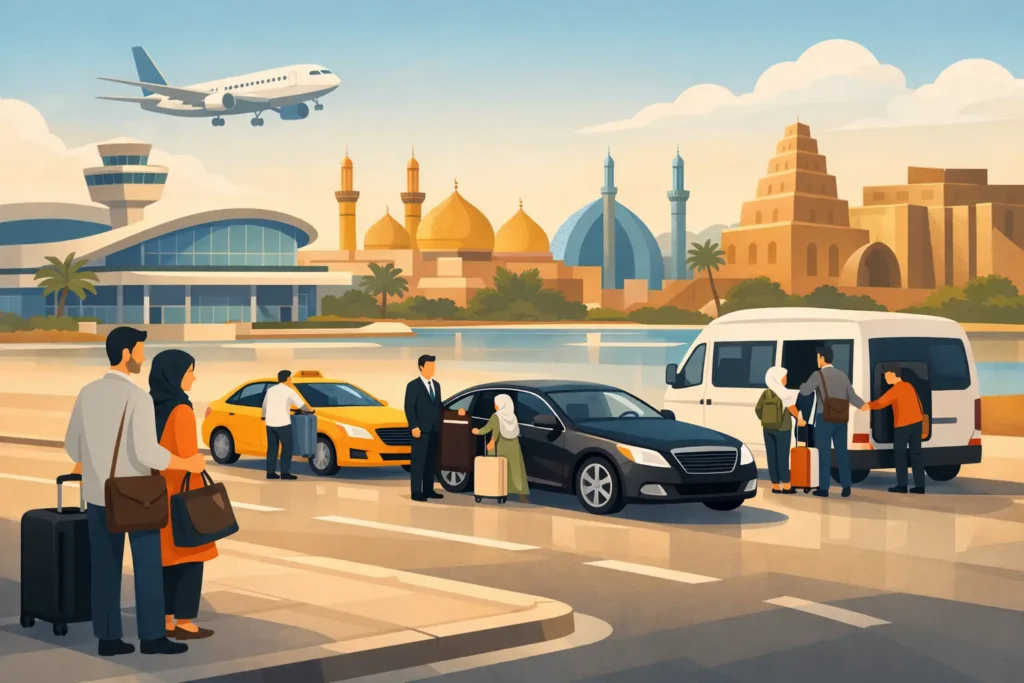
For most international visitors, a pre-arranged private driver is the simplest option. Your hotel, host, tour operator or a trusted local contact can arrange collection, usually with the driver meeting you at an agreed point after arrivals. This is especially useful for late-night landings, families, pilgrims carrying luggage, and travellers heading straight to another city.
Official airport taxis can also be practical, particularly for journeys into the city where the airport is located. They may be readily available at designated ranks, but arrangements and payment expectations can vary. Agree the fare and destination clearly before leaving, and keep the name and address of your accommodation written in Arabic or Kurdish where relevant.
Hotel transfers are a strong middle ground. Many established hotels can organise an airport pick-up on request, sometimes for a fixed charge and sometimes through a partner driver. This is often worth considering if you have just arrived in Baghdad or Najaf and do not want to negotiate transport while tired or without local currency.
Ride-hailing and app-based services may be useful in some urban areas, but availability at airport terminals, payment methods and driver access can be inconsistent. Treat them as a possible backup rather than the foundation of your arrival plan, particularly if your flight lands late or is subject to delay.
Why pre-arranged transfers suit most first visits
Iraq rewards curiosity, but its travel logistics are easier when the first steps are organised. A confirmed driver gives you a named contact, a vehicle expectation and a direct route to your accommodation. It also avoids the challenge of explaining a hotel location when mobile data is unreliable or when an address is better known locally by a landmark.
This matters most in Baghdad, where airport-to-city journeys can take longer than visitors expect depending on traffic, timing and the location of your hotel. A driver who knows the area can adapt to the route and help make the arrival feel calm rather than rushed.
Pre-arranged transport also makes sense for visitors continuing beyond the arrival city. A traveller landing in Najaf, for example, may be travelling onwards to Karbala for a religious visit. A planned private transfer can be more convenient than finding a short local taxi first and then arranging another journey. For diaspora travellers arriving with family members, the comfort of travelling together in a suitable vehicle can be just as important as the price.
The trade-off is cost. A private transfer is generally more expensive than taking a local taxi, and rates can differ according to vehicle type, journey length, waiting time and time of day. Ask for the full price in advance, including any parking or waiting charges, and confirm whether payment is expected in Iraqi dinar, US dollars or another agreed method.
What to confirm before you fly
A transfer booking should be specific, not vague. Send your flight number, arrival date, passenger count, luggage details and accommodation name. Ask for the driver’s name, telephone number, vehicle description and meeting instructions.
It is also wise to confirm what happens if your flight is delayed. A professional provider will normally monitor the flight or give you a clear contact procedure. Save key numbers on your phone and take a screenshot of the arrangements in case your connection is slow after landing.
Taxis from Iraq’s airports
Airport taxis remain a familiar and useful option, especially for travellers who prefer flexibility or have not booked accommodation that offers collection. They can work well for straightforward trips to central hotels, provided you take a few sensible steps before setting off.
First, use the recognised taxi area or ask airport staff where authorised taxis wait. Avoid assuming that every vehicle outside arrivals operates under the same conditions. Second, agree the fare before the journey begins. If a fixed airport rate is available, confirm what it covers. If the price is negotiated, state your destination, ask for the final amount and make sure there is no confusion over currency.
Cash is often the most straightforward way to pay for a taxi. Carry some small Iraqi dinar notes where possible, while recognising that some drivers may quote longer transfers in US dollars. Avoid relying entirely on card payment for airport transport. Currency exchange availability can vary by airport and time of arrival, so having a modest amount ready before you need a car is reassuring.
Taxis are particularly suitable when you arrive during daytime, know your hotel’s location and are comfortable handling the conversation yourself. They are less attractive when you are landing with children, carrying specialist equipment, arriving after midnight or travelling to a destination outside the immediate city.
Hotel pick-ups: a practical first-night choice
Your first hotel can do more than provide a bed. It can be the most helpful local point of contact in your journey. When booking accommodation, ask directly whether an airport collection is available, how much it costs and whether the hotel will share the driver’s details before arrival.
A hotel-arranged transfer is often valuable because the driver already knows the property and can take you to the correct entrance. This can be helpful in busy city areas, where a map pin may not tell the whole story. It also means the hotel knows when to expect you, which is useful if your arrival is late.
For travellers planning an itinerary across several cities, consider booking the first-night transfer through your accommodation and arranging later journeys once you have settled in. Stay In Iraq can help travellers begin that process by making it easier to identify accommodation suited to their route and travel style.
City-specific considerations
Baghdad International Airport is the main arrival point for many international visitors. Private transfers and hotel pick-ups are often the most comfortable choice, especially for a first visit. Build extra time into your plans rather than scheduling a tightly timed meeting immediately after landing.
Najaf International Airport serves travellers visiting one of the Muslim world’s most significant pilgrimage cities. Transfers to hotels in Najaf are common, while onward transport to Karbala should ideally be arranged in advance if that is your next stop. During major religious occasions, demand can be higher and early planning becomes particularly worthwhile.
Basra International Airport is convenient for visitors exploring southern Iraq, including Basra’s cultural life and the landscapes of the south. Confirm the precise location of your accommodation, as journeys can differ significantly depending on whether you are staying in the city, near business districts or continuing onwards.
Erbil International Airport serves the Kurdistan Region of Iraq and has its own transport patterns. Hotel transfers and pre-booked drivers are widely useful, while taxis may be an easy option for central Erbil. If you are travelling onward to another city, check driving times carefully rather than judging distance by a map alone.
Small details that make a big difference
Keep your accommodation address available in both English and the locally used script if possible. In Arabic-speaking cities, Arabic can be helpful; in the Kurdistan Region, Kurdish may be equally useful. Your hotel or host can usually provide a clear written address or landmark.
Make sure your phone is charged before landing and consider an offline map for your first route. Local SIM arrangements can be handled once you are settled, but do not assume you will have immediate data at the terminal. A portable charger, printed booking confirmation and a small amount of cash are simple preparations with real value.
Dress comfortably and respectfully for the season and place you are visiting. Iraq’s hospitality is often expressed through attentiveness and generosity, and a polite greeting with your driver goes a long way. If you need a stop for a cash machine, food or a pharmacy, ask clearly and agree any additional waiting time.
The best transfer is rarely the cheapest one on paper. It is the one that fits your arrival, gives you confidence and lets Iraq’s first welcome feel like what it should be: warm, organised and genuinely human.