A well-planned short stay can change how a city stays with you, and a Baghdad cultural weekend example is often the easiest way to see the capital clearly. In two days, Baghdad can feel layered rather than overwhelming – a city of booksellers, riverfront evenings, historic quarters, shrines, cafés and daily rituals that reward patient travel. For visitors who want more than a checklist, the right weekend rhythm matters.
Baghdad is not a city best approached as a race between landmarks. It makes more sense as a place to absorb in sequences: morning streets before the heat builds, long lunches that turn into conversations, museum visits that give shape to what you later see outside, and evening walks where the city feels softer and more social. That is why a cultural weekend works so well here. It gives enough time to understand the tone of the city without pretending that Baghdad can be fully known in 48 hours.
Why a Baghdad cultural weekend example works
For first-time visitors, Baghdad can appear vast in both history and scale. A weekend format keeps the experience focused. Instead of trying to cover every district, travellers can concentrate on a few meaningful settings and move through them with context.
This approach also suits different kinds of visitors. Heritage travellers can focus on museums, Abbasid and Ottoman traces, and literary Baghdad. Diaspora visitors may prefer neighbourhood time, family meals and places that reconnect memory with the present. Photographers and writers often do best when they leave room for unplanned encounters. A cultural weekend allows for all of that, provided expectations are realistic.
The trade-off is simple. You will not see everything, and that is fine. Baghdad rewards selectivity more than speed.
Day one: history, memory and the rhythm of the city
Start early with one of Baghdad’s major cultural institutions. A museum visit at the beginning of the trip helps travellers read the city more intelligently afterwards. Objects, historical periods and artistic traditions give shape to what might otherwise feel scattered. If you are particularly interested in ancient Mesopotamia, calligraphy, Islamic art or the modern Iraqi story, choose the collection that best fits your interests rather than trying to fit too much into one morning.
Afterwards, slow the pace. Move towards an older part of the city where Baghdad’s urban identity is felt in façades, side streets and everyday trade rather than grand spectacle. This is where a guide or knowledgeable local contact can add real value. Baghdad is full of details that are easy to miss unless someone explains what you are looking at – a restored building, an old courtyard, a mosque exterior, a former merchant lane, the significance of a particular street.
Lunch should not be treated as a break from the experience. In Baghdad, food is part of the cultural reading of the city. A traditional meal gives insight into hospitality, family-style dining and regional preferences. Grilled fish by the river, slow-cooked rice dishes, kebab, masgouf or a more modest local spread can all fit, depending on your schedule and appetite. What matters is choosing somewhere with a sense of place rather than somewhere purely convenient.
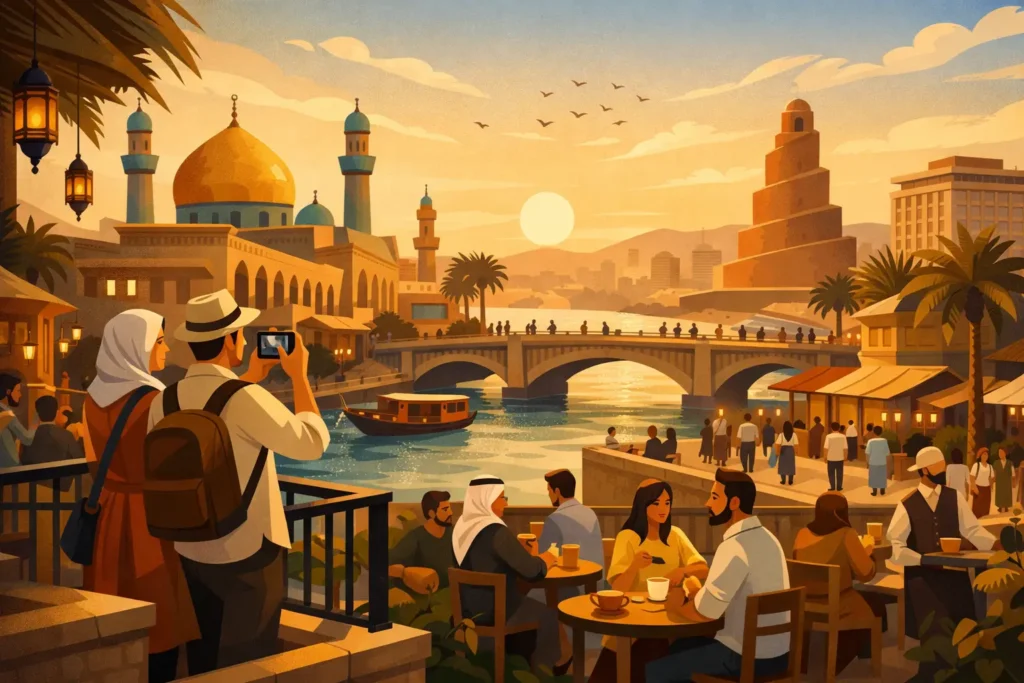
The afternoon is best kept flexible. Some travellers will want more heritage time, while others may prefer a book market, artisan area or a slower riverside pause with tea. Baghdad often reveals itself in these quieter intervals. You notice who gathers where, how public space is used, and how much of the city’s identity lives in conversation rather than display.
By early evening, the atmosphere shifts. Families come out, cafés fill, and the city becomes more visibly communal. This is a good time for a walk in a well-frequented area known for public life and cultural energy. Depending on the day, you may find booksellers, street food, students, families and groups of friends all sharing the same urban space. It is one of the most reassuring parts of a first visit because it replaces abstract ideas of Baghdad with something immediate and human.
Day two: faith, neighbourhoods and living culture
A strong second day in any Baghdad cultural weekend example should acknowledge that culture here is not only preserved in museums or historic buildings. It is also lived through religious practice, neighbourhood identity, language, hospitality and routine.
Morning is a good time to visit an important religious or heritage site, approached respectfully and with suitable dress. Even for travellers who are not visiting for pilgrimage, these places often provide some of the clearest insight into Baghdad’s moral and cultural life. Architecture, calligraphy, devotional atmosphere and visitor etiquette all reveal something essential about the city. The experience is different from a museum because meaning is active rather than curated.
After that, spend time in a district that feels residential or commercially local rather than purely symbolic. A market visit can be especially valuable if approached with curiosity rather than hurry. Spices, fabrics, household goods, sweets, perfumes, copperware and bookstalls each tell a different story about daily life. For international visitors, these moments can be more memorable than headline attractions because they show Baghdad as a functioning, expressive city rather than a backdrop.
Lunch on the second day can lean simpler – perhaps a beloved local restaurant, a bakery stop, fresh juice, tea and sweets. There is no need to force every meal into a major event. Some of the most enjoyable travel moments in Iraq come from ordinary places done well, where service is warm and the welcome feels unperformed.
If your weekend includes a Friday or Saturday, ask locally whether there are cultural events, heritage walks, book gatherings or seasonal activities taking place. Baghdad’s cultural life is not always packaged in the way visitors expect elsewhere. Sometimes the best experience is not a formal performance but a busy café, a conversation with a bookseller or an evening promenade where the city’s social character is on full display.
Practical planning for a short Baghdad stay
The success of a cultural weekend depends less on ambition and more on planning. Baghdad is best experienced with a clear base, sensible transport arrangements and enough flexibility to adapt to the day.
Choose accommodation that reduces travel time between key parts of your itinerary. For a short visit, convenience matters. Spending long periods in transit can flatten the experience, especially in a city where traffic patterns can affect timing. Travellers who stay somewhere comfortable and well-positioned are more likely to enjoy the city’s pace rather than feel they are constantly catching up.
Transport should be arranged with practicality in mind. If you are unfamiliar with Baghdad, pre-arranged transfers or a trusted local driver can make the weekend smoother. This is not about making the city feel inaccessible. It is simply the difference between using limited time well and wasting energy on avoidable complications.
Dress modestly and respectfully, particularly when visiting religious or traditional areas. This helps travellers move through the city more comfortably and signals cultural awareness. It is also worth keeping your schedule realistic in warmer months. Early starts and gentler midday plans usually work better than trying to pack outdoor activity into the hottest part of the day.
One more point matters: leave room for human interaction. Baghdad is a city where the welcome often becomes part of the itinerary. If someone offers tea, conversation or local insight in an appropriate setting, that exchange may become one of the defining memories of the weekend.
What not to expect from a weekend in Baghdad
A short cultural stay should not be sold as a perfect city break in the conventional sense. Baghdad is not a polished theme of history with every experience packaged neatly for visitors. That is part of its value. The city asks for patience, attentiveness and some adaptability.
You may find that your favourite moment is not the one you planned. It might be a riverside meal at sunset, the sound of a call to prayer moving across a district, a conversation in a bookshop, or the contrast between monumental history and ordinary daily warmth. Baghdad’s appeal is not only what it contains, but how it makes travellers reconsider what meaningful travel feels like.
For many visitors, that is exactly why a weekend here matters. It offers a first encounter that is substantial enough to challenge assumptions, yet short enough to feel manageable. And once Baghdad begins to make sense, even briefly, many travellers leave with the same thought: two days were only the beginning.