For many first-time visitors, the question is simple: do foreigners need Iraq visa approval before they travel? In most cases, yes. But the route to getting one depends on your nationality, passport type, where you plan to enter, and whether your itinerary includes Federal Iraq, the Kurdistan Region of Iraq, or both.
Iraq is becoming more accessible to heritage travellers, pilgrims, diaspora families and curious independent visitors. The country that gave the world Ur, Babylon, Najaf, Erbil and the marshlands is open to travellers, but entry rules must be checked carefully before booking flights or accommodation. Visa policy can change, and a small detail at the border can affect an otherwise well-planned journey.
Do foreigners need an Iraq visa?
Most foreign nationals need a visa to enter Iraq. Some travellers may be eligible for a visa on arrival, while others must arrange an e-visa or obtain approval through an Iraqi embassy or consulate before departure.
The key point is that there is no single answer for every passport. Eligibility is set by Iraqi authorities and can be updated without much notice. Do not rely solely on an old blog post, a friend’s previous experience, or an airline search result. Confirm the current rule for the nationality shown on the passport you will actually use for travel.
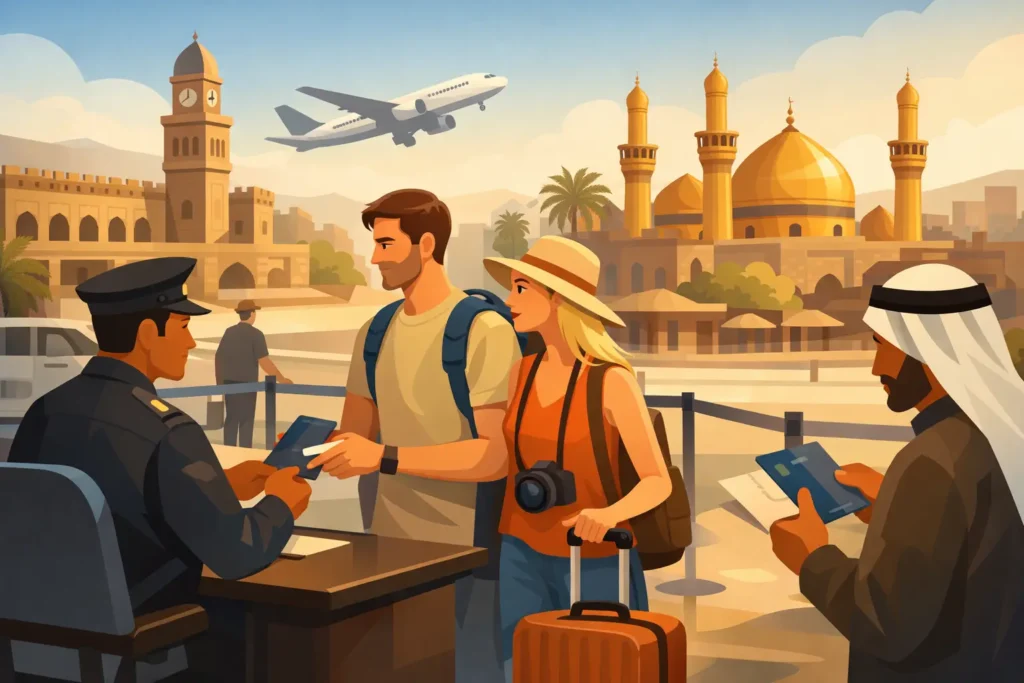
Travellers from certain countries have, at different times, been able to receive a tourist visa on arrival at major international airports and designated land crossings. This option is often associated with a stay of up to 60 days, but permitted length of stay, fees and qualifying nationalities can change. A visa on arrival is not the same as visa-free travel: you should still expect to complete entry formalities and pay any required fee.
If your nationality is not eligible for a visa on arrival, arrange your visa before travelling. Depending on the current system and your passport, this may mean applying through Iraq’s e-visa process or submitting an application to an Iraqi diplomatic mission.
Federal Iraq and the Kurdistan Region: plan for both
Iraq’s entry arrangements require particular care if your route crosses regional boundaries. Federal Iraq includes destinations such as Baghdad, Basra, Najaf, Karbala, Mosul, Babylon and the southern marshes. The Kurdistan Region of Iraq includes Erbil, Duhok and Sulaymaniyah, and may operate separate visitor entry procedures.
A permission or visa issued for entry into the Kurdistan Region should not automatically be assumed to permit onward travel into Federal Iraq. Equally, a Federal Iraq visa does not remove the need to understand entry requirements when arriving directly in the Kurdistan Region. This matters for travellers planning an itinerary that begins in Erbil and continues south to Baghdad, Babylon or the holy cities.
Before purchasing internal flights, arranging a driver, or setting a fixed multi-city schedule, confirm that your visa covers every part of Iraq you intend to visit. This is especially relevant for photographers, researchers, pilgrimage groups and diaspora visitors travelling across several governorates.
Visa on arrival: convenient, but not a shortcut
For eligible travellers, a visa on arrival can make a spontaneous visit possible. It is usually processed after landing, before you pass through immigration. Yet convenience should not be confused with certainty.
Airlines may refuse boarding if their systems do not show that your passport qualifies, even when you believe you are eligible. Carry clear evidence of your return or onward journey, your first accommodation booking and enough information to explain your itinerary. If you are visiting relatives, travelling with a group, or attending a religious occasion, keep any relevant contact details available.
Your passport should normally be valid for at least six months beyond your planned arrival date and have sufficient blank pages. A damaged passport, a passport close to expiry, or a mismatch between your booking details and passport name can create avoidable delays.
Visa fees are commonly paid at the border in US dollars, but payment arrangements and exact amounts can vary. Take clean, undamaged US dollar notes in small and practical denominations if you expect to use a visa-on-arrival facility. Do not assume card payment will be available.
When you should apply before travelling
Applying in advance is the sensible route when your passport does not qualify for visa on arrival, when you are entering through a crossing with less predictable facilities, or when you need certainty for a carefully timed itinerary. It may also be preferable for travellers with complex circumstances, including dual nationality, prior Iraqi residency, professional equipment, media work or a longer intended stay.
Tourist travel, business travel, journalism, research and organised religious visits can involve different documentation. A standard tourist visa does not automatically authorise paid work, filming for commercial purposes or formal reporting. If your trip has a professional purpose, be transparent and seek the correct permission before departure.
Allow more time than you think you need. Embassy processing can depend on public holidays, the completeness of your documents and whether further approval is required. Avoid booking non-refundable flights immediately after submitting an application unless the conditions allow for changes.
Documents that make entry easier
The precise requirements vary, but preparation tends to matter more than paperwork volume. Keep a printed and digital copy of your passport details, visa approval where applicable, flight itinerary and accommodation confirmation. Use the same spelling of your name across all reservations.
Border officials may ask where you are staying and how long you intend to remain. A real first-night booking is helpful, particularly if you arrive late in Baghdad, Basra, Najaf or Erbil. It also gives you a calm start after a long journey, rather than having to negotiate transport and lodging at the airport.
For a wider itinerary, retain a simple day-by-day plan. You do not need to over-engineer every hour, but knowing that you will spend three nights in Baghdad before travelling to Babylon or Najaf demonstrates that your visit is considered and practical.
Some visitors may be required to complete local registration procedures after arrival, depending on their visa, place of stay and current regulations. Hotels are often familiar with the process for international guests, but ask your accommodation host what support they provide and what you need to do personally.
Special cases worth checking early
Dual nationals should check requirements for both passports before deciding which document to use. If you have Iraqi heritage, prior Iraqi documents, or family connections in Iraq, your situation may be different from that of a straightforward tourist traveller. Ask the relevant Iraqi authority for guidance rather than making assumptions at the airport.
Visitors travelling for Arbaeen, Ashura or other major religious occasions should plan particularly early. These are deeply meaningful periods, when Iraq welcomes large numbers of pilgrims to Najaf, Karbala, Kadhimiya and Samarra. Demand for flights, rooms and local transport rises, while visa and border procedures can have event-specific arrangements.
Travellers arriving overland should verify their intended crossing in advance. Not every land border handles every nationality, visa type or entry purpose in the same way. The border used by a coach group may not be appropriate for an independent traveller with a different passport.
How to verify the right rule before you go
The most dependable approach is to check directly with an official Iraqi embassy or consulate responsible for your country of residence, and to review the current instructions issued through official Iraqi government visa channels. Ask a precise question: state your nationality, the passport you hold, your arrival airport or land crossing, your planned length of stay and whether you will visit the Kurdistan Region as well as Federal Iraq.
Then check with your airline before departure. Airlines apply their own document checks because they are responsible for carrying passengers with valid entry permission. A confirmation received weeks earlier is useful, but reconfirm close to travel if policies have changed.
Finally, build your first days around flexibility. Choose accommodation with a clear address and accessible support, leave adequate time between arrival and any onward journey, and keep key documents easy to reach. Stay In Iraq encourages travellers to approach the country with both curiosity and good preparation: the practical details create space for the experiences that matter most.
With the correct visa route confirmed, Iraq becomes far less intimidating on paper and far more exciting in person – a place where ancient sites, living faith, generous tables and everyday conversations reward the traveller who arrives ready to listen.