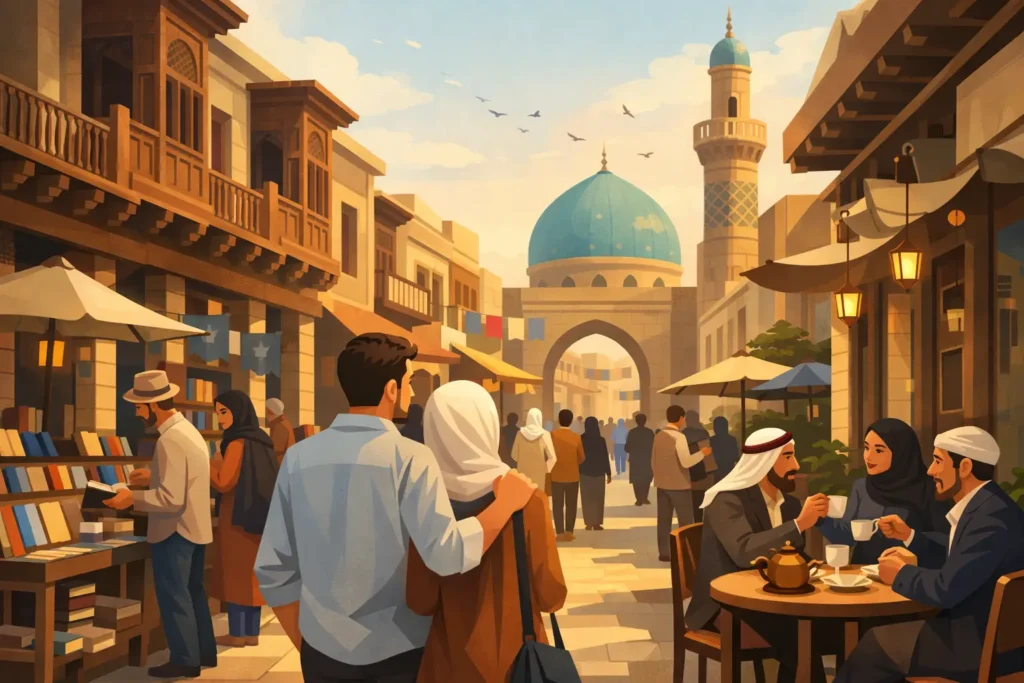
The scent of cardamom coffee, the rustle of paperbacks and the steady conversation of readers make Mutanabbi Street one of Baghdad’s most immediate expressions of daily cultural life. These Mutanabbi Street visitor tips will help you arrive with the confidence to slow down, browse with purpose and enjoy a place that is far more than a book market.
Named after the great tenth-century Arab poet Al-Mutanabbi, this historic street near the River Tigris has long been associated with booksellers, writers, publishers, artists and political debate. For visitors, it offers a vivid encounter with Baghdad as a living city of ideas – warm, sociable, creative and deeply attached to its literary heritage.
Plan your visit around the street’s rhythm
Friday morning is widely considered the most atmospheric time to visit. Booksellers set out stock on pavements, collectors browse old editions, and the surrounding cafés and lanes fill with Baghdad residents enjoying their day off. It is lively without needing to be rushed, and the best approach is to allow several unplanned hours.
That popularity comes with a trade-off. Fridays can be busy, particularly around late morning and early afternoon, so photographers and travellers who prefer a quieter experience may find another morning more comfortable. Opening patterns can vary by shop, season and public occasion. Ask your hotel or local host about the latest arrangements before setting out, rather than relying on an old timetable.
Arrive early if you hope to browse seriously, take photographs in softer light or find a table at a nearby café. The street rewards wandering, but it is compact enough to combine with central Baghdad sights on the same day.
Getting there and arriving comfortably
Mutanabbi Street is in central Baghdad, close to the historic Al-Rasheed Street area and not far from the Tigris. For most international visitors, a taxi arranged by their hotel or a trusted local driver is the simplest option. Agree the destination clearly, keep your accommodation’s address saved on your mobile phone, and ask the driver about the most convenient drop-off point, as pedestrian movement and access can change.
Traffic in central Baghdad can be busy, so build flexibility into your day. Comfortable walking shoes are more useful than fashionable ones: the pleasure of the area lies in moving slowly between bookstalls, small shops and cafés rather than seeing it from a car window.
Carry a modest amount of Iraqi dinars in small denominations. Some larger businesses may offer electronic payment options, but cash remains useful for a book, tea, a snack or a small print. Keep valuables close, as you would in any crowded urban setting, and avoid carrying more cash than you need.
How to browse the booksellers
Do not expect every stall to resemble a neatly labelled bookshop. Part of Mutanabbi Street’s character is the hunt: Arabic novels beside school texts, poetry collections, religious works, history titles, magazines, maps and second-hand volumes with decades of stories in their pages. Even travellers who do not read Arabic will find the visual culture compelling.
If you are looking for a particular subject, ask politely. A few Arabic words are appreciated, but English may be understood by some sellers and younger visitors nearby may be happy to help. You can also type a title or author’s name into your phone in Arabic script before you go. Iraqi booksellers are often proud of their stock and may point you towards another stall if they do not have what you seek.
Bargaining can be appropriate for some second-hand items, especially when buying several books, but it should be gentle and good-humoured. Start by asking the price, respond with courtesy and accept that a rare or beautifully produced edition may be priced accordingly. The conversation is often part of the experience, not simply a transaction.
Be mindful of weight. Books are a memorable souvenir, but they take up luggage allowance quickly. A slim bilingual poetry collection, a Baghdad-themed art book or a locally printed notebook can be easier to carry than a heavy stack of volumes.
Choose conversation over a rushed purchase
A brief exchange with a seller can reveal far more than a guidebook description. Ask what they recommend, whether a title is popular locally, or which Iraqi authors a newcomer should know. Nizar Qabbani and Mahmoud Darwish are widely recognised names in Arabic literature, while Iraqi writers, poets and historians offer a more direct route into the country’s cultural imagination.
Approach these conversations with curiosity rather than assumptions. Mutanabbi Street is a place where local intellectual life is active and varied. Let people describe their city on their own terms.
Visit the cafés with respect
The cafés around Mutanabbi Street are not merely places to pause between purchases. They are part of Baghdad’s long tradition of gathering to read, debate, meet friends and exchange news. Ordering tea or coffee and taking time to observe the rhythm of the room can be one of the most meaningful parts of a visit.
Choose a seat, order simply and follow the lead of those around you. Iraqi tea is often served sweet, while coffee may be strong and cardamom-scented. If you are unsure what to order, ask for a recommendation. Hospitality is a defining feature of Iraqi travel, and a friendly question is usually received warmly.
Photography needs particular care in cafés. A striking interior or a group of readers can be tempting to capture, but ask before photographing people closely, especially older guests, families or anyone who appears to be engaged in private conversation. A smile, a gesture towards your camera and a clear request are better than assuming permission.
Dress, manners and cultural awareness
Baghdad is a major, modern capital, yet modest, practical clothing is the most comfortable choice for visitors. Loose, breathable layers suit the climate and show consideration in public spaces. Women do not need to dress identically to local women, but clothing that covers shoulders and knees is a sensible baseline. Men will generally feel most at ease in trousers or smart, modest long shorts where appropriate, though trousers are the safer choice in central cultural settings.
Public warmth is welcome, but restraint matters. Keep voices moderate in quiet cafés or bookshops, avoid overt displays of affection, and do not treat people or religious material as props for social media. If you encounter a topic you do not understand, ask respectfully rather than drawing conclusions.
Arabic greetings go a long way. “Salaam alaikum” is a polite hello, and “shukran” means thank you. You do not need fluent Arabic to be welcomed, but making the effort signals respect for the people whose city you are visiting.
Make time for the wider historic quarter
Mutanabbi Street is best experienced as part of a wider central Baghdad walk, not as a quick stop between appointments. Depending on the day’s access arrangements and your interests, you may want to explore nearby historic streets, riverside views and cultural landmarks with a knowledgeable local guide. This can add valuable context, particularly for travellers interested in architecture, literary history or Baghdad’s changing urban life.
Avoid packing too much into one afternoon. The value of Mutanabbi Street is not measured by the number of sights checked off, but by the pauses: a conversation over tea, a handwritten dedication inside an old book, or the sound of a bookseller recommending a poet. For accommodation planning and city logistics, Stay In Iraq can help travellers build these unhurried cultural moments into a practical Baghdad stay.
A few final Mutanabbi Street visitor tips
Bring water in warmer months, wear sun protection and plan an indoor pause at a café when temperatures rise. Keep a charged mobile phone and a portable battery with you, particularly if you are using translation tools or coordinating with a driver. If you buy fragile prints or older books, ask the seller to wrap them, then protect them again before placing them in a day bag.
Most importantly, leave room for serendipity. On Mutanabbi Street, the book you did not plan to find and the person you did not expect to meet may become the most lasting memory of Baghdad.