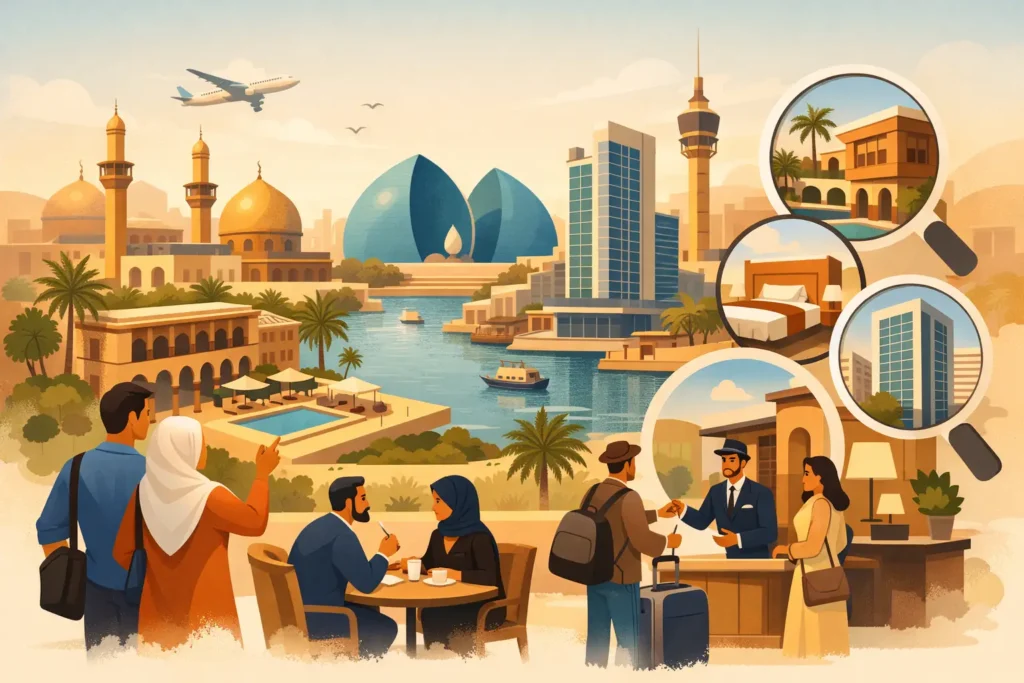
Baghdad rewards travellers who choose their base with purpose. A well-planned Baghdad hotels comparison is less about finding one universally “best” property and more about matching your stay to the reason you have come: a heritage-filled first visit, a religious journey, family time, business meetings, or a return to a city that still feels like home.
The capital is a living meeting point of history, commerce, scholarship and generous Iraqi hospitality. Hotel standards, room styles and services can vary more than they might in highly standardised destinations, so a little preparation makes a meaningful difference. Focus on location, the kind of support you need, and how you expect to move around the city.
Baghdad hotels comparison: start with your itinerary
Baghdad is geographically broad, and traffic can shape a day as much as distance on a map. Rather than selecting a hotel solely by star rating or room photographs, consider where you will spend most of your time. A central location can make a short cultural visit more manageable, while a hotel closer to a particular meeting venue or family neighbourhood may be the wiser choice for a longer stay.
Travellers interested in Baghdad’s historic character often value access to areas around the Tigris, traditional markets, cultural institutions and the older heart of the city. These stays can place you closer to the atmosphere that makes Baghdad memorable: early morning tea, busy streets, bookshops, river views and the everyday rhythm of a capital with deep intellectual and artistic roots.
Business travellers may prioritise newer districts, meeting facilities, reliable transport arrangements and a quieter room for calls. Diaspora visitors frequently choose according to proximity to relatives, accepting a longer journey to central landmarks in exchange for more time with family. There is no wrong approach. The right hotel reduces the friction in the particular trip you are taking.
What accommodation styles offer
Full-service international-standard hotels
Larger, full-service hotels are generally the most straightforward choice for first-time international visitors, corporate guests and anyone who values predictable on-site services. They commonly offer reception support around the clock, restaurants, breakfast, room service, meeting spaces and help arranging a car or airport transfer.
Their main advantage is reassurance. If your arrival is late, your Arabic is limited, or you have a tightly organised schedule, having staff who can assist with transport and local practicalities can be worth the higher nightly rate. Ask directly which services are currently available rather than assuming every advertised facility operates every day.
The trade-off is that these properties can feel more self-contained. They may be excellent for rest and logistics, but they are not always the most immersive option for travellers hoping to spend each evening in a walkable local setting.
Boutique and independent hotels
Smaller independent properties can offer more personality and a warmer, more individual welcome. Some are especially appealing to returning visitors, creatives and travellers who want their accommodation to feel less formal. The quality of service can be exceptional, but amenities may be fewer and room categories less consistent.
When comparing these hotels, look beyond design photographs. Confirm whether breakfast is included, whether a lift is available, how payment is handled, and whether the property can arrange trusted transport. These details matter particularly in Baghdad, where a well-organised arrival can set the tone for the whole visit.
Serviced flats and longer-stay options
A serviced flat can suit families, diaspora travellers and visitors staying for several weeks. More space, a kitchen and separate living areas can make an extended trip feel comfortable and practical. This option is also useful for travellers who prefer a quieter routine between day trips, family visits or professional commitments.
However, a flat usually provides less immediate support than a hotel. Check the building entrance, cleaning arrangements, heating or cooling, Wi-Fi reliability, local contact availability and payment terms before committing. For a first visit of only a few nights, a staffed hotel often remains the simpler choice.
Compare the details that affect your stay
A room rate tells only part of the story. During your Baghdad hotels comparison, ask what is included and what will need to be arranged separately. Breakfast can be a genuine convenience before a day of visiting heritage sites or travelling onwards. Airport collection is equally valuable for travellers arriving late, carrying equipment or unfamiliar with the city.
Wi-Fi deserves a specific question, especially for remote workers and journalists. Ask whether it reaches guest rooms well and whether there is a suitable quiet area for calls. If a hotel advertises a fitness room, pool, business centre or restaurant, confirm that it is open during your dates. This is not distrustful planning; it is the sensible way to avoid disappointment in any evolving travel market.
Also consider room configuration. Twin rooms, interconnected rooms, extra beds and accessible facilities should be requested clearly in advance. Families travelling with children may find that direct communication about bedding and meal requirements is more useful than relying on a generic room label.
Location, transport and the value of local help
For many visitors, the strongest hotel feature is not a marble lobby or a larger room. It is a helpful team who can organise a dependable driver, advise on realistic journey times and point you towards places that fit your interests and customs.
Baghdad is best experienced with patience and a flexible plan. Build extra time into journeys, particularly if you have a museum appointment, a business meeting or a domestic flight connection. A hotel that understands your schedule and can assist with transport may offer better value than a cheaper option that leaves every detail to you.
If you are travelling for religious purposes, explain the nature of your visit when making your enquiry. Staff can often help you plan departures, meals and transport in a way that respects your timetable. Baghdad also works well as part of a wider Iraqi journey, so it is worth checking whether your hotel can help coordinate onward travel or recommend the best departure time for your next city.
How to choose with confidence
Before reserving, read recent guest feedback with a practical eye. One comment about a delayed breakfast is less revealing than repeated feedback about cleanliness, staff attentiveness, noisy rooms, unreliable hot water or difficulties with payment. Recent reviews are usually more useful than a high overall score based on visits from several years ago.
Contact the property if any detail is essential to your trip. A concise message covering arrival time, airport transfer, room preference, breakfast, payment method and cancellation conditions can prevent most avoidable problems. Keep a copy of the confirmation and the hotel’s local contact details on your phone as well as offline.
Price should be considered alongside time and ease. A more central or better-supported hotel can save hours over a short stay, while a modestly priced long-stay flat may make more sense for a month-long family visit. The best value is the option that gives you the right level of comfort and support for your actual plans.
A stay that reflects the city
Baghdad’s accommodation scene is part of a wider story of renewal and welcome. From established hotels serving international guests to smaller stays shaped by personal attention, the city offers choices for different budgets and travel styles. Stay In Iraq can help travellers approach those choices with clearer expectations, while keeping the focus on what matters most: experiencing the capital with curiosity and respect.
Choose a place that gives you room to rest, reliable help when you need it, and enough time to step beyond the lobby. Baghdad’s most lasting impressions are often found in its conversations, its riverfront light, its generous tables and the quiet pride with which people share their city.