A clay tablet no bigger than a hand can carry the voice of a merchant, a temple official or a schoolchild from more than 4,000 years ago. That is the quiet power behind Mesopotamia archaeology discoveries: they do not simply reveal spectacular objects, but show how people lived, traded, worshipped, governed and imagined their world in the land that is now Iraq.
For travellers, this history is not confined to museum cases or textbook maps. Across southern and northern Iraq, ancient cities rise from the plains as tells – layered settlement mounds built up over generations. Visiting them offers a rare sense of proximity to the beginnings of urban life, writing and organised states. It also calls for patience and respect: many sites remain active places of research, conservation and local pride.
Why Mesopotamia archaeology discoveries matter
Mesopotamia, broadly the land between the Tigris and Euphrates rivers, was home to Sumerian, Akkadian, Babylonian and Assyrian civilisations. Its people developed some of humanity’s earliest cities, recorded accounts and literature in cuneiform script, and built temples that shaped both skylines and civic life.
Archaeology has changed the way this past is understood. Earlier excavations understandably drew attention to royal tombs, statues and monumental palaces. More recent work also studies ordinary houses, irrigation channels, food remains, pottery fragments and administrative records. These smaller traces can answer larger questions: how did a city feed its people? Who controlled land and labour? How did families respond to changing rivers, trade routes or political power?
That broader perspective matters when travelling in Iraq. The country is often described as the Cradle of Civilisation, but the phrase becomes more meaningful when visitors see civilisation as a human story rather than a distant label. It was made by farmers, craftspeople, scribes, priests, builders and families whose descendants form part of Iraq’s enduring cultural landscape.
Ur: royal splendour and a city of daily life
Near Nasiriyah in Dhi Qar Governorate, Ur is among Iraq’s most evocative archaeological destinations. Its great ziggurat, a stepped temple platform associated with the moon god Nanna, remains an extraordinary landmark against the open southern landscape.
Ur became internationally famous through excavations in the 1920s and 1930s, which uncovered the Royal Cemetery. Gold ornaments, musical instruments, carved seals and elaborately made objects demonstrated the skill and wealth of early Mesopotamian society. Yet the site is more than a royal burial ground. Residential areas, tablets and workshops reveal a sophisticated city where religious institutions, trade and domestic life were closely connected.
For many visitors, Ur has an additional spiritual resonance through its longstanding association with the Prophet Ibrahim, known in the Abrahamic traditions as Abraham. This connection should be approached with sensitivity. Archaeological interpretation and religious tradition are not identical, but both contribute to the site’s deep meaning for travellers.
Babylon: a city that still shapes the imagination
Babylon is one of the world’s most recognisable ancient names, yet its archaeological reality is more complex than the legends. Located south of Baghdad, the site preserves traces of a city that was repeatedly rebuilt, expanded and transformed over centuries.
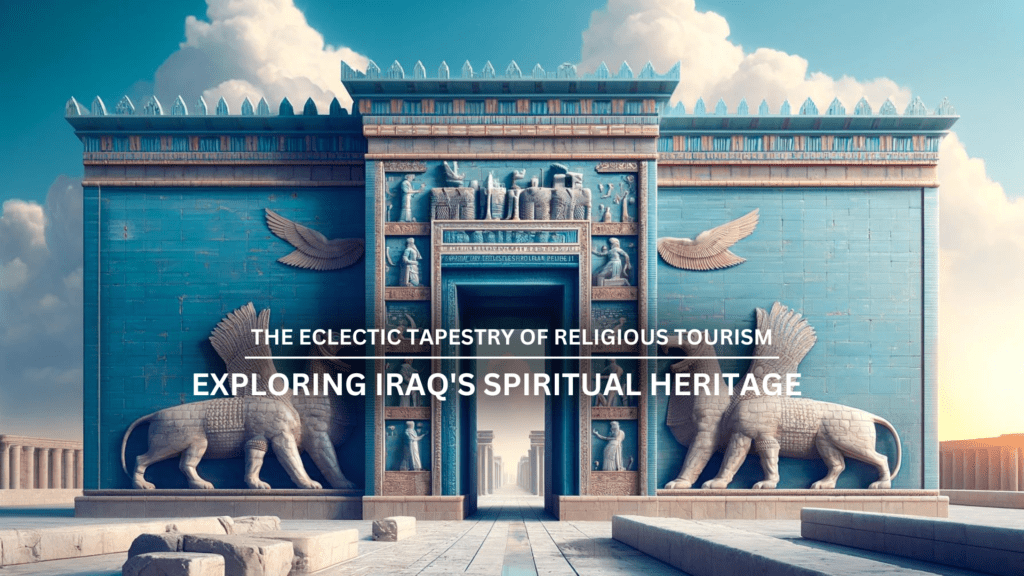
The best-known remains are linked to the Neo-Babylonian period, especially the reign of Nebuchadnezzar II in the sixth century BCE. Excavations revealed sections of monumental walls, processional routes, temples and palatial structures. The famous blue-glazed decoration of the Ishtar Gate, much of which is held abroad, has helped define the visual image of Babylon worldwide.
What a visit offers, however, is scale. Babylon makes clear that ancient cities were not isolated monuments. They were dense, managed environments shaped by water, labour, ceremony, markets and political ambition. Conservation at a site of this size is an ongoing task, so access and the condition of particular areas can vary. It is worth treating the visit as an encounter with a working heritage landscape rather than expecting a fully reconstructed ancient city.
The written record behind the ruins
One of Mesopotamia’s greatest discoveries was not a single treasure but a system: writing. Cuneiform began as a practical means of recording goods and transactions in southern Mesopotamia around the late fourth millennium BCE. It later carried laws, letters, hymns, scientific observations and literature.
The Epic of Gilgamesh, whose surviving versions were written on clay tablets, remains one of the world’s oldest great literary works. Its questions about friendship, loss, leadership and mortality still feel remarkably close. Seeing the landscapes of Iraq gives such texts a physical setting – river plains, city mounds and long horizons that make the ancient world easier to imagine without reducing it to myth.
Girsu and Lagash: where new research is changing the picture
Some of the most compelling Mesopotamia archaeology discoveries are not headline-grabbing treasures. They are careful findings that revise how archaeologists understand a city’s layout and the people who lived there.
Girsu, near the modern town of Tello in southern Iraq, was an important Sumerian religious and administrative centre. It has yielded inscriptions, statues and temple remains connected with the ruler Gudea, one of the best-known figures of the late third millennium BCE. Current archaeological and conservation work has renewed attention on the site, using survey methods alongside excavation to understand its sacred areas, neighbourhoods and relationship with the wider landscape.
Nearby Lagash was one of the region’s major early city-states. Archaeologists have studied its canals, buildings and settlement patterns to better understand how urban communities adapted to the wetlands and waterways of southern Iraq. These investigations challenge the idea that ancient cities were static. In reality, they shifted with environmental conditions, political change and the movement of people.
For heritage travellers, these sites reward preparation. They may be less visually monumental than Babylon or Ur, but they offer something equally valuable: a view of archaeology as a living process, where Iraqi specialists and international teams continue to refine the story.
Assyria’s northern capitals
Northern Iraq holds another chapter of Mesopotamian history: the Assyrian empire. Cities such as Nimrud, Nineveh, Assur and Dur-Sharrukin once formed centres of royal power, scholarship and long-distance exchange.
Their palaces were famed for stone reliefs showing processions, hunts, ceremonies and protective winged figures. These works were not merely decoration. They presented a carefully constructed vision of kingship, order and the relationship between ruler, gods and empire.
The archaeological importance of these sites also carries a responsibility. Their preservation requires sustained expertise, documentation and local stewardship. Visitors should follow official guidance, avoid climbing on fragile remains, and never remove stones, pottery or soil. Even a small fragment out of context can erase information that archaeologists need to understand a site properly.
How to experience Iraq’s ancient sites respectfully
A meaningful archaeological journey is usually best organised around cities rather than treated as a checklist of ruins. Baghdad provides museums and a vital modern cultural context. Nasiriyah is a natural base for Ur and the marshland heritage of the south, while visits to Babylon can be planned from Baghdad or nearby cities depending on current arrangements.
Conditions differ by season. Spring and autumn are generally more comfortable for extended outdoor visits, while summer heat can be intense, particularly on exposed southern sites. Wear modest, breathable clothing, bring water and sun protection, and allow more time than a map suggests. Distances between sites may look manageable, but road conditions, permissions and local arrangements can affect the day.
A knowledgeable local guide can add real value, especially at sites where interpretation panels are limited. Ask questions, listen to local perspectives and remember that archaeological places are part of living communities. Respectful photography, appropriate dress and a willingness to move at the pace of the place will make the experience richer.
Iraq’s ancient cities are not only evidence of what humanity achieved long ago. They are invitations to meet the country with greater curiosity: to stand before Ur’s ziggurat, walk the ground of Babylon, and recognise that the story of Mesopotamia is still being researched, cared for and carried forward by Iraqis today. Plan thoughtfully, leave every site exactly as you found it, and let the people and landscapes around the ruins shape your understanding as much as the stones themselves.