The road to Karbala during Arbaeen is unlike ordinary travel. You are not simply moving between cities – you are joining one of the world’s most profound acts of devotion, hospitality and shared purpose. For many visitors, the biggest difference is this: the journey runs on faith and generosity, but it still rewards careful planning. The best arbaeen pilgrimage travel tips help you arrive prepared enough to focus on the meaning of the walk itself.
Why Arbaeen travel needs a different mindset
Arbaeen is not a conventional city break, and treating it like one usually leads to frustration. Distances feel different when roads are crowded, mobile networks are under pressure, and your timetable depends as much on people and prayer as on transport. What looks simple on a map can take far longer in reality.
That is not a drawback. It is part of the experience. Along the route, you will find extraordinary generosity from local communities, volunteers and mawkibs offering food, rest and support. At the same time, international travellers should prepare with humility. Hospitality is abundant, but it should never be assumed as a substitute for personal responsibility.
Arbaeen pilgrimage travel tips before you leave
The most useful preparation starts well before you land in Iraq. Confirm your entry requirements through official channels, and do this early. Visa policies can change, and Arbaeen season brings high demand. If you are travelling from abroad, keep both printed and digital copies of your passport, visa documents, insurance details and hotel bookings.
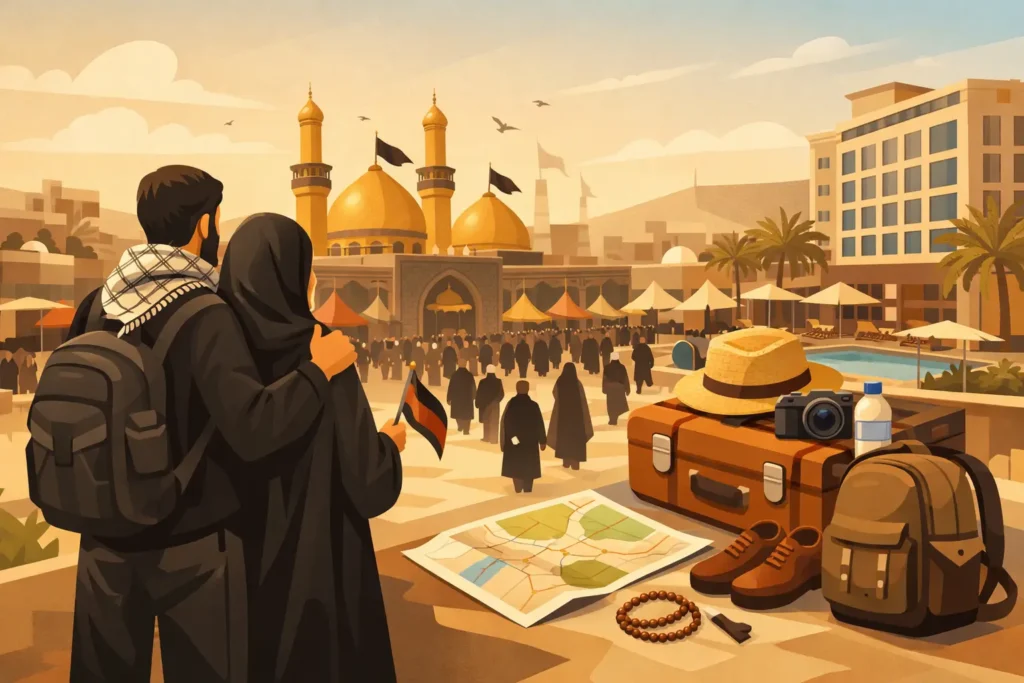
Packing for Arbaeen is also about restraint. Bring less than you think you need, but choose carefully. Comfortable, broken-in walking shoes matter more than almost anything else. A small backpack, light clothing suitable for warm days and cooler evenings, blister care, basic medicines, a refillable water bottle, power bank, tissues and sanitiser will make a real difference.
If you plan to walk long sections, avoid carrying a heavy suitcase from city to city. Many experienced pilgrims keep their main luggage at their accommodation and walk with only essentials. This is especially helpful if you are arriving in Najaf and continuing onwards to Karbala.
Money is another area where preparation matters. Carry cash in small notes for practical expenses, even though much of the route is supported by free community services. ATMs and card payments may not always be convenient when crowds are at their peak. A local SIM can also help, but be prepared for slower service in busy periods.
Choosing your arrival plan
For first-time visitors, the smoothest approach is usually to anchor your trip around one or two stays rather than moving constantly. Many pilgrims arrive in Najaf, spend time visiting the holy shrine, then begin the walk to Karbala. Others base themselves in Karbala and arrange shorter movements around the main pilgrimage days. It depends on your energy, your accommodation options and whether walking the full route is a central part of your intention.
If you are travelling with elderly relatives, children or anyone with mobility concerns, a shorter walking section may be the wiser choice. Arbaeen is deeply meaningful whether you walk the full route or only part of it. The experience should be shaped by sincerity and practical judgement, not pressure.
Accommodation also needs early attention. Rooms in Najaf and Karbala are in high demand around Arbaeen, and availability narrows quickly. If a private hotel stay is important for rest, family needs or personal comfort, secure it well in advance. Some travellers are comfortable relying partly on communal hospitality, but this is a personal decision and not ideal for everyone, particularly international visitors unfamiliar with local logistics.
On-the-ground Arbaeen pilgrimage travel tips
Once you arrive, patience becomes as valuable as any document or booking. Traffic can be dense, walking routes can be busy, and checkpoints may take time. Build flexibility into every transfer. If you have a flight, intercity drive or hotel check-in on a key Arbaeen date, allow far more time than you would during a quieter travel period.
Dress respectfully and practically. Loose, modest clothing is the right choice for both religious etiquette and physical comfort. Good socks, sun protection and layers for changing temperatures are often overlooked, yet they can shape your whole day.
Hydration is essential, even when refreshment is easy to find along the route. Drink regularly rather than waiting until you feel tired. If you are not used to long-distance walking, pace yourself from the start. It is common for first-time pilgrims to begin too quickly, then struggle later with fatigue or blisters.
Travelling in pairs or small groups can make the journey easier, especially if you are unfamiliar with Iraq or do not speak Arabic. Set meeting points in advance in case mobile service drops. A simple card in your bag with your hotel name, key contact numbers and destination written clearly can be surprisingly useful.
Respecting the spirit of the walk
Arbaeen is a spiritual gathering before it is a travel experience, and that distinction matters. Visitors are welcome, but the atmosphere calls for attentiveness and respect. Photography, for example, should always be thoughtful. Do not assume people want to be photographed while praying, resting or serving others. When in doubt, ask.
The same applies to hospitality. If you are offered food, tea or a place to sit, receive it with gratitude. A warm thank you goes a long way. Yet be mindful of your own limits too. You do not need to accept every offer, and gentle politeness is well understood.
For non-Arabic speakers, a few simple phrases can transform interactions. Even basic greetings show care and openness. More importantly, approach the journey with curiosity rather than entitlement. Iraq’s pilgrimage culture is built on generosity, and travellers honour that best by moving through it respectfully.
Health, rest and knowing your limits
One of the most overlooked travel mistakes during Arbaeen is underestimating physical strain. Even a spiritually energising journey can be hard on the body. Heat, crowds, irregular sleep and long periods on your feet can catch up with you quickly.
Try to protect your rest where you can. If you have booked accommodation, use it well. A shower, a few quiet hours and proper sleep can be the difference between meaningful endurance and unnecessary exhaustion. If you have any medical condition, keep medication easily accessible and do not rely on finding a replacement at the right moment.
Food is widely available, often through generous community provision, but eat with common sense. Choose what feels fresh, stay hydrated and give your body time to recover. If you are travelling from abroad and your routine is changing sharply, simpler meals may serve you better than overdoing it.
There is no virtue in pushing yourself to the point of illness. Some pilgrims walk the full route. Others complete a day, then rest. Others focus more on the shrine cities than the road itself. Arbaeen is not diminished by sensible choices.
Getting around Najaf and Karbala during peak days
Transport during Arbaeen requires realism. Distances that seem short can become lengthy because of road controls, pedestrian flow and volume of visitors. If your hotel says a site is nearby, ask whether that means by car under normal conditions or on foot during pilgrimage days. The answer may differ considerably.
In Najaf, staying within manageable reach of the shrine area can simplify the first part of your journey. In Karbala, location matters even more during peak days, when access patterns may change and roads around the shrine areas become exceptionally busy. A room that looks attractively priced far from the centre may cost you more in time and energy.
This is where planning with a platform familiar with local travel patterns, such as Stay In Iraq, can be genuinely useful. Clear information about where to stay, how far you will actually be from key sites, and what to expect during pilgrimage periods helps reduce uncertainty before you arrive.
What first-time visitors often get wrong
The most common mistake is trying to control every hour of the trip. Arbaeen runs on devotion, movement and human rhythm, not perfect schedules. Plan carefully, but do not cling too tightly to a rigid itinerary.
Another mistake is overpacking. Every unnecessary item becomes heavier with each kilometre. The third is assuming free services mean you need no budget at all. You still need money for private transport, accommodation, personal supplies and changes of plan.
Finally, some travellers focus so heavily on logistics that they miss the deeper atmosphere around them. Leave room for conversation, reflection and the small moments that stay with people long after the journey ends – a shared cup of tea, a stranger’s kindness, a prayer whispered on the road to Karbala.
Arbaeen asks for preparation, but it also asks for openness. If you arrive with both, Iraq has a remarkable way of meeting you with dignity, care and a sense of connection that is hard to find anywhere else.