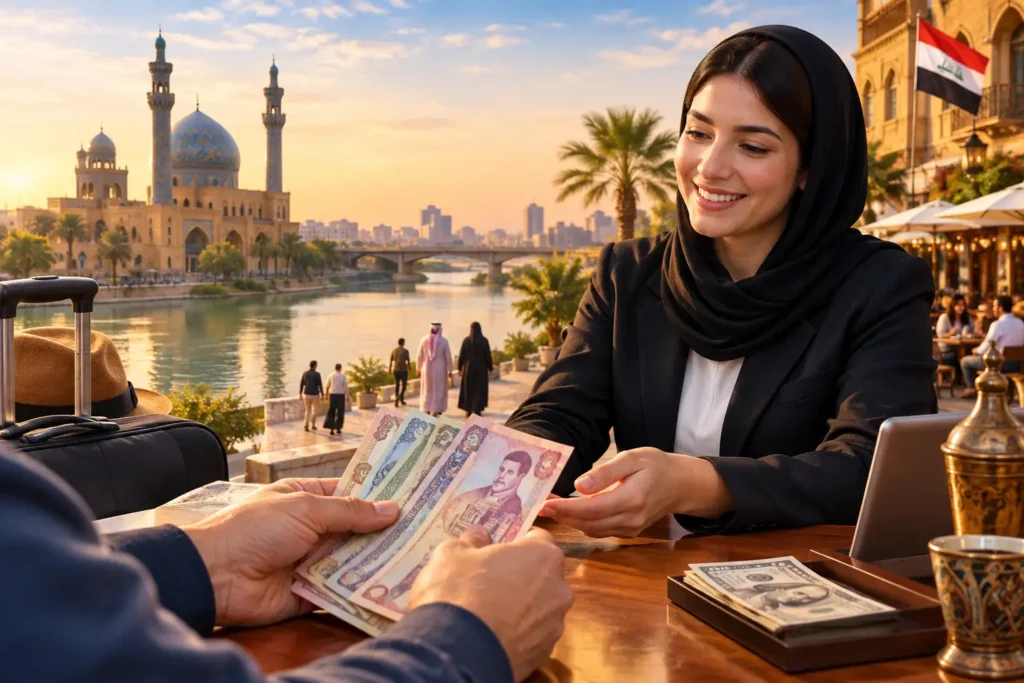
The first cup of tea offered by a welcoming host, the taxi from the airport, a meal beside the Tigris or a small purchase in a historic market all have one practical detail in common: Iraqi dinars. Knowing how to exchange Iraqi dinars before you need them makes the first hours of your journey calmer and leaves more room for the experiences that brought you to Iraq.
Iraq is a country of generous hospitality, deep spiritual meaning and living history, but it remains largely cash-led for everyday travel. With a little preparation, managing money here is straightforward. The key is to bring an appropriate foreign currency, exchange through established providers and keep a sensible cash plan as you move between cities.
How to Exchange Iraqi Dinars Safely
The Iraqi dinar is abbreviated as IQD. For most international visitors, the simplest approach is to bring a widely accepted foreign currency and exchange it after arrival. US dollars are generally the easiest currency to exchange, particularly for travellers visiting Baghdad, Najaf, Karbala, Basra, Erbil or Sulaymaniyah. Euros and some regional currencies may also be accepted by exchange businesses, although this can vary by city and provider.
Use established exchange offices, banks or authorised money-changing counters. In busy commercial areas, exchange shops are often easy to identify and commonly display their buying and selling rates. Your hotel may also be able to point you towards a reputable nearby provider, which can be especially useful after a late arrival or in a city you do not yet know well.
Before handing over your money, ask clearly how many dinars you will receive for the amount you wish to change. Check whether the quoted figure is the final amount and whether any service charge applies. Exchange rates can differ slightly from one provider to another, so there is no need to accept the first rate you see if you have time to compare two or three established businesses.
Avoid informal street exchanges, even if an offered rate appears attractive. Authorised providers give you a clearer transaction, a better opportunity to count your notes properly and greater peace of mind. Carry your passport with you, as some providers may ask for identification depending on the transaction and local procedure.
Bring clean, undamaged notes
Cash condition matters more than many first-time visitors expect. Bring clean, current foreign-currency notes without tears, heavy creases, writing or marks. Larger US dollar notes are often preferred for exchange, but requirements can differ between providers. Older or damaged notes may be refused or offered at a less favourable rate.
It is wise not to exchange all of your travel funds at once. Change enough for your first few days, then assess your spending. This protects you if your itinerary changes and reduces the chance of ending your trip with a large amount of dinars that may be difficult to exchange outside Iraq.
Where to Exchange Money in Iraq
Most travellers exchange a small initial amount on arrival, then use exchange offices in the city where they are staying. Airport counters can be convenient for transport, food and immediate essentials, but their rates may be less competitive than those available in town. Think of an airport exchange as a practical starting point rather than your only option.
In Baghdad and other major cities, exchange businesses are often concentrated in commercial districts and near markets. In Najaf and Karbala, visitors travelling for pilgrimage will find money services around key visitor areas, although availability and hours can change around major religious occasions. Ask your accommodation staff for current local guidance rather than relying on old online recommendations.
Hotels may exchange a small amount of money, but this is not universal and the rate may be less favourable. Larger hotels are generally better placed to help with directions, taxis or arranging a visit to a trusted exchange provider. Stay In Iraq encourages travellers to choose accommodation that can offer practical local support, especially on a first visit.
If you are travelling through the Kurdistan Region of Iraq, the Iraqi dinar is still used. The practical experience may differ by city, and some businesses serving international visitors may be more accustomed to foreign currencies and cards. Nevertheless, carrying dinars remains useful for everyday purchases, local transport and smaller family-run businesses.
Cash, Cards and ATMs: What to Expect
Cash is the most dependable way to pay for daily expenses in Iraq. You will use it for taxis, cafés, market shopping, entrance fees, tips and many local restaurants. Even where electronic payments are available, keeping enough dinars on hand avoids inconvenience.
International bank cards may work at selected hotels, larger restaurants and some modern businesses, but acceptance is not consistent enough to make cards your sole payment method. Likewise, an ATM may be available but may not accept every overseas card, may have withdrawal limits or may not be stocked with cash at the moment you need it. Treat cards and ATMs as useful back-up options, not the foundation of your travel budget.
For security and convenience, divide your money between a wallet, a secure bag and your accommodation safe where available. Carry the amount you expect to spend that day, plus a modest reserve. This is sensible in every destination and lets you enjoy crowded souqs, sacred sites and busy streets without repeatedly handling your full travel funds.
Keep smaller notes for everyday spending
Iraqi dinar notes come in several denominations, including 250, 500, 1,000, 5,000, 10,000, 25,000 and 50,000 dinars. Larger notes are useful for hotel bills, longer taxi journeys and substantial restaurant payments, but smaller notes make everyday transactions easier.
When exchanging money, ask whether the provider can include a mix of denominations. There is no need to carry a thick bundle of the smallest notes, but a practical spread will help with taxis, snacks, bottled water and modest tips. In a market setting, it is also courteous to have a suitable note ready rather than expecting a small independent seller to find change for a large denomination.
Count your dinars before leaving the counter and keep the receipt if one is provided. It is easier to clarify an honest counting error immediately than after you have walked away. Take a moment to familiarise yourself with the colours and values of the notes, particularly when you are tired after a flight.
Plan Your Spending Around Your Itinerary
How much to exchange depends on your travel style. A guided heritage itinerary with pre-arranged transport and hotels requires less daily cash than independent travel involving frequent taxis, local meals and shopping. Pilgrims may also wish to set aside cash for meals, transport, donations where appropriate and purchases from local vendors near holy sites.
Discuss payment expectations with your guide, driver or accommodation before a long journey between cities. Ask whether fuel, entrance fees, meals and driver costs are included. Clear arrangements help everyone and prevent you from having to search for an exchange office en route.
Try to retain a small amount of foreign currency as an emergency reserve. It is also sensible to keep your home bank informed of travel plans before departure and check any card charges for overseas transactions. These small preparations can make a meaningful difference if an ATM declines a withdrawal or a card payment does not go through.
Can You Exchange Leftover Iraqi Dinars After Your Trip?
Do not assume you will be able to exchange leftover dinars easily once you are home. Iraqi dinars are not routinely stocked or bought back by every foreign exchange provider, particularly outside the region. Before leaving Iraq, consider exchanging surplus cash through an authorised provider if you do not plan to return soon.
Leave enough dinars for airport transport, meals and any final purchases. Keep in mind that exchange counters may have limited opening hours, so do not leave this task until the last few minutes before departure. Many travellers choose to keep one or two notes as a small, meaningful reminder of a journey through one of the world’s great centres of civilisation.
A well-planned cash strategy should fade into the background once your trip begins. Exchange carefully, carry a practical mix of notes and let Iraq’s extraordinary welcome, from its ancient cities to its sacred shrines and generous tables, take centre stage.