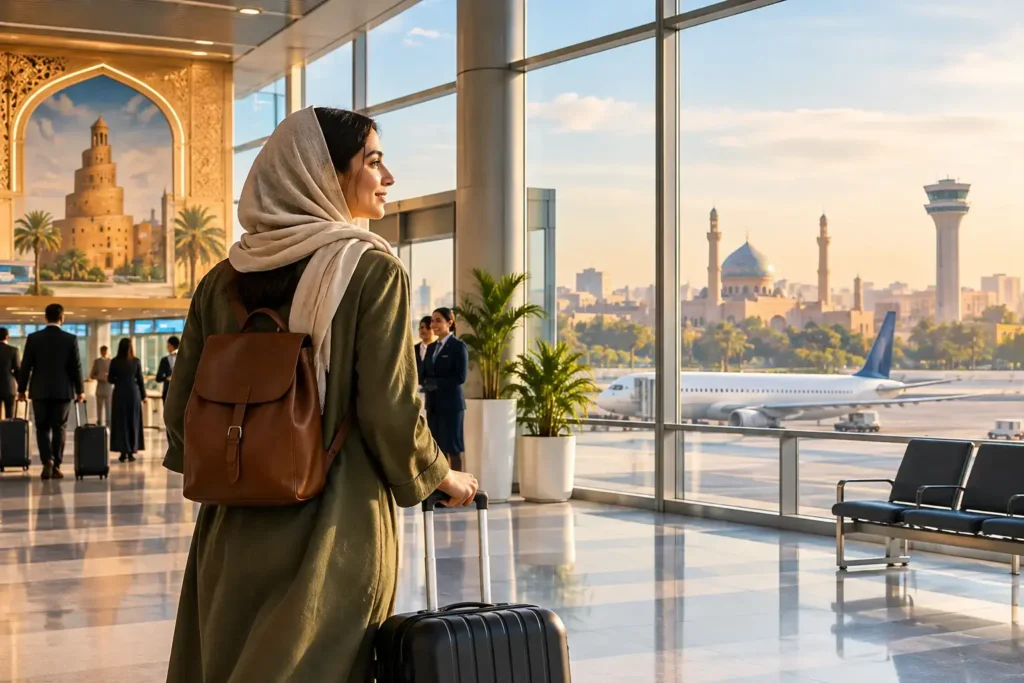
Your first welcome to Iraq may come in the quiet of an early-morning arrivals hall, through the warmth of a greeting from a driver, or in the sight of families reuniting after a long journey. Knowing how to navigate Iraqi airports helps that first moment feel less uncertain and leaves you free to focus on what brought you here: ancient cities, sacred shrines, family connections, remarkable food and the generosity of Iraqi hospitality.
Iraq’s airports are becoming more familiar to international and regional travellers, but procedures, facilities and transport options can vary by city. A little preparation goes a long way, especially if this is your first visit.
How to navigate Iraqi airports before you fly
Start by confirming which airport best suits your route. Baghdad International Airport is the principal gateway for the capital and onward journeys to central and southern Iraq. Najaf International Airport is particularly useful for pilgrims visiting Najaf and Karbala. Erbil International Airport serves the Kurdistan Region and is a popular choice for travellers beginning in Erbil, while Basra International Airport is practical for southern Iraq and the Gulf-facing city of Basra.
Your choice is not only about flight price. Consider where you will stay on your first night, the length of your onward road journey and whether your travel arrangements cover the federal regions of Iraq, the Kurdistan Region, or both. Entry requirements and visa arrangements can depend on your nationality, point of arrival and itinerary. Check the latest official guidance from the relevant Iraqi authorities and your own government before booking, rather than relying on old social-media posts or another traveller’s experience.
Keep your passport, visa documentation where required, hotel confirmation, return or onward flight details and local contact information together in a small document wallet. Save digital copies on your mobile phone as a backup, but do not depend on your battery alone. A printed hotel address and the telephone number of your host or driver can be especially useful if language or connectivity becomes an issue on arrival.
Arrival: take each step calmly
On landing, follow signs for passport control and remain patient if several flights arrive close together. Processing times can vary, particularly during religious holidays, major pilgrimage periods and peak regional travel dates. Airport staff may ask straightforward questions about the purpose of your visit, your accommodation and the length of your stay. Answer clearly and politely.
If you are eligible for a visa on arrival or have a visa procedure to complete at the airport, follow the instructions provided by airport staff and ensure you understand the payment method and documentation required before you travel. Rules can change, so this is one area where current official information matters more than assumptions.
After immigration, collect your luggage before heading through customs. Keep baggage tags until you have left the reclaim area, as they may be checked. Customs officers may ask about professional camera equipment, drones, large quantities of medication or other specialised items. If you are travelling for journalism, filming, research or a commercial project, arrange the relevant permissions in advance. Recreational photography is often part of a memorable trip, but airports, security areas and official facilities are not places to take photographs unless you have clear permission.
Cash, connectivity and the first practical decisions
Arriving with some cash makes the first hour easier. The Iraqi dinar is used for everyday spending, and cash remains useful for taxis, small purchases and many local services. Major hotels and some larger businesses may accept cards, but card use is not universal. Exchange counters and cash machines may be available at airports, although rates, availability and card compatibility differ.
It is sensible to carry a modest amount of widely accepted foreign currency for exchange, alongside a bank card and a small reserve of dinars if you have obtained them beforehand. Avoid carrying all your money in one place. As with any international airport, keep your passport, valuables and mobile phone close while managing bags, documents and payments.
A local SIM card or eSIM can make arrival far more straightforward. Depending on the airport and your provider, you may be able to arrange a connection soon after landing or at your hotel. Download offline maps, save your accommodation location in Arabic or Kurdish where relevant, and screenshot your driver’s details before you fly. Internet access can vary, and these small preparations prevent a simple collection arrangement becoming stressful.
Arrange your airport transfer before landing
For most first-time visitors, a pre-arranged transfer is the most comfortable way to leave an Iraqi airport. Ask your hotel, host, tour operator or trusted local contact to organise collection and share your flight number, arrival time and a way to recognise your driver. Confirm the meeting point in advance, as access rules around terminal exits can differ.
This is particularly worthwhile after a late arrival, when travelling with children or large luggage, or when heading directly to another city. It also gives you a local point of contact from the moment you land. Iraqi hospitality often begins with practical care: a driver waiting patiently, help with luggage, or advice on where to stop for tea on the road.
Taxis may be available outside terminals, but travellers should agree the fare before setting off and use official airport taxi arrangements where possible. Do not feel pressured to make a rushed decision at the exit. If you are unsure, call your hotel or ask an airport information desk to help confirm the safest, clearest option for your route.
Plan for the city, not just the airport
Airport-to-city travel times depend on traffic, road conditions and security procedures, so avoid scheduling a tightly timed activity immediately after landing. Baghdad’s airport is outside the central accommodation areas, while journeys from Najaf airport to central Najaf are generally shorter. From Erbil International Airport, many hotels are within a manageable drive, but arrivals can still be slower during busy periods. Basra visitors should similarly allow time to settle in before heading to a meeting or excursion.
If you are continuing by domestic flight, build in a generous connection. Separate tickets, baggage re-checks and terminal procedures can make a short connection riskier than it appears. Where possible, spend your first night in your arrival city. It is a calmer start and lets you adjust to the rhythm of the country before travelling onwards.
Respectful airport etiquette in Iraq
Iraqi airports are working spaces used by families, pilgrims, business travellers and people returning home. Dress neatly and modestly, particularly when arriving through Najaf or travelling during religious occasions. There is no single rule for all visitors, but clothing that covers shoulders and knees is a sensible baseline. Pilgrims visiting holy cities may choose more conservative dress in keeping with the setting.
Be courteous with staff, avoid loud frustration if a process takes longer than expected, and follow directions at security points without debate. Security screening may be more thorough than you are used to at some airports. Treat it as part of the journey and keep your belongings organised so you can move through efficiently.
Arabic is widely spoken across federal Iraq, while Kurdish is also widely spoken in the Kurdistan Region. English is common in some airport, hotel and tourism settings, though not everywhere. A few phrases can be warmly received: “shukran” for thank you, and “salaam alaikum” as a respectful greeting. A translation app helps, but patience and a friendly manner are just as valuable.
Departing Iraq without last-minute pressure
For your departure, confirm your terminal, baggage allowance and transport the day before you fly. Arrive earlier than you might for a familiar short-haul journey, as entry checks, baggage screening and check-in queues can take time. Your airline’s guidance should be your starting point, particularly during pilgrimage seasons and public holidays.
Keep any purchase receipts for valuable items if requested, check that souvenirs meet airline and customs rules, and do not pack restricted objects in hand luggage. If you have bought gifts such as dates, sweets, textiles or crafts, protect them carefully in checked baggage where appropriate. Iraq is a place where travellers often leave with more than photographs: books, spices, handwritten recommendations and gifts offered with kindness all have a way of finding space in a suitcase.
The most useful mindset is simple: arrive prepared, allow time, and accept that travel works best here when you leave room for human interaction. Iraqi airports are not merely transit points. They are the threshold to a country whose welcome is often more personal, generous and memorable than visitors expect.