Baghdad is often introduced through the scale of its history, but its museums make that history personal. The top Baghdad museums for visitors place carved stone, illuminated manuscripts, modern paintings and scenes of everyday life within reach, turning names such as Sumer, Babylon and Abbasid Baghdad into something immediate and human. They also reveal a capital that is not frozen in the past: Baghdad remains a city of artists, scholars, families and powerful cultural memory.
For travellers with limited time, museums are one of the best ways to understand the city before wandering its book markets, riverfront streets and historic quarters. Opening arrangements can change, particularly for smaller institutions, so it is sensible to confirm current hours locally before setting out and to allow time for security procedures at major cultural sites.
The top Baghdad museums for visitors
The Iraq Museum: the essential first stop
The Iraq Museum, also known as the National Museum of Iraq, is the defining museum visit in Baghdad. Its collection traces the long story of Mesopotamia through objects from Sumer, Akkad, Babylon, Assyria and later Islamic eras. For anyone drawn to archaeology, it is not simply a worthwhile stop. It is the place that gives context to the archaeological sites travellers may later visit across Iraq.
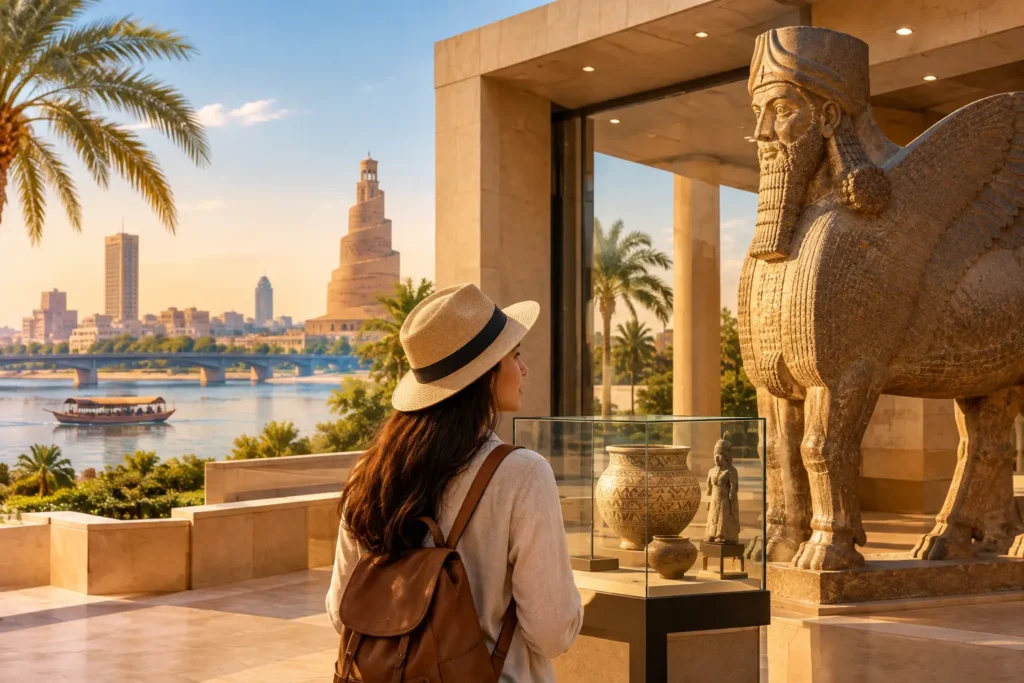
The galleries contain the kinds of objects that change the scale of history: early writing tablets, statues of worshippers, royal reliefs, cylinder seals and artefacts connected to some of the world’s earliest cities. Even visitors without a specialist interest in ancient history can feel the force of seeing how sophisticated urban life, administration, trade and artistic expression were in this region thousands of years ago.
Give the museum at least two hours, and longer if Mesopotamian civilisation is a central reason for your trip. Reading a little about Sumerian and Assyrian history beforehand helps, but do not feel obliged to arrive as an expert. Move slowly, look closely at the labels where available, and ask a local guide to explain the objects that interest you most. The experience is richer when stories are added to the dates.
This is also a museum to approach with patience. Access procedures, gallery availability and photography rules may vary. Dress respectfully, carry identification if requested, and treat the visit as a cultural appointment rather than a hurried tick on an itinerary.
Baghdad Museum: a portrait of everyday city life
Near the river and the historic heart of the capital, Baghdad Museum offers a different type of encounter. Rather than focusing on ancient artefacts, it presents Baghdad’s social customs, crafts and street life through life-sized scenes and traditional settings. For diaspora visitors, these displays can feel especially moving, recalling details of domestic and public life that are easily lost in a conventional history book.
The museum’s dioramas depict familiar moments from older Baghdad: market exchanges, coffeehouse conversations, weddings, religious observances and artisan workshops. Some displays have an almost theatrical quality, but that is part of their appeal. They invite visitors to picture the rhythms of the city and the communities that shaped it.
Pair this visit with time around Al-Mutanabbi Street and the nearby heritage quarter. The contrast is valuable. Inside the museum, you see remembered versions of Baghdad’s daily life; outside, the city’s literary and social culture continues in new forms. If you have only one afternoon in central Baghdad, this combination creates a rewarding cultural route.
Iraqi Museum of Modern Art: Baghdad through its artists’ eyes
Ancient Iraq is rightly famous, yet Baghdad’s modern artistic tradition deserves equal curiosity. The Iraqi Museum of Modern Art, associated with the Pioneers Museum and the Gulbenkian collection, introduces visitors to generations of Iraqi painters and sculptors who developed a distinctive visual language during the twentieth century and beyond.
Here, the subjects are often closer to the present: neighbourhoods, landscapes, calligraphy, memory, work, identity and the changing life of the nation. The most memorable works do not try to imitate European schools. They draw from Iraqi visual traditions, Arabic script, folklore and the country’s layered heritage while speaking in an unmistakably modern voice.
This is an excellent choice for travellers who want to see Baghdad as a creative capital rather than only an archaeological destination. It also offers a useful balance after the density of the Iraq Museum. Where ancient galleries ask you to look backwards across millennia, modern art asks what Iraqis have seen, felt and imagined in their own time.
Collection displays and public access can vary, so check locally before visiting. If the museum is not open on your planned day, ask a knowledgeable guide or your accommodation host about current exhibitions, galleries or cultural events in the city. Baghdad’s artistic life extends well beyond one building.
Al-Shaheed Monument and its museum spaces
Al-Shaheed Monument, or the Martyrs’ Monument, is among Baghdad’s most recognisable architectural landmarks. Its split turquoise dome rises above a broad memorial complex and is worth seeing for the structure itself: geometric, contemplative and strikingly different from the city’s older architectural forms.
The complex includes museum and exhibition spaces that add historical and cultural context to the memorial. The atmosphere is more reflective than that of the Iraq Museum, making it a good choice for visitors interested in modern Iraqi identity, architecture and public memory. Approach it thoughtfully. This is a place of remembrance, and respectful behaviour matters more than hurried photography.
Even if interior access is limited during your visit, the exterior and landscaped setting justify the journey. Photographers will appreciate the changing light on the dome, while architecture lovers may wish to spend time considering its symmetry, scale and carefully framed views. It is best visited as part of a wider east Baghdad itinerary rather than squeezed between central-city stops.
How to plan a museum day in Baghdad
Baghdad’s museums are best approached as a conversation between eras, not a checklist. Start with the Iraq Museum in the morning, when your attention is freshest for the archaeological galleries. Follow it with lunch and a walk around central Baghdad, then choose either Baghdad Museum for social history or the Museum of Modern Art for a more contemporary perspective.
Trying to visit all four major sites in one day can be tiring and may not be realistic if opening times or transport conditions change. Two museums in a day is usually the better pace. It leaves room for a proper meal, prayer times where relevant, traffic, security checks and the spontaneous conversations that often become a highlight of travelling in Iraq.
A private driver or local guide can simplify the day, particularly for first-time visitors. They can help confirm access, explain etiquette and provide context that is not always visible on signage. Independent travellers can also visit successfully, but should plan conservatively, use a reliable taxi arrangement and avoid relying on outdated online opening hours.
Practical etiquette for museum visitors
Baghdad’s cultural institutions welcome curious, respectful travellers. Modest clothing is a sensible choice, especially when combining museum visits with mosques, shrines or traditional neighbourhoods. Ask before photographing people, staff or security areas, and assume that flash photography and filming may be restricted around sensitive objects.
Museum labels may appear mainly in Arabic, with some English depending on the venue and gallery. This should not discourage a visit. A translation app can help with basic text, though a guide brings far more depth. For specialist travellers, arranging an Arabic-speaking or English-speaking cultural guide in advance can transform a good museum day into an exceptional one.
Do not overlook the value of conversation. Iraqis are often proud to discuss their country’s heritage, and a respectful question about a favourite artwork, local custom or historical period may open up a generous exchange. That warmth is part of the cultural experience, not an addition to it.
What these museums add to an Iraq itinerary
Baghdad’s museums are not only repositories of objects. They show why Iraq is central to the human story, while making clear that Iraqi culture is still being made. The clay tablets and monumental reliefs of the Iraq Museum explain the foundations of civilisation; Baghdad Museum preserves the texture of communal life; modern art galleries show the imagination of a living society; and Al-Shaheed Monument demonstrates how architecture can hold reflection and dignity.
For travellers continuing to Babylon, Samarra, Najaf, Karbala, Mosul or the marshes, a day in Baghdad’s museums provides the context that makes those places more meaningful. For those staying only in the capital, these collections offer something equally valuable: an invitation to meet Iraq through its own voices, memories and creative achievements.
Leave a little unplanned time after your final museum. A tea, a walk by the Tigris or an afternoon among the booksellers can carry the stories you have just encountered into the living city beyond the gallery walls.