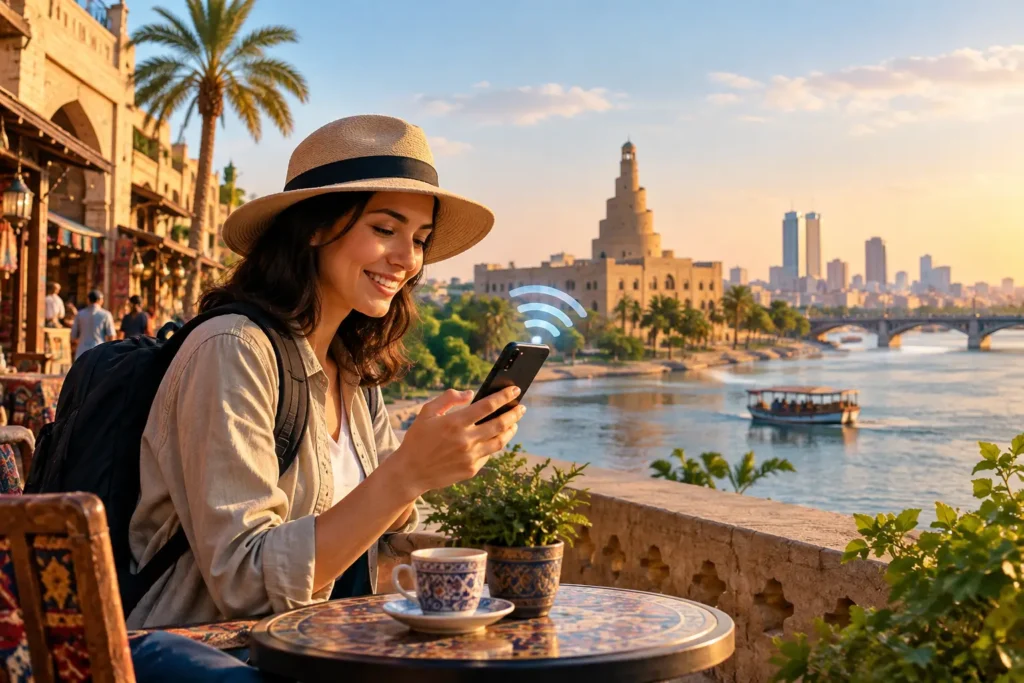
The moment you leave Baghdad International Airport, begin a road journey towards Babylon, or arrive in Najaf for ziyarat, a reliable connection makes travel feel markedly easier. Iraq mobile internet helps with the practical details that matter: confirming a hotel address, messaging a driver, translating a menu, sharing an arrival update with family, or finding the next stop on a busy itinerary.
For most visitors, getting online in Iraq is straightforward. It does, however, reward a little preparation. Coverage, phone compatibility and the best option for you can vary between a short city break, a religious visit during a major occasion, and a longer journey through several regions. Here is what travellers should know before relying on their phone.
How Iraq mobile internet works for visitors
Iraq’s mobile network is widely used by residents, businesses and visitors alike. The main operators travellers are likely to encounter are Zain Iraq, Asiacell and Korek Telecom. All offer prepaid SIM options, with data bundles that can be renewed as needed.
A local prepaid SIM is often the most practical choice for a stay of more than a few days. It provides a local number as well as mobile data, which can be useful when communicating with hotels, guides and transport providers. SIMs are commonly available at airport counters, official operator shops and mobile-phone retailers in major cities. Bring your passport, as identification is generally required for registration.
If your phone supports eSIM, an eSIM may be convenient for arranging data before departure or avoiding a search for a shop after landing. The trade-off is that an eSIM may offer data only, without a local Iraqi number, and its network partner or coverage terms can differ by provider. Check the package carefully rather than choosing solely on the headline data allowance.
International roaming is another option, particularly for a brief visit or as a backup when you first arrive. Yet roaming charges can become expensive quickly, especially when maps, image sharing and video calls are involved. For most independent travellers, a local SIM or suitable eSIM offers better value.
Choosing a SIM for your route
The best network is not always the one with the largest-looking package. Ask where the SIM will be used. A traveller spending most of their time in central Baghdad has different needs from someone travelling between Erbil, Duhok, Mosul, Karbala, Najaf and the southern heritage cities.
In Baghdad, Erbil, Sulaymaniyah, Najaf, Karbala and Basra, travellers can generally expect usable mobile data in urban areas. Network quality may vary by neighbourhood, building construction, weather and the number of people online at the same time. In older city centres, inside some hotels, or at archaeological sites beyond main urban areas, signal can be weaker or less consistent.
For a multi-city itinerary, buy from an official shop where staff can explain the current packages and help activate the line. If your journey includes remote locations, tell the seller the towns on your route and ask which network is strongest there. This small conversation is often more useful than relying on general claims about national coverage.
Pilgrims visiting Najaf or Karbala during high-demand religious periods should expect mobile networks to be busier than usual. A connection may remain available but feel slower in large crowds. Download key information beforehand, keep accommodation details saved offline and allow extra time for messages to send.
Check your handset before you fly
Your phone must be unlocked to accept an Iraqi physical SIM. If you are unsure, confirm this with your current provider before travelling. It is also worth checking that your handset supports the local network bands and that you have room for another SIM if you want to keep your home number active.
Dual-SIM phones are particularly helpful. You can use your home SIM for essential calls or security codes while setting Iraqi data as your preferred mobile-data line. Turn off data roaming on the home SIM to prevent unexpected charges. For eSIM users, install the eSIM while connected to dependable Wi-Fi and save the activation details somewhere secure.
How much data should you buy?
Data needs depend less on the length of your trip than on how you use your phone. A light user relying on hotel Wi-Fi for most browsing may need only a modest package for maps, messages and occasional searches. A photographer uploading daily images, a creator posting video, or a traveller working remotely will need considerably more.
For many visitors, starting with a mid-sized package and topping up later is the sensible approach. It avoids paying for far more data than you use while giving you enough flexibility for navigation and day-to-day communication. Mobile retailers can usually add credit or activate a new bundle, and hotel reception staff may be able to point you towards a nearby official shop.
Use Wi-Fi thoughtfully. Many hotels, cafés and guesthouses provide it, but speeds and reliability vary. Avoid sending sensitive documents or making financial transactions on open public Wi-Fi unless you are using appropriate security measures. Keep your phone updated, use a screen lock, and consider a reputable virtual private network if you regularly access personal or work accounts while travelling.
Make your connection work harder
The most useful mobile habit in Iraq is preparing for moments when the signal is not perfect. Download offline maps for each city before setting out. Save your hotel’s address in both English and Arabic where possible, along with a screenshot of the booking confirmation and the reception number. These details can make an arrival smoother when navigation or messaging is slow.
Messaging apps are widely used, but do not assume every driver, restaurant or small business communicates in the same way. A local phone number can help, and a short, polite message is often best. Iraqi hospitality is deeply personal: when a connection drops or directions are unclear, people are often willing to help in person.
Carry a power bank on full-day excursions. Long days can include museum visits, shrine precincts, markets, historic streets and intercity travel, all of which draw heavily on battery life when maps and cameras are in use. A local plug adaptor and charging cable in your day bag are simple but valuable additions.
It is also wise to keep a small amount of essential information on paper. Write down your accommodation name, a contact number and the next destination. Digital tools are helpful, but travel is more relaxed when every detail does not depend on a battery or signal.
Practical etiquette when using your phone
Mobile internet makes it easy to document memorable moments, from the brickwork of ancient sites to the energy of a market breakfast. Use that convenience with care. Always ask before photographing people, particularly families, worshippers and staff at religious places. At shrines and sacred spaces, follow local guidance on photography, phone calls and dress.
Avoid treating every encounter as content. Some of Iraq’s finest travel memories come from unplanned conversations over tea, an invitation to share food, or the pride with which a local person explains their city. Put the phone away when the moment calls for attention rather than recording.
A connected trip, with room for discovery
Iraq is increasingly practical to navigate for prepared visitors, and mobile data is part of that growing ease. Choose a SIM or eSIM that suits your route, set up offline backups, and keep your expectations realistic outside major urban centres. Then let your phone support the journey rather than dictate it. The most meaningful parts of Iraq often begin when a map leads you to the right street, and local welcome leads you further.