Baghdad rewards travellers who slow down, but it is not a city where walking should be treated as the default way to get everywhere. So, is Baghdad walkable? Yes, within the right neighbourhoods and with a thoughtful plan. Its most memorable experiences often happen at street level: browsing bookstalls, following the scent of cardamom coffee, pausing beside the Tigris, and meeting people who are proud to share their city. Yet Baghdad is a vast, energetic capital, and distances between major sights can be considerable.
The best approach is to combine short, purposeful walks with taxis or a trusted driver between districts. This gives you the texture of Baghdad without turning a day of discovery into an exhausting journey along busy roads.
Is Baghdad walkable for first-time visitors?
Baghdad is partly walkable rather than fully walkable. Central historic areas can be explored on foot, particularly when you arrive with local knowledge or a clear route in mind. The city’s older quarters were shaped around markets, mosques, cafés and civic landmarks, creating places where walking feels natural and rewarding.
What makes Baghdad less suited to all-day walking is its scale. Neighbourhoods that appear close on a map may be separated by broad roads, river crossings, traffic or limited pedestrian infrastructure. Pavements can be uneven or interrupted, and crossings are not always designed around visitors on foot. Summer heat is another serious consideration: a route that feels manageable in the cool morning can become uncomfortable by midday.
For most international travellers, the practical answer is simple: walk within a destination area, then take transport to the next one. Think of Baghdad as a collection of walkable experiences rather than one walkable city centre.
The best places to explore on foot
Al-Mutanabbi Street and the historic heart
Al-Mutanabbi Street is one of Baghdad’s clearest examples of why walking matters. Named after the celebrated tenth-century poet, it is known for its booksellers, literary atmosphere and enduring role in the city’s cultural life. On a lively Friday morning, visitors can browse Arabic titles, antiques and prints, stop for tea, and absorb the easy conversation that gives the street its character.
This area works best as a slow, unhurried walk. Pair it with the nearby Qishla, an important Ottoman-era landmark, and the Abbasid Palace, whose brickwork and arches offer a striking reminder of Baghdad’s deep architectural heritage. Allow time to look closely rather than trying to race through a long list of sites.
The surrounding streets can be busy, so use ordinary urban awareness. Keep valuables secure, cross with care, and ask a local guide, hotel team or trusted contact which entrances and routes make the most sense that day. Conditions can change around events, prayer times and official arrangements.
The Tigris riverfront
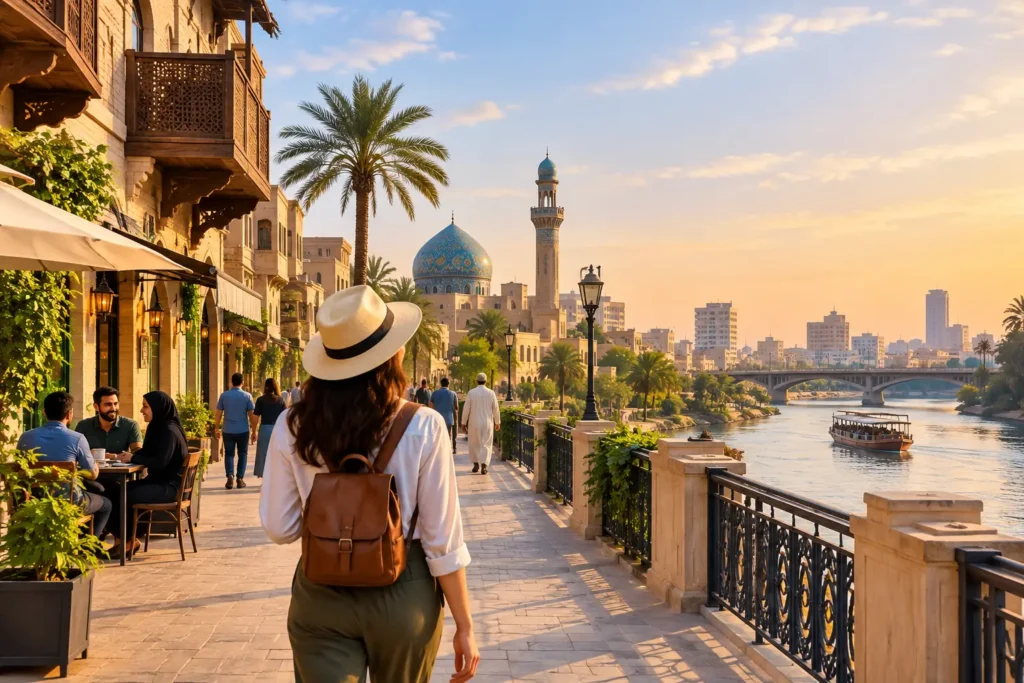
The Tigris is not merely a landmark on a map. It is part of Baghdad’s rhythm. A riverside stroll, particularly later in the afternoon when temperatures ease, offers a calmer counterpoint to the city’s traffic and commerce. Views across the water help place Baghdad’s story in perspective: this is a living capital built beside one of the world’s most historic rivers.
Not every stretch of riverfront functions as a continuous promenade, so avoid planning an ambitious point-to-point walk. Instead, choose a specific riverside café, public area or viewpoint recommended locally, then enjoy the immediate surroundings. This is where a flexible itinerary pays off.
Kadhimiya and religious heritage areas
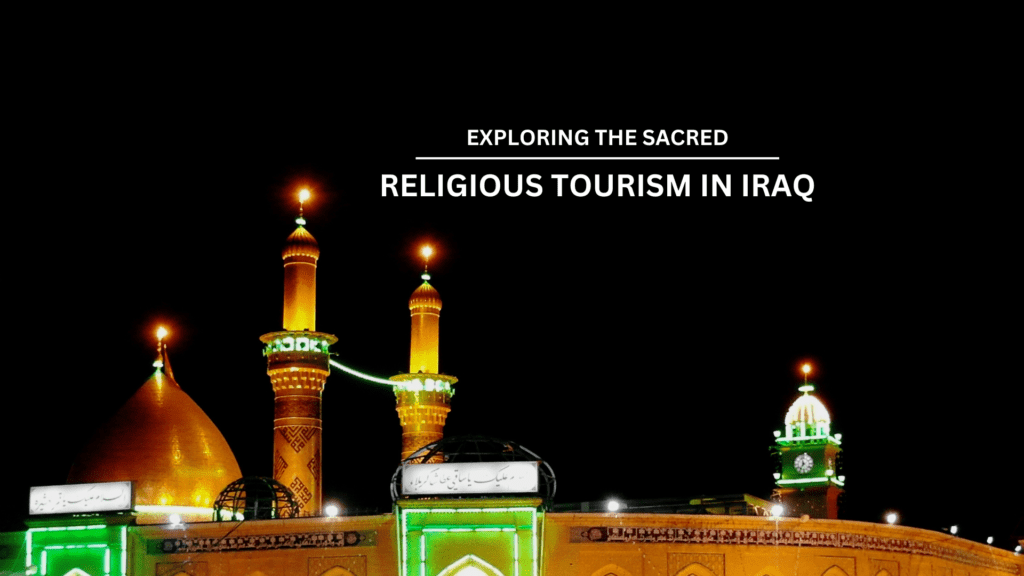
For visitors interested in spiritual travel, the district around the Al-Kadhimiya Shrine can be meaningful to explore on foot once there. The area has a distinct devotional atmosphere, with pilgrims, families, small shops and places to pause for refreshment. As with any major religious site, dressing modestly and behaving respectfully are essential.
Access procedures, visitor flow and appropriate timings may vary, especially on significant religious dates. Non-Muslim visitors should check current arrangements before setting out and consider visiting with a knowledgeable local host or guide. The aim is not simply to see a landmark, but to understand the reverence it holds for millions of people.
When walking is not the practical choice
A taxi or arranged driver is usually the better option for travelling between the historic centre, Kadhimiya, museums, accommodation districts and other widely spread parts of Baghdad. It also makes sense after dark, in intense heat, when carrying camera equipment, or when travelling with children or older relatives.
This is not a compromise on authenticity. In Baghdad, the journey between neighbourhoods is part of navigating a major modern capital. A local driver can help with changing road conditions, recommend a good lunch stop, and save valuable time for the places you actually came to experience.
If you use taxis, agree the fare or booking arrangement before departing where possible. Hotels can often help arrange reputable transport, particularly for airport transfers, first arrivals and full-day sightseeing. Keep your accommodation’s address saved in Arabic as well as English, and carry the name of your hotel on paper or on your mobile phone in case mobile coverage or battery becomes an issue.
A comfortable way to plan a walking day in Baghdad
Start early. Baghdad’s mornings are often the best time for outdoor exploration, especially from late spring through early autumn. Plan one concentrated walking area before lunch, rest during the hottest hours, then return outside in the late afternoon for the riverfront, a café or a quieter neighbourhood walk.
Wear light, modest clothing suited to the season and comfortable closed shoes with good grip. A refillable water bottle, sunscreen, sunglasses and a portable charger are genuinely useful. In cooler months, layers can be helpful, particularly in the evening.
It is also wise to avoid relying entirely on map apps. They can be useful for orientation, but they do not always show the most convenient pedestrian route or reflect short-term access changes. Ask your hotel, guide or a trusted local for practical advice before you set off. Iraqi hospitality is often at its most visible in these small exchanges: a shopkeeper pointing you in the right direction, a café owner suggesting a quieter street, or a family recommending their favourite place for tea.
Walking respectfully and confidently
Baghdad is a city of communities, faith, family life and strong social customs. Travellers who approach it with courtesy tend to have warmer, more meaningful interactions. Ask before photographing people, particularly families, religious visitors and shopkeepers. Be discreet around security points and official buildings, where photography may not be appropriate.
A modest appearance is recommended across the city, and particularly important at religious sites. Women may wish to carry a light scarf for shrine visits. Men should avoid overly casual clothing in formal or devotional settings. These are simple considerations that show respect and make it easier to move comfortably through different spaces.
Walking alone is a personal decision shaped by experience, confidence, time of day and the specific area. First-time visitors often get more from Baghdad by arranging a guide for their first day, then using that familiarity to explore selected places independently. Stay In Iraq encourages travellers to treat local advice as a strength, not a limitation: it is often the route to experiences no map can explain.
The verdict: walk Baghdad in chapters
Baghdad is not built for a single grand walking circuit, and that is part of its character. Its rewards are found in chapters: a morning among books on Al-Mutanabbi Street, an architectural pause in the old city, a shared meal, a riverside evening, a quiet moment in a sacred district. Use transport to connect those chapters, then walk slowly enough to let the city speak for itself.
Come with comfortable shoes, a flexible schedule and genuine curiosity. Baghdad’s greatest distances are not measured in kilometres, but in the stories waiting behind each familiar welcome.