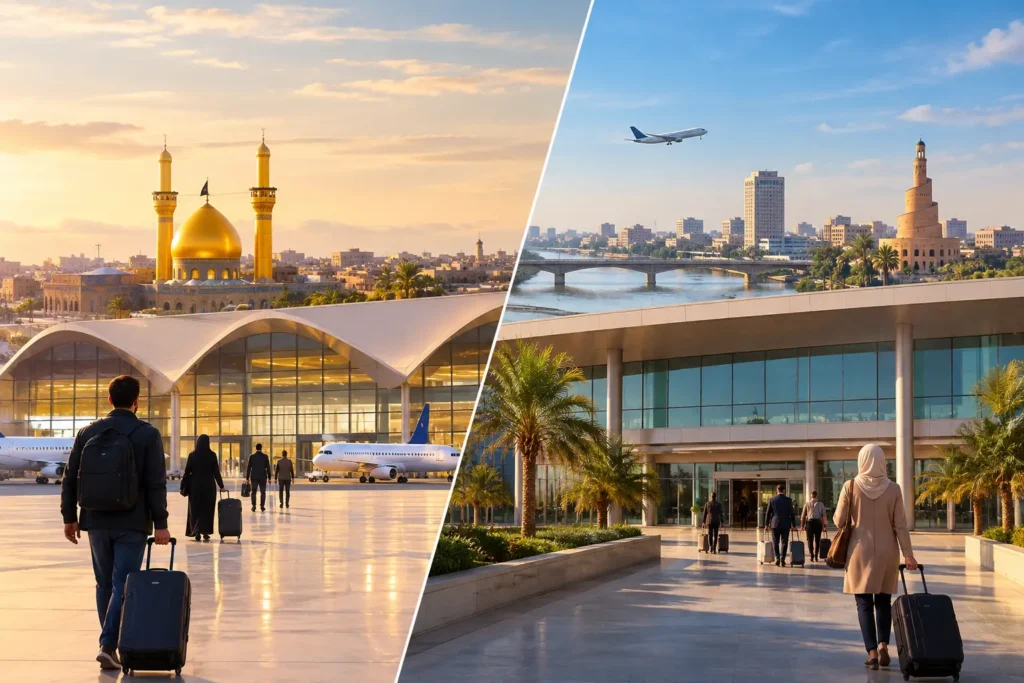
For many visitors, the choice between Najaf airport versus Baghdad airport shapes the rhythm of the whole Iraq itinerary. One arrival places you close to the spiritual heart of Najaf, Kufa and Karbala; the other opens the capital, major museums and a wider range of onward routes. Neither is simply ‘better’. The right airport is the one that puts your first meaningful stop within easy reach.
Iraq rewards travellers who plan by region rather than by airport name alone. Before booking, consider the purpose of your visit, the cities you want to see first, your flight options and how comfortable you are arranging a private transfer or domestic connection.
Najaf airport versus Baghdad airport at a glance
Najaf International Airport, commonly identified by the code NJF, is the natural gateway for visitors focused on religious travel in central and southern Iraq. It is particularly convenient for pilgrims travelling to the Shrine of Imam Ali in Najaf, as well as visitors continuing to Kufa or Karbala. The airport can be especially busy around major religious occasions, when demand for flights, transfers and accommodation rises significantly.
Baghdad International Airport, or BGW, serves Iraq’s capital and is generally the more flexible choice for travellers building a broader itinerary. Baghdad is a living cultural centre with historic streets, literary traditions, markets, museums and a food scene that deserves time rather than a brief stop. From here, travellers can also plan journeys north, south or towards nearby heritage sites.
In practical terms, Baghdad often has a wider selection of international flight options, while Najaf can offer a more direct arrival for a pilgrimage-centred stay. Airline schedules, transit rules and seasonal services can change, so confirm your exact route and baggage arrangements before committing to an itinerary.
Choose Najaf for pilgrimage and southern Iraq
Arriving in Najaf makes immediate sense when the spiritual purpose of your journey is central. The city is one of the most significant places in the Shia Muslim world, yet it is also a place of scholarship, family life, hospitality and quiet contemplation. Starting here gives visitors time to experience it respectfully, rather than treating it as a rushed stop between flights.
The journey from Najaf airport into the city is relatively short. Kufa, with its own profound religious and historical importance, is also close by. Karbala is commonly reached by road from Najaf, with journey times depending on traffic, the season and the route used. Many pilgrims prefer a pre-arranged driver, particularly on a first visit, as it makes arrival simpler after a long flight and helps with hotel drop-off.
Najaf is also a strong starting point for travellers who want to combine religious heritage with southern Iraqi culture. From the city, it is possible to continue towards the Euphrates region and, with more time, build an itinerary towards Babylon, Nasiriyah or the Mesopotamian Marshes. These are longer onward journeys, so they suit travellers with a driver, guide or carefully planned transport rather than a tightly timed weekend break.
There is another advantage to beginning in Najaf: the experience feels focused. For diaspora visitors reconnecting with family history, or pilgrims travelling with relatives, arriving near the heart of the visit can bring a welcome sense of ease. Accommodation in Najaf ranges from practical hotels near key religious sites to more comfortable stays suited to longer visits. Booking ahead is wise during high-demand periods.
Choose Baghdad for a wider cultural itinerary
Baghdad airport is usually the better arrival point for travellers who want to understand Iraq through its capital first. Baghdad is not merely a transport hub. It is a city of poets, booksellers, riverside evenings, traditional cooking and layered history, where ancient heritage and everyday urban life sit side by side.
A stay in Baghdad can include the Iraq Museum, the historic Al-Mutanabbi Street book market area, heritage districts and local restaurants, with the exact programme shaped by opening times and local guidance. It is also a useful base for travellers visiting family, attending business meetings or beginning a multi-city journey.
Baghdad’s location is helpful for certain heritage routes. Babylon is reachable south of the capital, while Samarra lies to the north. Travellers interested in a longer circuit can continue from Baghdad to Najaf and Karbala by road, then move further south. The Baghdad-to-Najaf drive is manageable, but it is not a quick airport transfer: allow several hours and avoid planning it immediately before an important appointment or onward flight.
The trade-off is that Baghdad requires a little more city navigation. The airport is outside the central districts, and journey times to hotels vary with traffic and the location of your stay. A confirmed hotel transfer or licensed driver is a sensible choice, especially if you arrive late or are travelling with children, older relatives or substantial luggage.
Flights, arrivals and the practical differences
Your flight itinerary may decide the question before your preferences do. Baghdad generally provides more possibilities for international arrivals and connections, which can make fares and timings more competitive. Najaf has important international services too, particularly for regional travellers and religious visitors, but availability is more dependent on date and season.
Do not choose an airport based on a route you saw months ago. Check the operating airline’s current timetable, visa requirements applicable to your nationality, transit conditions and any restrictions on checked baggage. If your route has a long layover, arriving closer to your first destination is often worth more than saving a modest amount on the ticket.
At either airport, keep your essential travel documents accessible, including hotel details, a local contact where available and evidence of onward plans if relevant to your visa arrangements. Dress respectfully, be patient at arrival formalities and keep some Iraqi dinar available for small immediate expenses once you are in the city. International cards are useful in some hotels and larger businesses, but cash remains practical for many day-to-day purchases.
Transfers: what first-time visitors should arrange
For most international visitors, the most comfortable option is to arrange a trusted airport transfer in advance. This is less about complication and more about giving yourself a calm first hour in a new country. Your driver can take you directly to your accommodation, help identify the correct entrance and remove the need to negotiate transport after an overnight flight.
In Najaf, a transfer is particularly useful if you are staying near the old city or travelling onwards to Karbala. In Baghdad, it is helpful because hotel locations can be spread across different districts and travel times vary. Ask for the driver’s name, vehicle details, price and payment method before arrival.
Independent travellers can still plan confidently, but should avoid overloading the first day. Schedule a light evening, a good meal and rest. Iraq is best appreciated with energy and attention, whether you are entering a shrine courtyard in Najaf or walking Baghdad’s cultural streets with a local guide.
Which airport is best for your itinerary?
Choose Najaf airport if your priority is Najaf, Kufa, Karbala or a pilgrimage-led journey. It is also the more direct choice when you want your first days to be centred on religious heritage and the hospitality of Iraq’s holy cities.
Choose Baghdad airport if you want to explore the capital in depth, need the broadest possible flight choice or are planning a route that includes northern and central destinations alongside the south. It is the stronger all-round gateway for a first trip built around Baghdad’s culture, history and onward travel.
For travellers with enough time, the best answer may be both: arrive in one city and depart from the other. An open-jaw itinerary can reduce backtracking and allow the journey to unfold naturally, from the capital’s creative energy to Najaf’s spiritual depth. Stay In Iraq can help travellers compare accommodation bases as they shape that route.
The more useful question is not which airport is superior, but what kind of Iraq you hope to encounter first. Choose the arrival that gives you time to settle in, meet people and begin with intention. That first city will not just be a point on a map – it will be your introduction to a country of extraordinary memory, generosity and living culture.