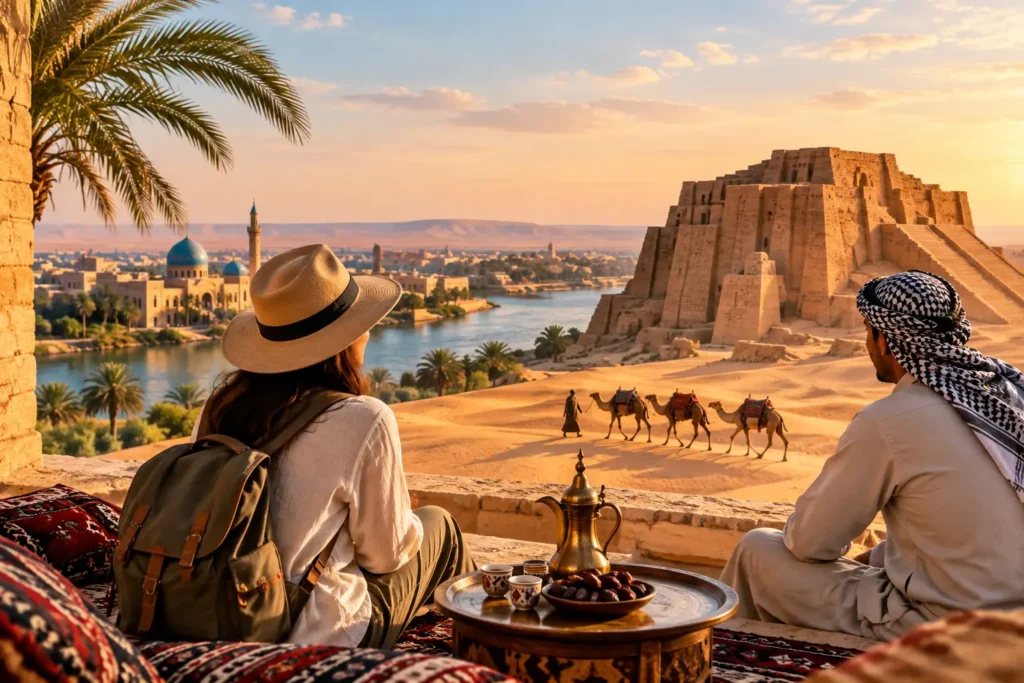
The best Iraqi desert experiences are not built around crowds, fixed camps or polished tourist trails. They begin with wide horizons, ancient stone, strong tea shared in the open air and the local knowledge that turns an unfamiliar landscape into a meaningful journey. Iraq’s deserts hold remarkable traces of trade, faith, empire and daily life, but they reward travellers who plan patiently and travel with respect.
For most visitors, the most memorable desert journey combines an archaeological site with time on the road and a trusted local guide. Conditions, access permissions and road routes can change, so the desert is one part of Iraq where flexibility is as valuable as a good camera.
1. Stand inside the ancient city of Hatra
Hatra, also known locally as Al-Hadar, is one of Iraq’s most striking desert sites. Set within the open landscape of Nineveh Governorate, this fortified city once sat on important routes between Mesopotamia and the wider region. Its scale is the first surprise: broad walls, circular planning and monumental temples rise from a setting that makes the city feel both remote and immediate.
The best way to experience Hatra is slowly. Look closely at the stone carvings, the columns and the blend of architectural influences that reflects the city’s role as a meeting point of cultures. Morning or late afternoon light is particularly rewarding for photographers, while a guide can bring context to features that may otherwise appear as beautiful ruins alone.
Access to Hatra should always be confirmed before travelling. A well-organised visit from Mosul or with a specialist Iraq itinerary is generally more practical than attempting to arrange transport independently.
2. Visit Ukhaidir Fortress near Karbala
Ukhaidir Fortress offers a different kind of desert drama. Located south-west of Karbala, this vast early Islamic fortified complex is known for its high walls, imposing gateway and carefully designed interior spaces. It is a powerful reminder that Iraq’s desert was never empty – it connected settlements, pilgrims, merchants and rulers across long distances.
Walking through Ukhaidir, visitors can trace corridors, courtyards and chambers that reveal both defensive purpose and refined planning. The fortress is often paired with a visit to Karbala, making it a strong choice for travellers who want to combine religious heritage with a quieter historical excursion beyond the city.
Bring water, sun protection and comfortable shoes. There is limited shade, and the experience is far more enjoyable when you are prepared for the heat and open terrain.
3. Seek out the desert palaces of Karbala Governorate
The landscapes around Karbala hold lesser-known heritage sites that deserve more attention from curious travellers. Al-Shabaka Palace and Al-Abyadh Palace are among the structures that reflect the region’s long history of movement through the desert. They may not offer the scale of Ukhaidir, but that is part of their appeal.
These sites create a sense of discovery. Their weathered walls, quiet surroundings and distance from the usual visitor routes make them especially rewarding for travellers interested in architecture, archaeology and landscape photography. They also show why a local driver or guide matters: locations can be difficult to find, and the journey itself often becomes part of the experience.
Do not treat these places as a checklist. Ask your guide about their local names, histories and condition, and allow time for unhurried exploration rather than rushing from one stop to the next.
4. Follow the open landscapes of Wadi Hauran
Wadi Hauran is one of western Iraq’s most notable natural features, a vast valley system cutting through the Anbar landscape. The scenery is not defined by rolling dunes alone. Instead, it offers dry wadis, escarpments, rocky ground and immense skies that give a clearer sense of the country’s western geography.
This is an experience for travellers who appreciate the journey as much as the destination. The landscape is especially compelling in the softer light of early morning and late afternoon, when its colours shift from pale limestone to warm gold. Birdwatchers, geographers and photographers may find the changing textures as absorbing as history enthusiasts do.
Wadi Hauran should be visited only with knowledgeable local arrangements and an appropriate vehicle. Mobile coverage, facilities and marked routes cannot be assumed. It is not a place for improvised off-road driving, particularly for first-time visitors to Iraq.
5. Spend a considered night beneath the desert sky
A desert night can be one of the most personal Iraqi travel experiences, but it should be arranged responsibly. There are not yet standardised luxury desert-camp networks across Iraq in the way some visitors may expect elsewhere. The more authentic option is usually a private camp or hosted evening arranged through a reputable local operator, often in the western desert or on the desert edge near heritage routes.
The pleasure lies in simplicity: a meal prepared over coals, Iraqi tea, conversation and a sky undimmed by city lights. For diaspora travellers, these evenings can feel like a return to stories heard from family. For international visitors, they offer a chance to see Iraqi hospitality in its most direct form – generous, unforced and deeply human.
Choose an operator that provides suitable transport, drinking water, bedding, food and clear information about the exact location. Respect local customs in dress and behaviour, keep noise low, and leave no waste behind. A desert camp should leave the landscape as quiet as it found it.
6. Pair Uruk with the southern desert plain
Near Samawah, the ancient city of Uruk rises from a dry plain that feels vast even by Iraqi standards. Uruk is associated with some of humanity’s earliest urban developments, writing traditions and monumental architecture. Its setting is not a classic dune desert, yet the open southern landscape is central to its atmosphere.
A visit here offers a powerful contrast to Iraq’s busy cities and shrine centres. The site invites travellers to consider how an urban civilisation emerged in a landscape that still appears boundless. The remains are subtle in places, so a guide or well-informed companion adds real value, helping visitors understand what lies beneath the mounds and how the city shaped world history.
Combine Uruk with a stay in Samawah or a wider southern Iraq itinerary rather than treating it as a quick roadside stop. The slower pace gives space for the site’s significance to settle in.
7. Take the desert road as part of the experience
Some of the best Iraqi desert experiences happen between major sites. A drive from Karbala or Najaf towards the western plateau reveals changing ground, isolated structures, grazing animals and occasional roadside tea stops where conversation comes easily. These journeys offer a perspective on Iraq that city-based itineraries cannot provide.
The road should never be romanticised at the expense of sensible planning. Distances can be longer than they appear on a map, summer heat can be intense, and facilities may be sparse. Travel in daylight, carry more water than you think you will need, and make sure your driver knows the route and current access conditions.
Planning Iraqi desert experiences with confidence
The desert is best approached as a guided extension of an Iraq journey, rather than a completely independent expedition. Start with your accommodation in a well-connected city such as Karbala, Najaf, Mosul or Samawah, then arrange day trips or an overnight experience with an established local contact. Stay In Iraq can help travellers begin by identifying suitable bases for their route and building an itinerary around realistic travel times.
Spring and autumn are generally the most comfortable seasons for desert travel. Summer journeys require greater care because daytime temperatures can be severe, while winter evenings can be unexpectedly cold. Wear modest, breathable clothing, bring a light layer for after sunset, and ask before photographing people, private homes or religious sites.
Most importantly, leave room for the unexpected kindness that defines travel in Iraq. A planned stop at a fortress or archaeological site may be memorable, but a shared cup of tea beside the road can become the moment you carry home. Travel prepared, listen to local guidance, and let the desert reveal Iraq at its own measured pace.