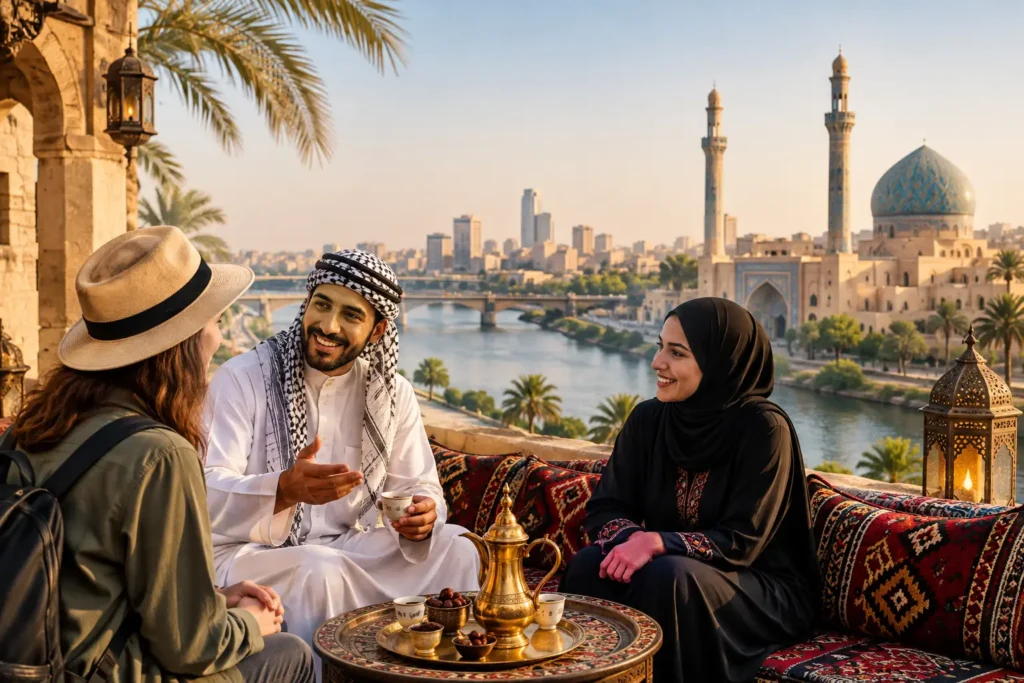
A warm welcome in Iraq often begins before a word is fully understood. A greeting offered in Arabic, Kurdish or English can quickly become a conversation, a cup of tea, and practical help with the next stage of your journey. So, what language is spoken in Iraq? The short answer is Arabic and Kurdish, but the fuller answer reveals a country shaped by many living languages, communities and regional identities.
For travellers, you do not need to be fluent to feel at ease. Learning a few greetings, knowing what to expect in different parts of the country, and approaching conversations with patience will carry you a long way.
What language is spoken in Iraq?
Arabic and Kurdish are Iraq’s two official languages. Arabic is used widely across much of the country, including Baghdad, Basra, Najaf, Karbala, Mosul and many cities of central and southern Iraq. Kurdish is official alongside Arabic and is the principal language across the Kurdistan Region, including Erbil, Sulaymaniyah, Duhok and Halabja.
Yet Iraq’s linguistic map is richer than a two-language answer suggests. Turkmen, Syriac and Armenian are also spoken in particular communities, while several forms of Neo-Aramaic remain part of daily life and religious heritage for Assyrian, Chaldean and Syriac Christian communities. In areas where these communities are concentrated, local languages may appear on signs, be used in schools, or be heard in homes, markets and places of worship.
This diversity is not a barrier to travelling in Iraq. It is one of the most meaningful parts of the experience. Language reflects the country’s deep history as a meeting point of civilisations, faiths and trade routes, while also showing the distinct character of each city and region.
Arabic: the language most visitors will encounter
Arabic is the most useful language for visitors travelling through federal Iraq. In everyday conversation, people generally speak Iraqi Arabic, a warm and expressive group of dialects that differs in pronunciation and vocabulary from the Arabic heard in the Gulf, the Levant or North Africa.
Modern Standard Arabic, known as fusha, is used in formal writing, news, official announcements and much written communication. It is also broadly understood by educated Arabic speakers. However, the Arabic you hear in a Baghdad café, a Basra market or on a shared taxi is more likely to be Iraqi colloquial Arabic.
There are local variations, too. Baghdadi speech has its own familiar rhythm; southern dialects can sound noticeably different; and Mosul has linguistic features shaped by its particular history. Visitors are not expected to recognise these distinctions. The key point is that Arabic is the practical starting point in most destinations outside the Kurdistan Region.
If you have studied standard Arabic, use it confidently and simply. Most people will appreciate the effort and will often adjust their speech, repeat a phrase, or switch to English where possible. A willingness to communicate matters far more than perfect grammar.
A few useful Arabic phrases
These phrases are a good beginning, especially when delivered with a smile:
- As-salamu alaykum – peace be upon you, a widely used greeting.
- Shukran – thank you.
- Min fadlak or min fadlich – please, when speaking to a man or woman respectively.
- La, shukran – no, thank you.
You may hear the reply wa alaykum as-salam after your greeting. It is a simple exchange, but one that signals courtesy and respect from the first moment.
Kurdish in Erbil, Sulaymaniyah and Duhok
Kurdish is central to everyday life in the Kurdistan Region of Iraq. Arabic is also official and commonly understood, particularly in business, government and among people who have travelled or worked elsewhere in Iraq. Still, learning even a small amount of Kurdish is a thoughtful gesture when visiting Erbil, Sulaymaniyah, Duhok or smaller towns and mountain communities.
The two Kurdish varieties travellers are most likely to encounter are Sorani and Kurmanji. Sorani is especially prevalent in and around Erbil and Sulaymaniyah. Kurmanji is widely spoken in Duhok and northern areas. They are closely related but not identical, so vocabulary and pronunciation can vary between places.
A few straightforward phrases can help create an immediate connection. Slaw means hello, and supas means thank you. These are easy to remember and warmly received. Do not worry if your pronunciation is imperfect: local people are generally generous with visitors making an effort.
In the Kurdistan Region, you will often see Kurdish written in an Arabic-based script. In some contexts, particularly cultural material and online information, Latin-script Kurdish may also appear. Road signs and public information frequently include Arabic and English as well, which makes independent travel increasingly manageable.
Will English be enough for travel in Iraq?
English is widely useful, but it should be treated as a helpful bridge rather than the only language you will need. It is common in hotels, larger restaurants, airports, universities, tourism businesses and among many younger Iraqis. In cities such as Baghdad, Erbil, Najaf and Basra, travellers can often manage key arrangements in English, particularly when booking accommodation or speaking with guides and drivers.
The experience changes outside major centres. In family-run shops, local eateries, rural areas and traditional markets, English may be limited. This is where a translation app, offline map, written addresses and a few Arabic or Kurdish phrases become genuinely useful.
For practical tasks, save your hotel name and address in both English and Arabic or Kurdish where possible. Screenshots are often more useful than attempting to pronounce an unfamiliar street name. If you are travelling between cities, ask your accommodation host to write down your destination, particularly if you are using local transport.
It also helps to remember that communication is not only verbal. Iraqis are known for their hospitality, and people frequently go out of their way to assist a visitor who is polite, calm and clear about where they are trying to go. A gesture, a map pin and a shared laugh can solve more than travellers expect.
Languages you may hear beyond Arabic and Kurdish
Iraq’s cultural richness is heard as much as it is seen. In Kirkuk and parts of northern Iraq, you may hear Iraqi Turkmen, a Turkic language with a long local history. In the Nineveh Plains and in some communities of Baghdad and the north, Syriac and Neo-Aramaic varieties continue to connect families to ancient linguistic traditions.
These languages carry particular cultural and religious significance. Visitors to churches, heritage sites or community areas should avoid assuming that Arabic is everyone’s first language, even where it is readily spoken. Listening with curiosity is a better approach than trying to categorise people quickly.
Many Iraqis are multilingual. Someone may speak Iraqi Arabic at work, Kurdish with neighbours, a heritage language at home and English with international guests. That flexibility is an everyday reflection of Iraq’s layered identity.
Language etiquette that makes a difference
A few habits will make conversations more comfortable. Begin with a greeting before asking for help, especially in smaller shops, taxis and family-run businesses. Speak at a measured pace if you are using English, and avoid treating limited English as a lack of knowledge or education. Language confidence varies, but hospitality does not.
It is also considerate to ask before photographing people, homes or religious spaces. If a conversation turns to personal background, let the other person lead. Iraq is home to many communities, and a respectful interest in someone’s city, food, family traditions or favourite local place is usually a far better conversation starter than broad assumptions about the country.
When travelling for pilgrimage, Arabic will be especially useful in Najaf, Karbala, Kadhimiya and Samarra. In these spiritually significant cities, respectful greetings and a modest, observant manner will be appreciated as much as any phrasebook vocabulary.
Preparing before you arrive
Download Arabic and Kurdish language packs for your translation app before departure, since mobile data can vary during long road journeys. Keep essential addresses saved offline, carry your accommodation details, and learn how to say thank you, please, yes and no. These small preparations make travel feel less transactional and more connected.
Stay In Iraq can help travellers pair that cultural preparation with practical planning, from choosing where to stay to understanding the character of each destination. The country is easier to navigate when you have reliable local context behind you.
You do not need flawless Arabic or Kurdish to travel meaningfully in Iraq. Arrive with a handful of words, an open manner and genuine respect, and the conversations you remember may become as memorable as the ancient sites, sacred cities and generous tables that welcome you along the way.