Babylon does not feel like a museum preserved behind glass. It is a vast archaeological landscape where sun-baked brick, ancient foundations and later reconstructions sit beneath the open Iraqi sky. This Babylon ruins visitor guide helps you approach one of humanity’s most influential cities with realistic expectations, practical preparation and the respect a place of this significance deserves.
For travellers drawn to the Cradle of Civilisation, Babylon is not simply a name from schoolbooks or biblical tradition. It is a chance to stand close to the city associated with Hammurabi, Nebuchadnezzar II, monumental gateways and stories that have travelled across millennia. The experience is quieter and more reflective than many expect – and that is part of its power.
Why Babylon still matters
Babylon rose to prominence in southern Mesopotamia, on the fertile plain between the Tigris and Euphrates. It became a major political, religious and cultural centre, particularly under the Neo-Babylonian Empire in the sixth century BCE. Its influence reached far beyond Iraq through law, astronomy, architecture, literature and religious memory.
The city is closely associated with Nebuchadnezzar II, whose building programme transformed Babylon into a remarkable imperial capital. The famous Ishtar Gate, the Processional Way and the city’s immense walls helped create an image of Babylon that endured long after its decline. Although the Hanging Gardens remain one of history’s great debates, the wider story needs no embellishment: Babylon was genuinely one of the ancient world’s great urban centres.
Today, the site is a UNESCO World Heritage property near Hillah in Babil Governorate, roughly 90 kilometres south of Baghdad. Visiting offers a useful corrective to the idea that ancient Iraq exists only in distant collections abroad. Here, the scale of Mesopotamian civilisation is grounded in the landscape where it developed.
What you will see at the Babylon ruins
Set expectations before arriving. Babylon is an archaeological site, not a fully reconstructed ancient city. Many original mud-brick structures have weathered over centuries, and some areas include modern or twentieth-century reconstructions. A knowledgeable guide can help distinguish what is ancient, what has been stabilised and what has been rebuilt to suggest the city’s former form.
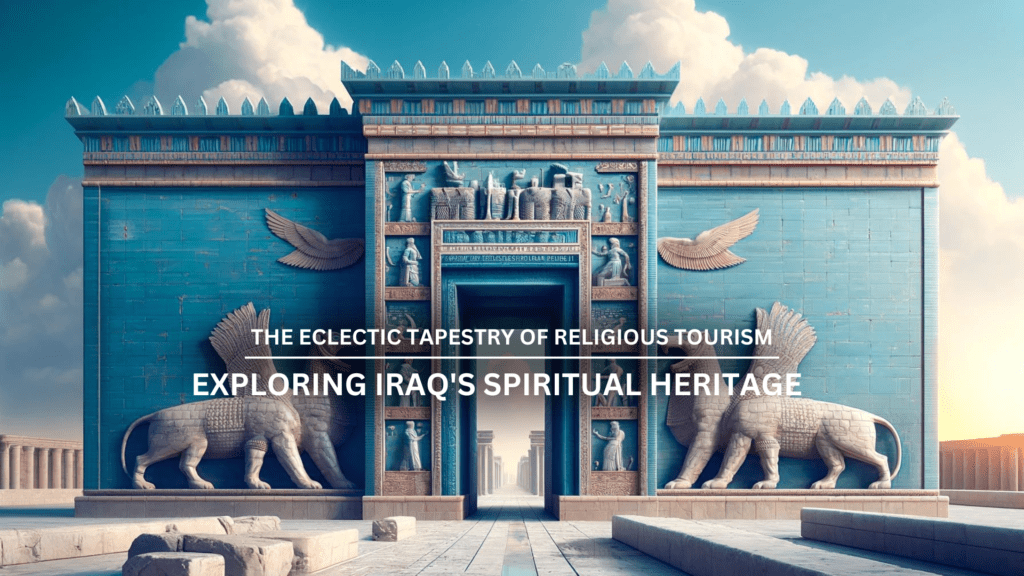
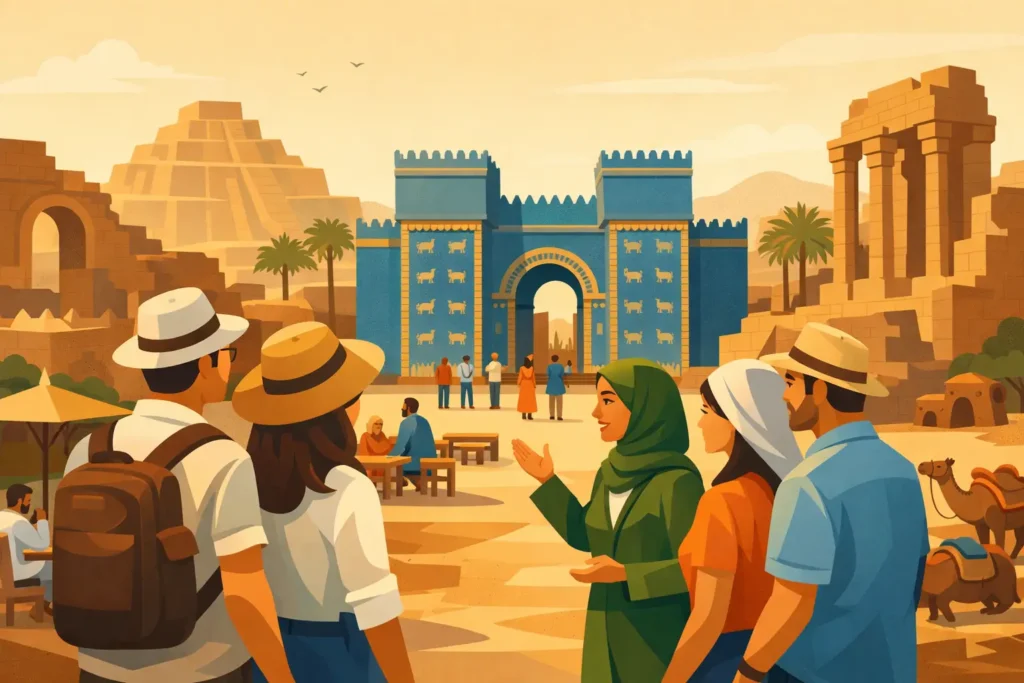
The Processional Way is among the most evocative features. This ceremonial route once led towards the Ishtar Gate and was decorated with vivid animal reliefs. The original glazed-brick Ishtar Gate is displayed in Berlin, but the site still conveys the route’s ceremonial importance and the ambition of Babylonian urban design.
Look out, too, for the Lion of Babylon, a striking basalt sculpture that has become one of the country’s best-known archaeological symbols. Nearby remains and reconstructed walls give visitors a sense of the city’s royal and sacred precincts. The foundations associated with major temples are less visually immediate, but their importance becomes clearer when a guide explains the city layout and the relationship between religion, governance and daily life.
A visit is often strongest when you resist the urge to rush from landmark to landmark. Pause to look across the plain. The distance between features, the texture of the brickwork and the sheer footprint of the site reveal more than a quick photograph ever can.
Planning your Babylon ruins visit
Babylon is usually visited as a day trip from Baghdad or as part of a wider stay in Hillah, Karbala or Najaf. Baghdad offers the broadest choice of accommodation and transport, while Hillah places you closer to the site and can suit travellers who prefer a gentler pace. Karbala and Najaf may fit naturally into an itinerary that combines heritage with religious travel, though journey times and route planning should be discussed locally.
For most international visitors, arranging a private driver or an organised guide is the most practical option. Public transport may be possible for experienced travellers with Arabic skills and local knowledge, but it is not the easiest way to visit an archaeological site with limited onward connections. A driver also gives you flexibility around heat, entry arrangements and stops in Hillah.
Opening times, ticket procedures and photography rules can change, particularly around public holidays, religious occasions or conservation work. Confirm the latest details with a reputable local operator, your accommodation or the relevant site authorities shortly before travelling. Do not rely on an old social media post as your only source of information.
Choose the right season and time of day
The cooler months, broadly from October to April, are generally the most comfortable for outdoor heritage visits. In summer, temperatures can become intense, so an early morning start is sensible. Bring water, a hat, sunglasses and sun protection, and wear light clothing that covers shoulders and knees comfortably.
The site involves uneven ground, dust and substantial walking. Closed, supportive shoes are better than sandals, especially if you plan to spend time examining foundations and pathways. There may be limited shade and facilities, so carry essentials rather than assuming services will be available on site.
Allow enough time for context
Give Babylon at least two to three hours, and longer if you are travelling with an archaeologist, historian or specialist guide. The visible remains can appear understated without interpretation. With context, a wall becomes evidence of a palace complex and a raised mound becomes part of an urban world that shaped later civilisations.
If your itinerary allows, combine the visit with time in Hillah rather than treating the area as a brief stop between larger cities. Eating locally, speaking with residents and seeing modern life around ancient landscapes offers a more human understanding of Iraq than a checklist ever could.
Respectful etiquette at an ancient Iraqi site
Babylon is part of Iraq’s living national heritage, not a film set. Treat the ruins with the same care you would give to a cathedral, shrine or historic home. Do not climb on fragile walls, remove fragments, carve names into surfaces or step beyond marked areas. Even small actions can damage mud-brick archaeology that has survived for thousands of years.
Dress modestly and practically. This is not about a rigid tourist uniform, but about showing consideration in a public cultural setting. Ask before photographing staff, local visitors or families, and be especially mindful if areas are used for official events or school visits.
A respectful approach also means listening to local interpretation. Babylon has been studied by international archaeologists, but it belongs first to the landscape, communities and cultural memory of Iraq. Iraqi guides often bring a perspective that connects ancient history with contemporary pride, hospitality and everyday knowledge of the region.
How to build Babylon into a wider Iraq itinerary
Babylon works particularly well within a southern Iraq route. From Baghdad, travellers can continue towards Karbala and Najaf, important centres of faith and learning, or travel further south towards the marshlands, Nasiriyah and the ancient sites of Ur and Eridu. Each place reveals a different chapter of Iraq’s story.
It depends on your interests and available time. History-focused travellers may want several days for Mesopotamian sites, while visitors on a shorter trip can pair Babylon with Baghdad’s museums and historic quarters. Diaspora travellers may prefer to leave room for family visits and unplanned conversations, which are often among the most memorable parts of travelling in Iraq.
When choosing where to stay, prioritise a location that makes your next day realistic rather than chasing the lowest rate at the edge of a city. A well-located hotel in Baghdad, Hillah, Karbala or Najaf can make early departures, driver collection and evening meals far easier. Stay In Iraq can help travellers compare accommodation options as they shape a route that suits their pace.
A final thought before you go
Babylon rewards curiosity more than spectacle. Arrive prepared for heat, open space and archaeological remains that require imagination. Leave space for the quieter moment, too: the recognition that this ground once held a city whose ideas, stories and artistic ambition still echo across the world – and that Iraq welcomes you to encounter that legacy where it began.