You notice it quickly in Iraq – distances on the map can look modest, but each journey connects a different mood, landscape and rhythm of life. Knowing how to travel between Iraqi cities is not just about getting from Baghdad to Najaf or Erbil to Mosul. It is about choosing the right balance of comfort, flexibility, budget and local experience.
For many international visitors, this is one of the biggest practical questions before arrival. The good news is that intercity travel in Iraq is far more achievable than many first-time travellers expect. The best option depends on where you are going, how much time you have, and whether you prefer independence or support along the way.
How to travel between Iraqi cities: your main options
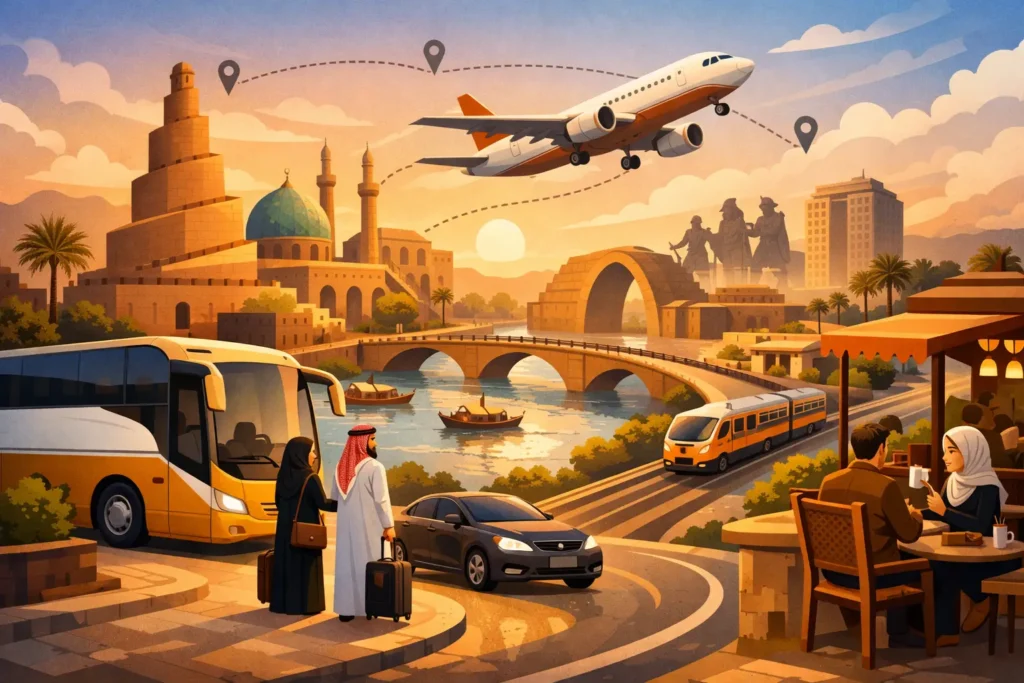
Most travellers move between Iraqi cities in one of four ways: domestic flights, private car transfers, shared taxis and, in some cases, local buses or minibuses. There is no single perfect method for every route. A short religious journey between Najaf and Karbala calls for a different approach from a longer trip between Baghdad and Basra.
If your priority is speed, domestic flights are the clearest choice on longer routes. If you want door-to-door convenience and the ability to stop along the way, a private driver is often the most comfortable option. Shared taxis remain a common and practical part of travel culture in Iraq, especially for regional routes, while buses can suit confident travellers with flexible schedules.
The key is not to think of Iraqi transport as one fixed system. It works more like a network of practical local habits, and once you understand that, planning becomes much easier.
Domestic flights for long distances
Domestic flights are often the simplest way to cover larger distances, especially if you are travelling between the north and the south or trying to make the most of limited time. Routes involving Baghdad, Basra and Erbil are usually the most relevant for visitors, and flights can save many hours compared with road travel.
This option suits business travellers, short-stay visitors, photographers working to a schedule and pilgrims combining multiple cities in one trip. It also makes sense if you are arriving internationally and want to continue onwards without a long overland transfer.
That said, flights are not always the best choice for every itinerary. They reduce travel time, but they also remove the texture of the road – the small tea stops, changing landscapes and gradual shift from one region to another. If Iraq is a destination you want to feel as well as see, road travel can be more rewarding.
Private drivers and car transfers
For many international travellers, this is the most reassuring option. A private driver offers flexibility, direct routing and a much easier experience if you do not speak Arabic or Kurdish. It is particularly useful on routes where public transport information is limited or where you want to visit more than one place in a day.
A driver can also make a major difference in comfort. Instead of negotiating stations, departure times or shared vehicle arrangements, you travel on your own schedule. This works especially well for couples, families, small groups, journalists and diaspora travellers visiting relatives in multiple cities.
Private road travel is often the best fit for routes such as Baghdad to Babylon, Najaf to Karbala, or Erbil to smaller towns that are less straightforward by public transport. It is usually more expensive than shared options, but the extra cost often buys clarity and peace of mind.
Shared taxis and service cars
Shared taxis are one of the most common ways locals travel between Iraqi cities. They are practical, widely used and often faster than waiting for formal bus timetables. In many places, you go to a known transport area or garage, find the route you need, and either wait for the car to fill or pay more to leave sooner.
For travellers comfortable with a little spontaneity, this can be an excellent middle ground. You get a direct road connection without the cost of a fully private transfer. On popular routes, shared taxis can be straightforward and efficient.
The trade-off is predictability. Vehicles vary, departure times are flexible rather than fixed, and language can be a barrier if you are unfamiliar with local transport customs. If you prefer highly structured travel, shared taxis may feel uncertain. If you are adaptable and patient, they can be one of the most authentic and useful ways to move around.
Buses and minibuses
Buses and minibuses exist on some routes, but they are not always the first recommendation for international visitors planning a smooth multi-city journey. Services can be less clearly signposted, less comfortable on long trips and more dependent on local knowledge.
Still, they can work well for budget-conscious travellers or those already familiar with the region. On shorter journeys, they may be perfectly adequate. The question is less whether buses exist and more whether they suit your style of travel. If you want convenience and certainty, other options are usually easier.
Choosing the right transport for your route
The most practical answer to how to travel between Iraqi cities is often route-specific. Iraq is not one experience from north to south. Travel conditions, road habits and available services vary by region and by city.
Baghdad to Najaf, Karbala or Babylon
These are some of the most common journeys for cultural and religious travellers. Because the distances are manageable by road, a private driver or taxi is usually the simplest choice. It allows for direct travel and leaves room for changes in timing, especially if you are visiting shrines, historical sites or family connections on the same day.
For Babylon, road travel is especially appealing because the journey itself is short enough to keep the day comfortable. For Najaf and Karbala, many travellers combine the two cities within one broader itinerary.
Baghdad to Basra
This is a longer route, so the best option depends on your priorities. If you are short on time, a domestic flight is the most efficient solution. If you want to experience southern Iraq gradually and do not mind a longer day on the road, a private car can work very well.
Basra deserves time, so it is worth avoiding an exhausting transfer if your schedule is already tight. If you arrive tired, you lose some of what makes the city memorable.
Baghdad or Basra to Erbil
For north-south travel, flying is often the most sensible choice. The time saved is significant, and for many visitors this makes a multi-city Iraq itinerary much more realistic. Road travel is possible, but it is a longer commitment and best suited to travellers with more time and a clear reason to make the journey overland.
Erbil to Mosul or nearby northern cities
Road travel is common here, usually by private car or taxi. Distances are more manageable, and this can be one of the easier parts of an Iraq itinerary to arrange once you are on the ground. If you want flexibility for day trips or photography stops, private transport is especially useful.
Practical tips before you set off
Build extra time into your plans. Even when a route looks simple, departure times, traffic and local logistics can shift. Iraq rewards travellers who leave room in the day rather than trying to move with minute-by-minute precision.
Carry cash. While digital payments are becoming more common in some settings, transport between cities is often easier to handle in cash, especially for taxis and informal arrangements.
Keep your hotel or host informed about your next move. Accommodation teams can often help organise trusted drivers or explain the most practical route for that day. This is one reason platforms like Stay In Iraq matter – good local travel planning often begins with people who understand the realities of each city.
It also helps to have your destination written clearly in Arabic if you do not speak the language. For travel in the Kurdistan Region, Kurdish may also be helpful depending on the route.
Confidence matters as much as transport
Intercity travel in Iraq becomes much less complicated once you stop expecting one universal system and start planning city by city. Some journeys are best by air, some are better by road, and some depend entirely on how much independence or local support you want.
The encouraging part is this: Iraq is not a destination where you must remain in one place. With thoughtful planning, travellers can move between its religious centres, ancient sites, modern cities and welcoming communities with much more ease than outsiders often assume.
Choose the route that fits your time, budget and comfort level, and let the journey itself become part of what you remember.