Erbil rewards travellers who like cities with layers. One moment you are standing beneath the walls of a citadel believed to be among the world’s oldest continuously inhabited sites, and the next you are drinking tea in a modern café, watching local life unfold at an easy pace. If you are researching things to do in Erbil, the city offers a rare mix of deep history, warm hospitality and practical comfort that makes it an especially good starting point for travelling in Iraq.
For many visitors, Erbil feels accessible in the best sense of the word. It is a city where you can move between heritage, food, markets and contemporary neighbourhoods without feeling rushed. That balance matters. Some travellers want archaeology and religious heritage, others want atmosphere and conversation, and most want both. Erbil delivers that combination naturally.
Things to do in Erbil if it is your first visit
The best way to understand Erbil is not by rushing through landmarks, but by letting the city reveal its rhythm. Start in the historic core, then give yourself time for food, walking and unplanned stops. A day packed too tightly can miss the real charm of the city, which often appears in small interactions rather than staged attractions.
Visit the Erbil Citadel
If there is one place that anchors the city, it is the Erbil Citadel. Rising above the surrounding streets, this ancient settlement is both a landmark and a living symbol of the region’s long human story. Walking around its perimeter is impressive enough, but stepping inside gives you a better sense of its scale and significance.
The citadel is not a polished museum quarter in the way some travellers might expect from Europe. That is part of its character. It feels historic, regional and deeply rooted in place. Depending on restoration work and access at the time of your visit, some areas may be easier to explore than others, so flexibility helps. Even when certain sections are quieter, the experience remains meaningful because the site itself carries so much historical weight.
Wander through the bazaar below the citadel
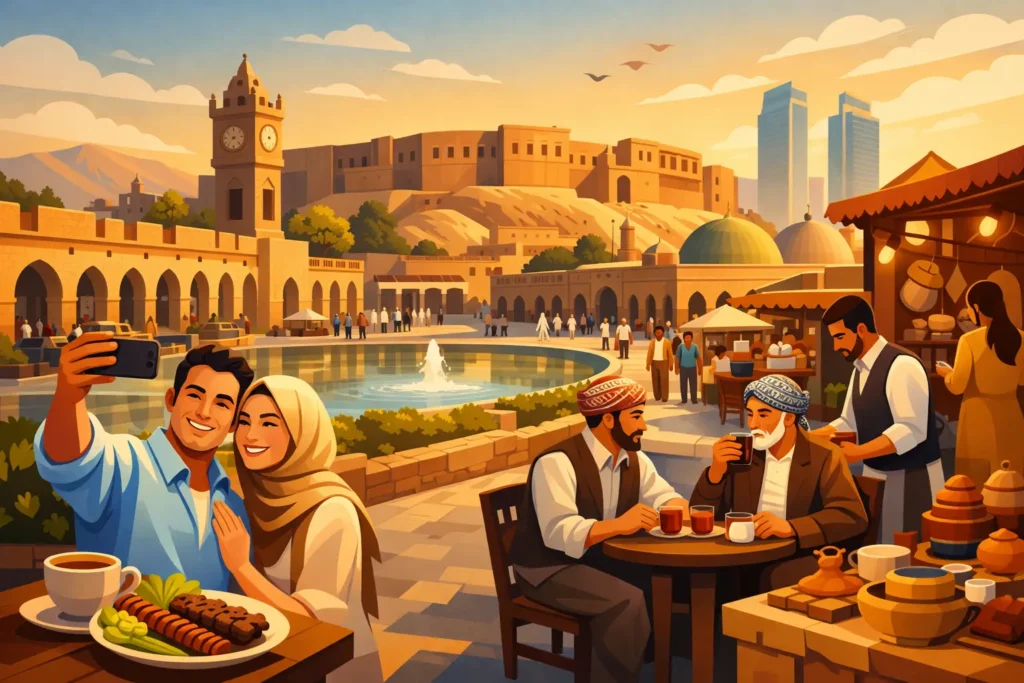
At the foot of the citadel, Erbil’s bazaar provides a completely different energy. This is where the city feels most immediate – fabrics, spices, household goods, sweets, perfume, tea shops and busy conversations all sharing the same space. It is worth slowing down here rather than treating it as a quick photo stop.
The bazaar is ideal for travellers who want contact with everyday life. You may find handcrafted items and local products, but just as valuable is the atmosphere itself. Morning and late afternoon often feel more comfortable for walking, especially outside winter. As with many traditional markets, part of the pleasure is not knowing exactly what you will find.
Spend time in Shar Park and the central square
Just beyond the old quarter, the city opens into public spaces where local families, students and workers move through the day. Shar Park and the surrounding central square are useful places to pause and watch Erbil as it is now, not only as it was centuries ago.
This area helps first-time visitors connect the historical and modern parts of the city. It is also a good reset after the sensory density of the bazaar. If you are travelling with family or simply want a slower hour between major stops, this part of Erbil feels easy and welcoming.
Cultural things to do in Erbil beyond the obvious
Erbil is often introduced through its citadel, and rightly so, but the city has more depth than a single monument. The strongest visits usually combine major sites with smaller cultural experiences that reveal how people live, remember and gather.
Explore Erbil Civilisation Museum or local heritage spaces
For travellers interested in Mesopotamian history, regional archaeology and Kurdish heritage, a museum visit adds essential context. Collections and displays can vary, and opening patterns are worth checking locally, but giving time to a museum helps make sense of the wider landscape you are travelling through.
This is especially worthwhile if Erbil is only one stop on a broader Iraq itinerary. Objects, inscriptions and historical material can turn later visits to ancient sites into something richer and more connected. If you prefer travel with substance rather than a checklist, this is time well spent.
Visit religious and cultural landmarks with respect
Erbil’s identity has been shaped by different communities over centuries, and that diversity appears in its religious and cultural sites. Depending on access and your interests, visiting mosques or heritage quarters can offer a more grounded understanding of the city’s social fabric.
The key is to approach these places respectfully. Dress modestly, ask before photographing people, and remember that active places of worship are not simply attractions. For many international visitors, these moments become some of the most memorable because they feel personal rather than performative.
See Sami Abdulrahman Park
One of the largest green spaces in the city, Sami Abdulrahman Park offers another side of Erbil altogether. Wide paths, open lawns, fountains and evening footfall make it a popular place for families and groups of friends.
It is not an ancient site, and that is precisely why it belongs on the list. A city guide should show how people live in the present, not only what they inherited from the past. If you visit near sunset, the park gives you a relaxed view of local life and a welcome break from denser urban areas.
What to eat and where to slow down
Some of the best things to do in Erbil are tied to the table. Food here is not just a practical stop between landmarks. It is one of the clearest ways to experience hospitality, regional flavour and the city’s social warmth.
Try Kurdish and Iraqi dishes in local restaurants
A proper meal in Erbil should go beyond familiar grilled staples, though you will find those too. Look for dishes such as dolma, biryani, kebab, lentil soup, fresh flatbread and rice-based plates served with herbs, yoghurt and pickles. Shared meals are common, and portions are often generous.
If you are unsure where to begin, ask locals or your accommodation host what they personally recommend. The best meals are not always in the most polished venues. Sometimes a simple, busy restaurant tells you more about a city than somewhere designed only for visitors.
Stop for tea and sweets
Tea culture in Erbil deserves its own place in your plans. A small glass of tea in a market-side café or casual teahouse can become one of the most human parts of your visit. It gives you time to observe, greet people and absorb the pace of the city.
Pair it with local sweets if you can. Even a short stop can shift your day from sightseeing to actual presence. That difference matters in a city like Erbil, where hospitality is often expressed in small gestures rather than grand presentations.
Easy day experiences around the city
Not every traveller wants a tightly packed schedule. Erbil works well for people who prefer a lighter pace, particularly if the city is the first stop of a longer trip.
Walk modern districts and cafés
Parts of Erbil feel contemporary, polished and comfortable, with shopping areas, cafés and restaurants that make the city easy to navigate for international visitors. This does not replace the heritage side of Erbil, but it rounds it out.
For diaspora travellers, this contrast can be especially moving. For first-time visitors, it is often reassuring. You can spend the morning in one of the region’s most historically significant urban spaces and the evening in a stylish café discussing the day over coffee. Both are real parts of Erbil.
Use Erbil as a base for wider Kurdistan travel
If your schedule allows, Erbil is also a practical base for exploring other parts of the Kurdistan Region. Mountains, smaller towns and scenic drives are within reach, depending on transport arrangements and how independently you prefer to travel.
That said, do not make the mistake of treating Erbil only as a transit point. The city deserves at least two full days, and three is better if you like a slower pace. Rushing in and out usually means missing its most rewarding quality – the sense of welcome that grows stronger when you stay a little longer.
Practical tips for enjoying Erbil well
Erbil is straightforward in many ways, but a few habits will improve your experience. Dress respectfully, particularly when visiting religious or historic areas. Carry cash for markets and smaller cafés. Build in time for traffic, especially at busier hours, and be open to plans changing slightly.
The city is suitable for solo travellers, couples, families and cultural groups, but the experience will differ depending on what you want. Photographers may prefer early morning around the citadel. Food-focused travellers will enjoy evenings most. Heritage travellers should combine landmarks with museum time and unstructured walking. There is no single right version of Erbil, which is exactly why it appeals to such a wide range of visitors.
If you approach the city with curiosity and patience, Erbil tends to give more than expected. It is not trying to impress through spectacle alone. Its strength lies in continuity, character and the quiet confidence of a place that has welcomed people for generations. Leave space in your itinerary for that feeling – it may become the part you remember most.