The first sight of Ur’s Great Ziggurat has a rare power: a vast stepped monument rising from the southern Iraqi plain, built more than four millennia ago and still immediately recognisable. For travellers wondering how to visit ancient Ur, the experience is far more achievable than it may appear. It does, however, reward thoughtful planning, a local guide or driver, and time to understand the extraordinary place beneath your feet.
Ur is not a museum recreated for visitors. It is an archaeological landscape in Dhi Qar Governorate, where the remains of one of the world’s earliest great cities sit in the open desert near Nasiriyah. Come prepared for a meaningful heritage visit rather than a heavily managed attraction, and the site can become one of the defining days of a journey through Iraq.
Why ancient Ur deserves a place on your Iraq itinerary
Ancient Ur, known in Arabic as Tell al-Muqayyar, was a leading Sumerian city and a major centre of trade, worship and royal power. Its history stretches back to the third millennium BCE, when southern Mesopotamia was home to sophisticated urban societies that developed writing, administration and monumental architecture.
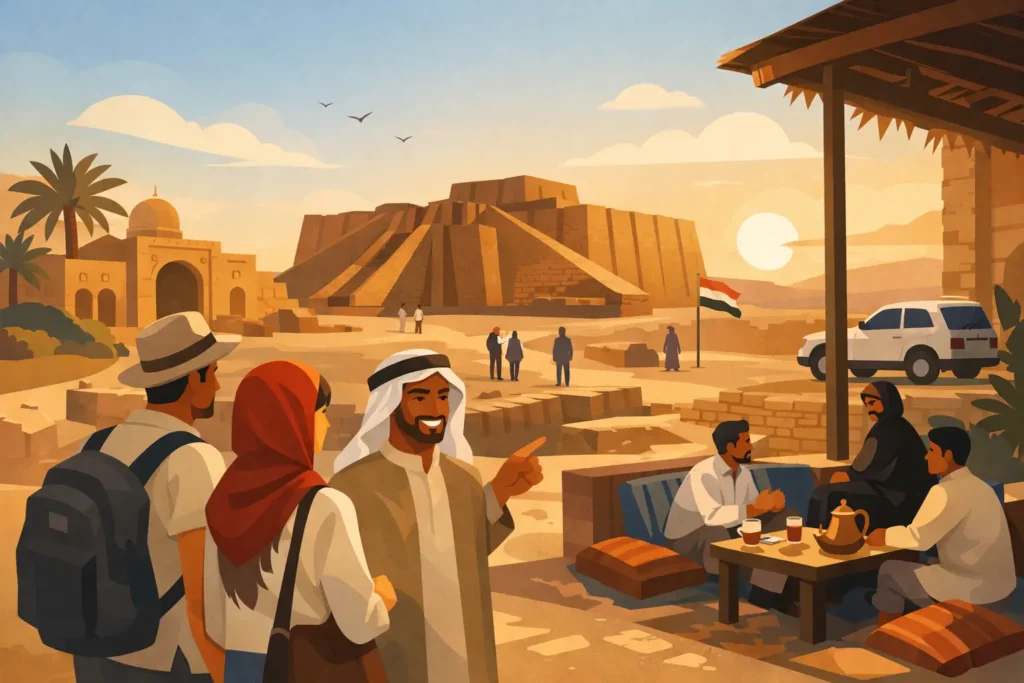
The Great Ziggurat, dedicated to Nanna, the moon god, is the site’s most striking landmark. Its restored lower levels and monumental stairways offer a powerful sense of scale, but Ur is larger than this single structure. The surrounding ruins include the Royal Cemetery area, residential quarters and the sacred precinct. Looking across the low mounds, it becomes easier to imagine a dense, living city where people worked, prayed, traded and recorded their lives on clay tablets.
For many visitors, Ur also carries spiritual significance through its long-standing association with the Prophet Abraham, or Ibrahim in Islamic tradition. Archaeological certainty and religious tradition are not the same thing, so it is best to approach this connection respectfully rather than present it as a settled historical fact. The enduring association gives the place an additional emotional resonance for Muslim, Christian and Jewish visitors alike.
How to visit ancient Ur: plan the practical details first
Ur is roughly 20 kilometres south-west of Nasiriyah, the principal city in Dhi Qar Governorate. The most practical way to visit is by private car with a knowledgeable local driver or licensed guide, usually as a half-day or full-day excursion from Nasiriyah. Public transport does not offer the flexibility or clarity most international visitors need for an archaeological site outside the city.
Many travellers reach Nasiriyah overland from Baghdad, while others build Ur into a southern route that includes Basra and the Mesopotamian Marshes. Journey times vary with traffic, road conditions and checkpoints, so avoid planning an overly tight same-day schedule. A driver who knows the route can manage the practicalities while you focus on the visit itself.
Before confirming plans, ask your hotel, host, tour organiser or driver to verify current site access, opening arrangements and any identification requirements. Archaeological sites can occasionally have altered hours, maintenance activity, official visits or local access controls. This simple check is more useful than relying on old online itineraries.
International travellers should also confirm Iraq’s current visa requirements directly with the relevant Iraqi embassy, consulate or official immigration source before booking flights. Eligibility, entry procedures and documentation can differ by nationality and may change. A reputable local travel provider can help explain the on-the-ground process, but official guidance should always be your final reference.
Choosing a guide, driver or organised day trip
Independent-minded travellers may be tempted to hire a car and navigate alone. For most first-time visitors, a local driver or guide is the better choice. It reduces uncertainty around directions, entry procedures and communication, and adds the historical context that turns mud-brick foundations into a story of human ingenuity.
The best arrangement depends on your priorities. A driver is ideal if you have already researched Ur and prefer a quiet, flexible visit. A specialist guide is worthwhile for archaeology enthusiasts, photographers and anyone wanting a deeper explanation of Sumerian religion, urban life and excavation history. An organised trip can be particularly convenient if you are travelling from Baghdad or combining Ur with Nasiriyah’s cultural sites.
When arranging transport, agree the itinerary, waiting time, price, language needs and whether entrance fees are included before departure. Ask whether there will be shade, drinking water and time for stops. Clear expectations are a normal part of good travel planning and make the day more relaxed for everyone.
When to go and what to bring
The cooler months, generally from late autumn to early spring, are the most comfortable time to visit Ur. Southern Iraq can become extremely hot in summer, and the site offers limited natural shade. If you travel in warmer weather, aim for an early morning start and keep the visit shorter.
Wear light, modest clothing that covers shoulders and knees, along with comfortable closed shoes suitable for uneven, dusty ground. A wide-brimmed hat, sunglasses, sunscreen and more water than you think you will need are essential. Bring a charged mobile phone, but do not assume there will be facilities for charging devices or buying refreshments at the site.
Photography is often one of the joys of Ur, especially when low sunlight brings out the texture of the ancient brickwork. Still, ask before photographing staff, security points or fellow visitors. Drone use requires particular caution and should never be assumed to be permitted. Your guide can advise on the current rules.
What to expect once you arrive
Ur’s atmosphere is part of its appeal. There are no theatrical reconstructions, costumed performers or souvenir-lined avenues competing for attention. Instead, the landscape asks you to look carefully: at the baked brick, the wide open sky and the outlines of a city that once stood close to the Euphrates and the Gulf’s ancient shoreline.
Start with the Great Ziggurat, where the scale and construction are easiest to appreciate. From there, take time to look beyond the obvious monument. A guide can point out the city’s wider layout and explain why archaeologists found Ur so important, including the discoveries from its royal graves and the evidence of a complex, literate society.
Access within the site may vary. Some areas can be closed for preservation, safety or archaeological work, and visitors should not climb, touch or cross barriers where this is prohibited. These structures have survived for thousands of years because they are precious, but they are also vulnerable. Respectful behaviour is not a restriction on the experience. It is part of being welcomed into a shared human inheritance.
Expect basic facilities rather than a polished visitor centre. Eat beforehand, carry your own water and use facilities when available in Nasiriyah before setting out. This is also why a guide or driver matters: practical preparation allows you to stay present once you arrive.
Pair Ur with the living culture of southern Iraq
Ur is most rewarding when it is not treated as an isolated stop. Spend time in Nasiriyah, where the rhythms of modern southern Iraq offer an important counterpoint to the ancient ruins. Depending on your route and available time, you may also consider the Mesopotamian Marshes, a distinctive wetland culture shaped by reeds, waterways and generous local hospitality.
A two-night stay in or around Nasiriyah gives more breathing room than a rushed day journey. It allows for a morning at Ur, a slower local meal and the possibility of adding another cultural experience without turning the trip into a checklist. Stay In Iraq can help travellers research accommodation and build a route that suits their pace.
Be mindful that southern Iraq is a place of deep religious and social traditions. Dress respectfully, accept hospitality graciously and ask before entering private spaces or taking portraits. A few Arabic greetings go a long way, but warmth and courtesy matter more than perfect pronunciation.
Travel with curiosity, not assumptions
Visiting Ur is a chance to stand close to the beginnings of city life, writing and organised society. It also offers something more personal: a reminder that Iraq is not only a place studied in textbooks, but a welcoming country whose living communities remain connected to one of humanity’s most remarkable landscapes.
Give Ur time, arrive prepared and let a local voice add context to the silence of the ruins. The memory you carry away is likely to be not just of an ancient ziggurat, but of the people and hospitality that made reaching it possible.