Some places change the pace of your journey the moment you arrive. In Iraq, that often happens at the threshold of a shrine courtyard, beneath a historic minaret, or in the quiet of an old madrasa where centuries of scholarship still feel close. For travellers interested in Islamic heritage sites in Iraq, the experience is not only architectural or historical. It is deeply human, shaped by living faith, memory, hospitality, and the rhythms of daily devotion.
Iraq holds some of the most significant Islamic sites in the world. For Muslim pilgrims, these places carry profound religious meaning. For heritage travellers, they reveal how Islamic civilisation in Iraq developed through theology, art, learning, urban life, and craftsmanship. What makes the country especially compelling is that its sacred sites are not preserved as distant relics. They remain active, visited, cared for, and woven into the life of their cities.
Why Iraq’s Islamic heritage matters
To understand Iraq through its Islamic heritage is to understand a major part of the region’s intellectual and spiritual history. Cities such as Najaf, Karbala, Kadhimayn, Samarra, and Baghdad have long been centres of pilgrimage, jurisprudence, teaching, manuscript culture, and religious architecture. Their importance is not limited to one period. Across centuries, rulers, scholars, artisans, and local communities all shaped the religious landscape visitors see today.
That said, not every site offers the same kind of experience. Some are monumental and ceremonial, drawing vast numbers of visitors during key religious occasions. Others are quieter and reward slower attention – a carved doorway, a tiled dome, a calligraphic inscription, or a neighbourhood built around a shrine. The best approach is to see these places not as isolated attractions, but as parts of living cities.
Key Islamic heritage sites in Iraq
Imam Ali Shrine, Najaf
For many visitors, Najaf is the spiritual heart of a journey through Iraq. The shrine of Imam Ali is one of the most revered sites in the Islamic world, and the atmosphere around it is immediate and powerful. The old city streets leading to the sanctuary are lined with shops, pilgrims, clerics, and families, creating a sense of movement that feels devotional rather than touristic.
Architecturally, the shrine is known for its gilded dome, mirror work, intricate tile decoration, and richly detailed courtyards. Yet what stays with many travellers is not only the visual grandeur. It is the sense of continuity. Najaf is a centre of Islamic learning as well as pilgrimage, and that scholarly tradition gives the city a depth that extends well beyond the shrine itself.
Imam Husayn Shrine and Al-Abbas Shrine, Karbala
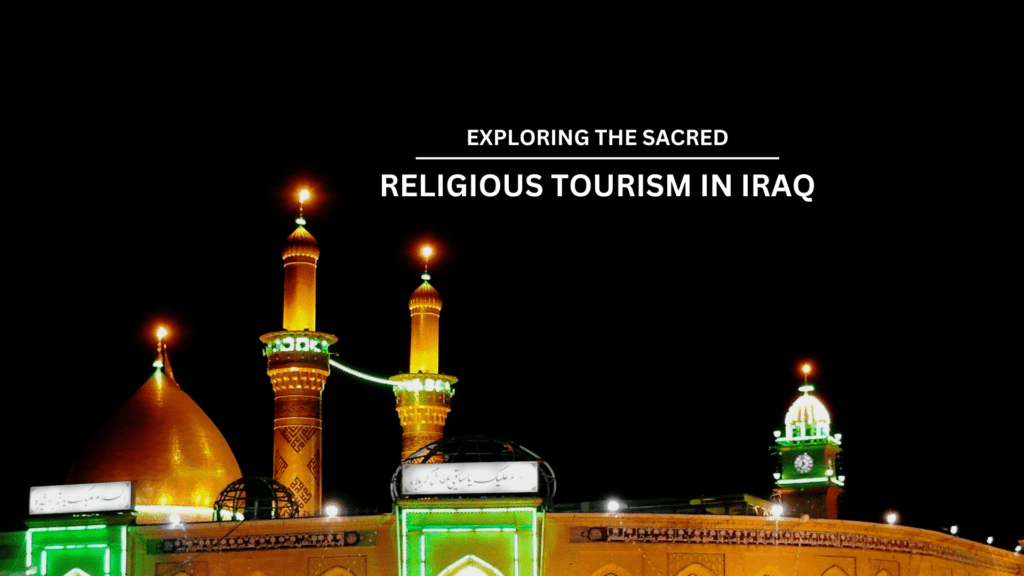
Karbala is impossible to separate from emotion. The shrines of Imam Husayn and Al-Abbas stand at the centre of one of the most meaningful pilgrimage cities in the Muslim world. Their religious importance is immense, especially for Shia Muslims, and the bond between the two sanctuaries shapes the city’s identity.
The visual impression is striking – golden domes, expansive courtyards, elegant minarets, and carefully maintained interiors. But Karbala’s significance is also tied to remembrance, ethics, and sacrifice. Travellers who visit respectfully often find that even without sharing the same devotional background, the sincerity of the city is deeply moving. If you go during major religious periods, expect a more intense and communal experience. At quieter times, there is more space to absorb the architecture and urban setting.
Al-Kadhimiya Mosque, Baghdad
In Baghdad, the Al-Kadhimiya Mosque offers one of the capital’s most important Islamic landmarks. The shrine of Imam Musa al-Kadhim and Imam Muhammad al-Jawad has long been a destination for pilgrims and a centre of religious life. Its golden domes and minarets are among the most recognisable sacred features in Iraq.
For travellers, Kadhimayn also provides a useful reminder that Baghdad’s Islamic heritage is not only Abbasid and historical in the museum sense. It is present in neighbourhood life, in active worship, and in the enduring role of shrine cities within a modern capital. Visiting here can be combined with a broader look at Baghdad’s historic districts, where layers of Islamic urban history still shape the city.
The Great Mosque of Samarra and the Malwiya Minaret
Samarra offers a different kind of encounter with Islamic heritage. The Great Mosque of Samarra and its famous spiral Malwiya Minaret are among the most important monuments of early Islamic architecture. Built during the Abbasid period, the site reflects imperial ambition on a scale that still feels unusual.
Unlike the shrine-centred experience of Najaf or Karbala, Samarra is often appreciated for its archaeological and architectural significance. The spiral form of the minaret is instantly recognisable, but its real value lies in what it says about the ambition and visual language of the Abbasid era. For history-focused travellers, this is one of the clearest places to see Iraq’s contribution to the development of Islamic architecture.
Abu Hanifa Mosque, Baghdad
The Abu Hanifa Mosque, associated with the founder of the Hanafi school of jurisprudence, is another important religious and scholarly site in Baghdad. It reflects a different strand of Iraq’s Islamic legacy – one linked closely to legal thought, teaching, and Sunni religious tradition.
This is where nuance matters. Iraq’s Islamic heritage is not represented by one city, one dynasty, or one community alone. A well-planned trip should recognise that the country’s religious landscape is broad and layered. Sites such as Abu Hanifa Mosque help visitors appreciate that diversity with greater historical clarity and respect.
Baghdad’s wider Islamic heritage
When travellers think of Baghdad, they often begin with the Abbasid caliphs, and rightly so. The city was one of the great centres of Islamic civilisation, known for scholarship, administration, literature, science, and theology. While many of its most famous early institutions do not survive in complete form, Baghdad still contains powerful traces of that legacy.
The Abbasid Palace is one example often included in heritage itineraries. Although not a mosque or shrine, it helps visitors place Iraq’s Islamic sites within a wider cultural world of governance, courtly life, and urban sophistication. Historic mosques, old markets, and surviving architectural details across Baghdad also reward travellers who are willing to look beyond headline landmarks.
What travellers should know before visiting
Visiting Islamic heritage sites in Iraq is highly rewarding, but context matters. These are living religious spaces first. Modest dress is essential, and at major shrines women may be asked to wear an abaya or appropriate covering, often available near the entrance. Shoes are removed before entering certain areas, and photography rules vary from site to site.
It also helps to think carefully about timing. During major religious commemorations, the atmosphere can be extraordinary, but crowds are significantly larger and accommodation may need to be arranged well in advance. If your priority is quiet reflection or architectural photography, outside peak pilgrimage dates may suit you better. Neither option is better in every case – it depends on the kind of experience you want.
Transport and planning are improving, but Iraq still rewards travellers who prepare properly. Distances between religious cities are manageable, yet journey times can vary. Many visitors combine Baghdad with Najaf and Karbala, while Samarra may require more deliberate planning depending on route and local arrangements. Using a trusted platform such as Stay In Iraq can make the process more straightforward, especially if you are visiting for the first time and want practical guidance alongside cultural context.
Visiting with respect, not just curiosity
The strongest travel experiences in Iraq often come from slowing down. Rather than trying to collect sites quickly, spend time noticing how people use these spaces. Watch families entering together, listen to recitation in the courtyards, and pay attention to the relationship between shrine, street, market, and neighbourhood. This is where Iraq feels most real – not staged for visitors, but open to those who arrive with respect.
For photographers and writers, sensitivity matters as much as access. Not every moment should be captured. Some spaces invite observation more than documentation. Asking permission when people are identifiable, dressing appropriately, and avoiding intrusive behaviour all make a difference.
A heritage journey with living meaning
What sets Iraq apart is that its Islamic heritage is not frozen behind barriers. It is active, layered, and emotionally present. A shrine in Najaf, a courtyard in Karbala, a mosque in Baghdad, and a minaret in Samarra each tell a different part of the story. Together, they show a country whose religious and cultural significance remains immediate, not merely historical.
If you are considering Iraq for a heritage-focused journey, these sites offer far more than visual grandeur. They offer perspective – on faith, scholarship, memory, and the everyday generosity that still shapes travel here. Go with time, go with humility, and let the places speak in their own voice.