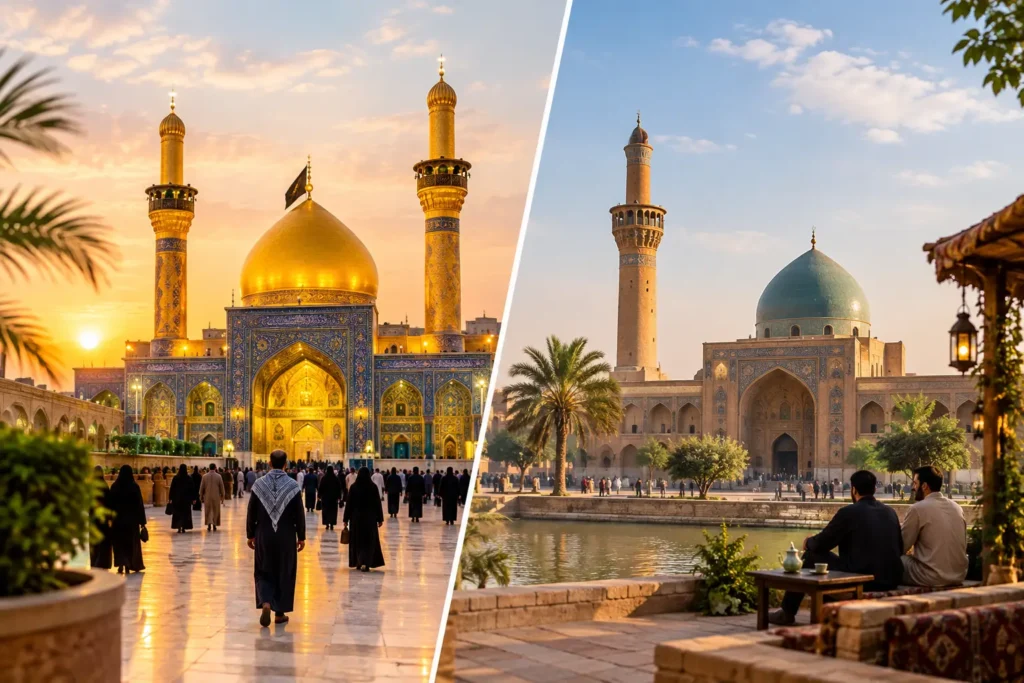
Najaf and Kufa sit only a short journey apart, yet they offer distinctly different experiences of faith, memory and Iraqi hospitality. For travellers comparing Najaf versus Kufa pilgrimage sites, the choice is rarely about which city matters more. It is about understanding what each place asks of the visitor: Najaf centres the devotion to Imam Ali, while Kufa reveals the formative landscape of early Islamic history.
Both deserve time. Together, they create one of Iraq’s most meaningful religious and cultural journeys, whether you are visiting as a pilgrim, travelling with family, reconnecting with Iraqi roots or seeking a deeper understanding of the country’s living heritage.
Najaf versus Kufa pilgrimage sites: the essential difference
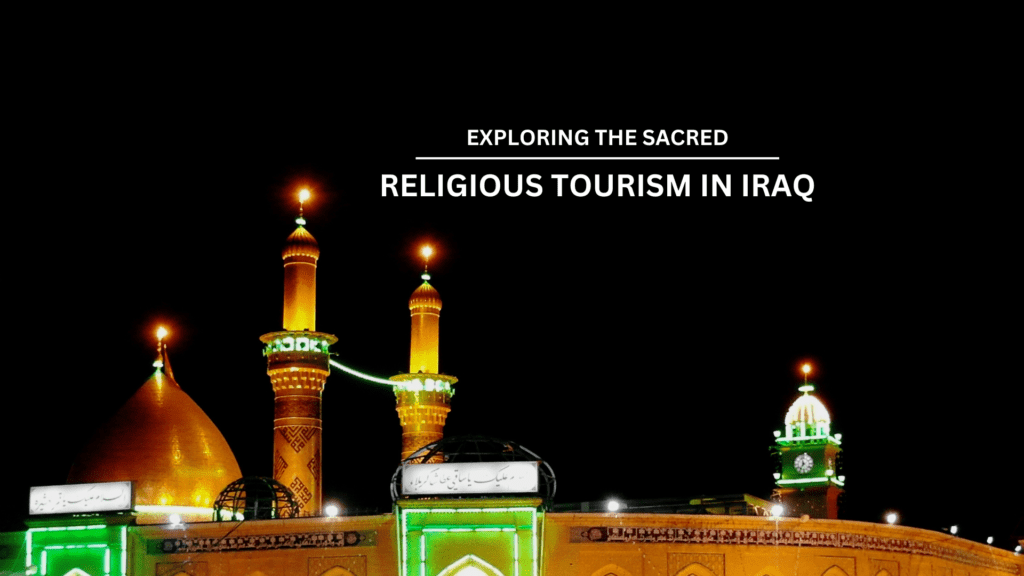
Najaf is defined by the Shrine of Imam Ali ibn Abi Talib, a site of immense significance for Muslims worldwide, particularly Shia pilgrims. Its golden dome, courtyards and constant movement of visitors give the city an immediate spiritual gravity. Pilgrimage here is intensely personal, but also communal: families arrive from across Iraq and beyond, prayers are recited softly, and strangers routinely offer directions, tea or a place to rest.
Kufa, by contrast, feels more historical and contemplative. Its importance is no less profound, but its sacred places invite visitors to reflect on the earliest chapters of Islamic leadership, learning and worship. The city was once the capital of Imam Ali’s caliphate, and its mosques and shrines retain powerful connections to figures and events central to Islamic history.
A practical way to think about the comparison is this: Najaf is the heart of the pilgrimage, while Kufa adds essential historical context. Travellers with one day should prioritise Najaf and make time for Kufa if possible. Those with two days or more can experience both without rushing the moments that matter.
Najaf: the shrine, the cemetery and the rhythm of devotion
The Shrine of Imam Ali is the principal destination in Najaf. Approaching it through the old city is part of the experience. Lanes filled with bookshops, religious goods, small cafés and family-run stalls gradually open towards the shrine complex, where gilded architecture meets the quiet concentration of worshippers.
Visitors should allow more time than they expect. Entry procedures, prayer times and crowd levels can shape the pace of a visit, especially on Thursday evenings, Fridays, Ramadan and major religious commemorations. It is not a place to treat as a quick sightseeing stop. Even non-Muslim or non-pilgrim visitors who enter respectfully will find that slowing down helps them understand the atmosphere and observe local custom with care.
Nearby, Wadi al-Salam cemetery is another defining part of Najaf’s spiritual landscape. Regarded as one of the world’s largest cemeteries, it is a place of remembrance with deep religious significance. A visit can be moving, but it requires particular sensitivity. Dress modestly, keep voices low, avoid photographing people without permission, and do not walk into private family moments of mourning or prayer.
Najaf also rewards those who look beyond the shrine precinct. The city’s scholarly tradition is visible in its religious seminaries, book culture and conversations with local residents. This is not heritage held behind glass. It is a living city whose everyday rhythm has been shaped by generations of pilgrims, students, traders and hosts.
Who will find Najaf most meaningful?
Najaf is especially suited to travellers whose visit is centred on ziyarat, prayer and the spiritual presence of the shrine. It is also a strong choice for diaspora visitors introducing younger relatives to family heritage, and for culturally curious travellers who want to see how faith shapes a city’s daily life.
The trade-off is intensity. Around peak periods, the surrounding streets can be busy and accommodation fills quickly. Staying close to the old city offers convenience, while a hotel farther out may provide a quieter overnight base. The best choice depends on whether you value being within easy walking distance of the shrine or prefer more space after a full day of visiting.
Kufa: early Islamic history in a more reflective setting
Kufa’s central landmark is the Great Mosque of Kufa, one of Islam’s most historically significant mosques. It is associated with Imam Ali’s time in Kufa and remains a major place of worship and pilgrimage. Within its sacred spaces, visitors encounter traditions connected with prophets, early Islamic figures and pivotal moments in the city’s history.
The mosque is best approached with patience rather than a checklist. Its courtyards and prayer areas carry layers of meaning that can be missed if the visit is hurried. A knowledgeable local guide can be particularly valuable here, helping international visitors understand the religious associations of different spaces while observing the correct etiquette.
Close to the mosque, the shrines of مسلم ibn Aqil, commonly written Muslim ibn Aqil, and Hani ibn Urwa hold deep importance for many pilgrims. Their stories are closely connected to the moral and historical memory surrounding Karbala. Visitors do not need specialist knowledge before arriving, but reading a little or asking a trusted guide for context can make the experience far richer.
Another major stop is the Mosque of al-Sahlah, near Kufa. It is cherished for its associations with prophets and with Imam al-Mahdi in Shia tradition. Compared with the central shrine environment in Najaf, al-Sahlah can feel spacious and meditative, particularly outside major pilgrimage periods. Many visitors come to pray, reflect and spend unhurried time in its courtyard.
Why Kufa should not be treated as an add-on
It is tempting to label Kufa a short excursion from Najaf, but that description understates its importance. Kufa was a centre of governance, religious learning and Arabic language scholarship during a formative period of Islamic civilisation. Its pilgrimage sites do not simply complement Najaf geographically. They deepen the story of why the wider Najaf-Kufa area holds such a central place in Muslim memory.
For photographers and heritage travellers, Kufa also offers a different visual and emotional texture. Najaf’s shrine district is luminous, dense and animated by a continuous flow of pilgrims. Kufa’s mosque complexes can offer more room for architectural observation and quiet reflection. Photography rules vary by site, however, and worshippers’ privacy always comes first. Ask before taking images, particularly indoors or near prayer areas.
Planning a visit to Najaf and Kufa
Most travellers find it easiest to base themselves in Najaf, where the accommodation choice is broader and the main shrine is close at hand. Kufa is reachable by taxi or a pre-arranged driver, and the journey between the cities is usually straightforward. Travel times can change with traffic, religious events and road management, so build flexibility into the day rather than scheduling every minute.
A sensible itinerary gives Najaf a full first day, including the Shrine of Imam Ali and time around the old city. On the following morning or afternoon, visit the Great Mosque of Kufa and the Mosque of al-Sahlah. This leaves room for prayer, rest and conversation instead of turning a sacred journey into a race between landmarks.
Pilgrims and visitors should dress conservatively. Loose, modest clothing is appropriate for everyone, and women should carry a headscarf for shrine and mosque visits. Shoes are removed before entering designated prayer spaces, so socks are useful. Keep a small bag for footwear if needed, follow signs and staff guidance, and avoid stepping in front of people praying.
It is wise to carry cash in Iraqi dinars for taxis, small purchases and informal services. Agree transport arrangements before setting off, especially if you want a driver to wait while you visit several sites. During major pilgrimage dates, booking accommodation well in advance is essential, and a hotel team can often help with local transport advice and current entry arrangements.
Choosing the right balance for your journey
If your time is limited, do not frame Najaf and Kufa as competing destinations. Najaf offers the concentrated spiritual power of the shrine of Imam Ali and a city shaped by pilgrimage. Kufa offers the historical setting that makes the wider journey more complete, from the Great Mosque to al-Sahlah and the city’s enduring scholarly legacy.
The most rewarding visit allows both places to speak in their own way. Arrive prepared, dress with care, leave room in your schedule, and accept the hospitality offered with courtesy. In Najaf and Kufa, the lasting memory is often not only the architecture or the history, but a quiet prayer, a shared cup of tea, or a local welcome that makes Iraq feel immediately human.