For anyone asking about mesopotamia or egypt history, the answer is not a simple contest with one clear winner. Both regions produced extraordinary early civilisations, but they did so in different landscapes, on different timelines and with different strengths. Egypt gave the world some of its most recognisable monuments; Mesopotamia gave humanity many of the systems that made urban life possible.
For travellers, the distinction matters. Egypt is often encountered through famous royal tombs and monumental temples. Iraq, the heartland of ancient Mesopotamia, offers something equally profound: the places where cities, writing, law, long-distance trade and organised administration took early and influential forms. This is not history behind glass alone. It is a living landscape of rivers, communities, sacred sites and enduring cultural memory.
Mesopotamia or Egypt history: the essential comparison
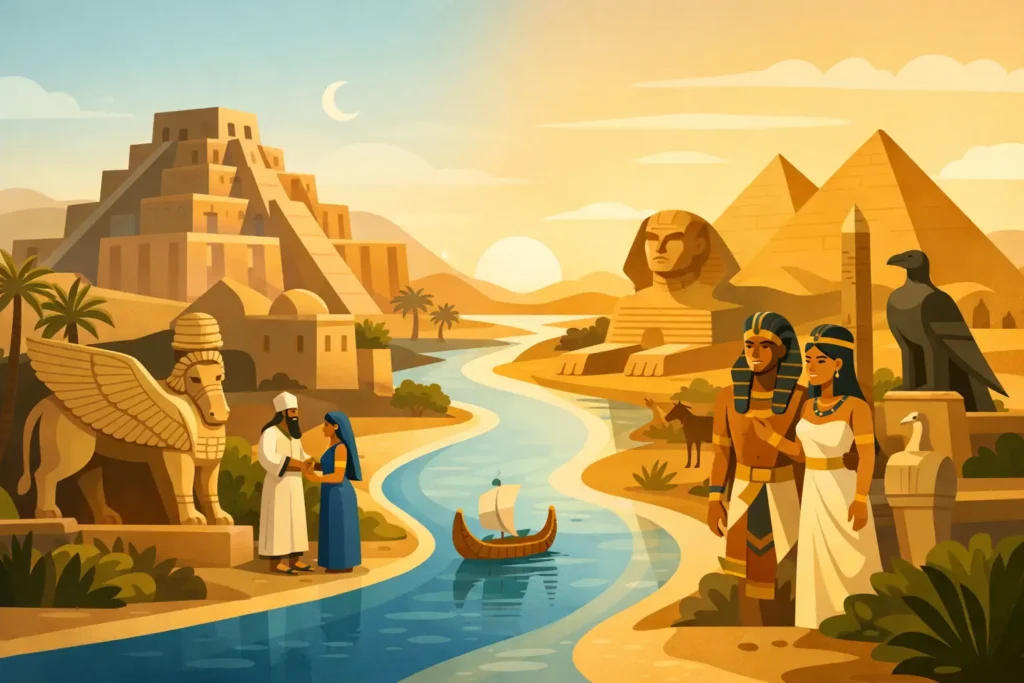
Mesopotamia means “the land between the rivers”, referring broadly to the fertile territory between the Tigris and Euphrates. Much of its ancient southern heartland lies in present-day Iraq. Here, Sumerian cities such as Uruk, Ur, Eridu and Nippur developed over millennia, supported by irrigated agriculture and increasingly complex systems of governance.
Ancient Egypt grew along the Nile, a river whose annual flooding was comparatively predictable and whose valley formed a long, connected corridor. This geography helped support a strongly unified kingdom from an early period. By around 3100 BCE, Upper and Lower Egypt had been brought together under one pharaoh, establishing a model of central authority that would shape Egyptian history for thousands of years.
Mesopotamia’s political story was more varied. Its city-states often competed, cooperated and changed hands, while later powers such as Akkad, Babylonia and Assyria united large territories at different times. That does not make Mesopotamia less advanced than Egypt. It reveals another path to complexity: a region where many influential centres produced ideas, technologies and institutions in conversation with one another.
Which civilisation is older?
The question depends on what “older” means. Farming communities existed in both regions long before the first cities and kingdoms. If the focus is on early urbanisation, southern Mesopotamia has a particularly strong claim. Uruk expanded dramatically in the fourth millennium BCE and is widely regarded as one of the world’s first true cities.
If the focus is on a durable, unified state, Egypt’s early dynastic period is a major milestone. Egypt’s political unification happened very early, while Mesopotamia remained divided into city-states for much of the same era. Neither fact cancels the other. Early civilisation was not invented once in a single place, then copied everywhere else. It developed through several remarkable societies responding to local conditions.
That is why “Mesopotamia versus Egypt” can be misleading. These were not isolated worlds. They exchanged goods and ideas through wider regional networks, while each retained its own social structures, beliefs and visual language.
Cities, writing and power in ancient Mesopotamia
One of Mesopotamia’s greatest legacies is the city itself. At Uruk, growing populations required new ways to manage grain, labour, land, offerings and trade. Early accounting marks on clay developed into cuneiform, a writing system made with wedge-shaped impressions. By the late fourth millennium BCE, people in southern Mesopotamia were recording economic transactions, names and administrative information.
Writing later became a tool for literature, scholarship and law. The Epic of Gilgamesh, rooted in Mesopotamian traditions, remains one of humanity’s oldest surviving literary works. Babylonian scholars observed the heavens with impressive precision, while legal collections associated with rulers such as Hammurabi show how authority was expressed through rules, obligations and public order.
Egypt developed its own writing system, hieroglyphs, at roughly a similar early date. Yet its written culture was often displayed in highly visible, monumental settings: carved on temple walls, tombs, statues and royal objects. Mesopotamian cuneiform, by contrast, commonly survives on clay tablets. One tradition catches the eye through stone and colour; the other invites close attention to the everyday records that made a city function.
Power also looked different. Egyptian pharaohs were central figures in a sacred kingship that linked political rule, cosmic order and the afterlife. In Mesopotamia, kingship was also religiously meaningful, but city gods and temple institutions had especially powerful roles. The towering stepped temple platform known as a ziggurat became a defining Mesopotamian form, built as a sacred high place within the city rather than as a royal tomb.
Why Egypt’s monuments feel more familiar
Egypt’s pyramids, temples and tombs were built in stone and, in many cases, survived in dramatic condition. Their scale is immediately legible to modern visitors. A pyramid announces royal ambition before anyone reads a word of history.
Mesopotamia was built largely from mud brick, the practical material of the alluvial plain. It was excellent for construction but vulnerable to rain, wind and time. Ancient sites can therefore appear as broad mounds, eroded walls and reconstructed gateways rather than complete stone monuments. This has affected public perception, not historical importance.
In fact, the quieter appearance of many Mesopotamian sites can make a visit more powerful for travellers who value context. At places such as Ur, the Royal Cemetery, the ziggurat and the surrounding plain reveal how a city was embedded in its environment. At Babylon, walls, processional spaces and palace landscapes evoke a capital whose name travelled across the ancient world. These are places to approach patiently, ideally with knowledgeable local guidance and a willingness to look beyond postcard expectations.
A different relationship with rivers
The Nile’s rhythm helped Egypt develop a strong agricultural base and easy north-south movement. The Tigris and Euphrates were equally life-giving, but their behaviour could be less predictable. Mesopotamian communities relied on irrigation channels, embankments and collective labour to direct water across the plains.
This may help explain why administration became so prominent in Mesopotamian life. Managing fields, workers and supplies required records. Temples and palaces became economic as well as sacred and political centres. Of course, geography never determines culture by itself. People made choices, built institutions and adapted creatively. But the contrast between the Nile valley and the Iraqi river plains offers a useful lens for understanding why Egypt and Mesopotamia developed distinct identities.
What travellers can experience in Iraq today
To understand Mesopotamia, it helps to see Iraq as more than an ancient map. Baghdad, one of the great historic cities of the Islamic world, carries forward Iraq’s long tradition of learning, trade and urban life. In the south, Basra connects visitors with waterways, date palms and the Gulf. The Iraqi Marshes offer another essential perspective on the country’s relationship with water, landscape and local knowledge.
Ancient sites are often best reached through a carefully planned route, with transport, opening arrangements and local conditions checked in advance. The distance between major sites can be considerable, and summer heat demands sensible timing, water, sun protection and a flexible pace. Respectful clothing is appropriate at religious sites and in conservative communities, while asking before photographing people remains good travel etiquette everywhere.
A journey through southern Iraq can pair archaeological depth with human connection. Visitors may begin in Baghdad, travel south towards the ancient sites around Nasiriyah, and continue through cities whose markets, food and hospitality offer a contemporary counterpart to the history. Stay In Iraq helps travellers move from curiosity to practical planning by bringing destination knowledge and accommodation discovery into the same journey.
The better question to ask
Rather than asking whether Mesopotamia or Egypt was “better”, ask what each civilisation helps us see. Egypt demonstrates the extraordinary reach of a unified state, sacred kingship and monumental building. Mesopotamia shows how densely connected cities could generate writing, bureaucracy, legal thought, literature and scientific observation.
Egypt may offer the more familiar image of antiquity, but Iraq offers a rare opportunity to stand close to civilisation’s earliest urban experiments. For travellers drawn to origins rather than only icons, Mesopotamia is not a footnote to Egypt. It is one of the world’s great historical destinations, waiting to be understood on its own terms.
The most rewarding visit begins with curiosity, continues with respect and leaves room for the unexpected conversation, meal or landscape that turns ancient history into a personal memory.