
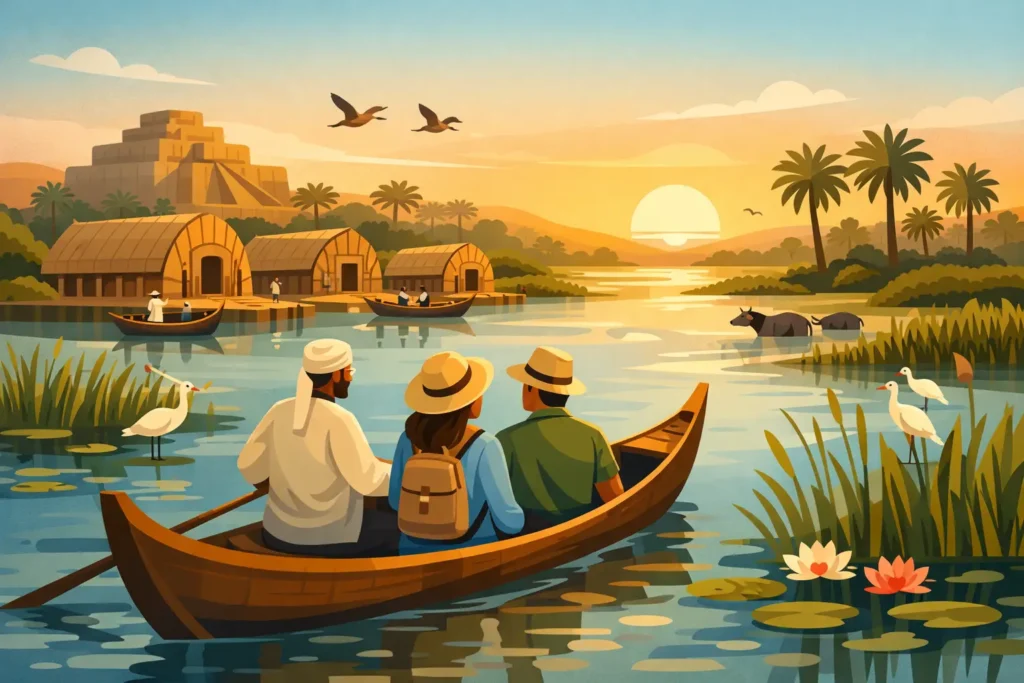
At sunrise, the Iraqi Marshes seem to stretch beyond the horizon: reed beds catch the light, water buffalo move quietly through shallow channels, and narrow mashoof boats pass between homes made from reeds. Iraqi marshes eco travel is not simply a scenic addition to a southern Iraq itinerary. It is an opportunity to encounter a living wetland culture shaped by water, family knowledge and remarkable ecological recovery.
For travellers who come to Iraq seeking more than monuments, the marshes offer a different perspective on the country. Ancient cities and sacred shrines reveal Iraq’s deep past; the marshes reveal a present-day landscape where hospitality, work, food and nature remain closely connected. Visiting well means arriving with curiosity, choosing local expertise and understanding that this is a home before it is a destination.
Why the Iraqi Marshes matter
The marshes of southern Iraq are among the world’s most important wetland landscapes. They lie across the provinces around Basra, Dhi Qar and Maysan, with well-known areas including the Hammar Marshes, Central Marshes and Hawizeh Marshes. Their waterways, mudflats and dense reeds support migratory birds, fish and other wildlife, while also sustaining communities commonly known as the Ma’dan, or Marsh Arabs.
This landscape has changed profoundly over generations. Water levels, seasonal conditions and access can vary, and the marshes continue to depend on careful stewardship. That is why responsible travel matters here. A visitor’s boat trip, meal or overnight stay can contribute directly to local livelihoods when arranged through community-based providers, rather than treating the marshes as a backdrop for a quick photograph.
The most memorable part of a visit is often not the wildlife checklist. It may be sharing fresh fish cooked over an open fire, being welcomed into a mudhif, the traditional reed guesthouse, or listening as a boatman explains how families read the water and weather. These moments make the marshes feel less like a remote attraction and more like one of Iraq’s most distinctive cultural landscapes.
Iraqi marshes eco travel begins with a local guide
Independent travellers can reach southern Iraq through Basra or Nasiriyah, but a locally based guide or trusted operator is strongly recommended for a marsh visit. Routes change with water levels and local conditions, while many of the most meaningful experiences take place away from obvious roadside stops. A guide also helps ensure that visits are welcome, culturally appropriate and timed well.
Chibayish, near Nasiriyah, is a common starting point for exploring parts of the Central Marshes. Basra can be a practical base for visitors interested in the Hammar Marshes and for those arriving by air. Which base suits you depends on the wider journey: Nasiriyah works especially well alongside ancient heritage sites in Dhi Qar, while Basra offers an easy combination of city life, riverfront culture and southern wetlands.
Avoid assuming that every marsh excursion follows a fixed timetable. A two-hour boat ride may be enough for travellers with limited time, but it can feel rushed. A full day allows space for a slower journey through the channels, a local lunch and conversations that give context to what you are seeing. If an overnight stay is available through a reputable host, it can be especially rewarding, though standards and facilities may be simpler than in a city hotel.
What responsible travel looks like on the water
Eco travel is sometimes reduced to carrying a reusable bottle. That is useful, but in the Iraqi Marshes it also means respecting privacy, pace and local authority. Families live and work along the waterways. Homes, fishing areas and buffalo grazing grounds are not public sets for drone footage or staged portraits.
Ask before photographing people, homes and private gatherings. Your guide can help with this, but the simplest approach is always the best: greet people, accept a refusal graciously and put the camera away when it is not appropriate. Portraits made after a real conversation are usually better photographs anyway.
Keep noise low on the water. Boat engines are part of daily life, but loud music and unnecessary disturbance can unsettle birds and diminish the calm that visitors have come to experience. Do not leave plastic, food packaging or cigarette ends behind, and avoid taking reeds, feathers or other natural materials as souvenirs.
When choosing a tour, ask practical questions. Who owns the boat? Is the meal prepared by a local family? Does the guide come from, or work closely with, the community being visited? These questions are not about demanding perfection. They help distinguish a locally rooted experience from one that uses the marshes without returning much value to the people who care for them.
Plan for comfort, not luxury
The southern Iraqi climate should shape your plans. Spring and the cooler months from roughly October to April are generally more comfortable for extended time outdoors. Summer heat can be intense, especially in open boats, so early morning and late afternoon outings are preferable if you are travelling then.
Bring light, modest clothing that covers shoulders and knees, plus a hat, sunglasses and sun protection. Closed shoes or sturdy sandals are more useful than fashion-led footwear, as paths can be muddy or uneven near jetties. Carry drinking water and any essential medication, but do not expect every stop to have shops, card payments or extensive facilities.
Respectful dress is both practical and courteous. Iraq is diverse, and standards vary between cities and rural areas, yet visitors will find that modest clothing helps them feel comfortable in family settings. A light scarf can be useful for sun and dust, and for women who prefer additional coverage in more traditional environments.
Accommodation planning deserves equal care. Larger cities such as Basra and Nasiriyah offer a broader choice of hotels and services, while rural lodging can be more limited and should be arranged in advance through a reliable local contact. Stay In Iraq can help travellers begin their wider accommodation research, but it is wise to confirm transport, departure times and what is included before committing to a marsh excursion.
Food, hospitality and the value of saying yes
Food is often central to a marshland visit. Fish, rice, bread, tea and dairy products may be served with generous warmth. Masgouf-style grilled fish or fish prepared locally over fire is a highlight for many visitors, though recipes and methods differ from household to household.
If you have allergies, dietary requirements or concerns about drinking water, communicate them ahead of time and again with your guide on the day. Flexibility is appreciated, but clarity prevents awkwardness. Accepting tea or a small portion of food, when you can, is a simple gesture of respect. Equally, a polite explanation is better than silently declining a host’s offer.
Do not expect the marshes to perform an imagined version of the past. Communities use mobile phones, modern engines and contemporary materials alongside inherited traditions. This does not make the experience less authentic. It shows what authenticity actually is: a living culture adapting on its own terms.
Build the marshes into a slower southern Iraq itinerary
The marshes deserve more than a rushed detour between destinations. Give yourself at least one full day, ideally with a flexible following morning in case weather, water conditions or road timings change. Combining the wetlands with Nasiriyah, Basra or nearby heritage sites creates a fuller picture of southern Iraq, from ancient urban civilisations to communities whose relationship with water remains central today.
For photographers and content creators, the strongest work usually comes from patience. Return to the same channel as the light changes. Photograph hands preparing tea, reflections in the reeds and the everyday details your hosts are happy to share. Caption images accurately, name communities where appropriate and avoid presenting people as relics from another age.
The Iraqi Marshes ask visitors to travel with a lighter footprint and a wider attention span. Sit in the boat a little longer, listen before taking the next photograph, and let the people who know these waters best set the rhythm of the day.