A morning tea offered before you have fully unpacked, a host pointing out the best route to an old market, or the quiet certainty of a staffed reception desk at midnight: accommodation shapes how Iraq feels. For travellers weighing an Iraqi homestay versus hotel, the best choice is rarely about price alone. It is about the rhythm you want for your journey, the level of independence you need, and how closely you hope to experience everyday Iraqi hospitality.
Iraq is a destination of great cities, sacred places, ancient landscapes and deeply rooted traditions of welcome. A hotel and a homestay can both be excellent bases for discovering it. They simply offer different kinds of confidence.
Iraqi homestay versus hotel: the central difference
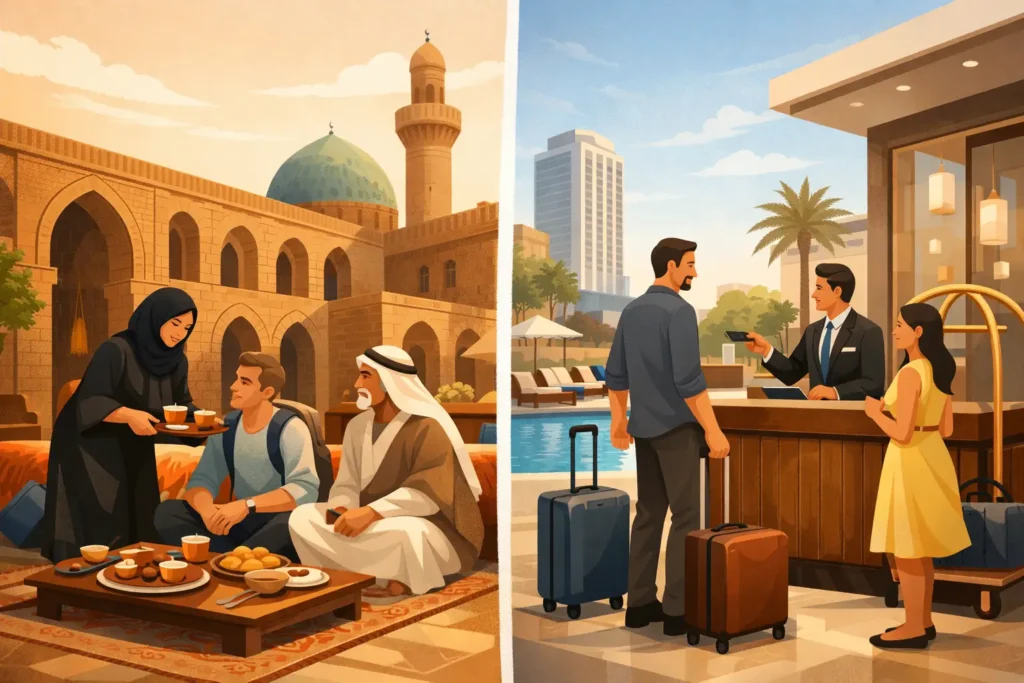
A hotel is designed to give travellers a predictable, self-contained stay. You normally have a private room, an en-suite bathroom, reception support, and a clear boundary between your personal time and the life of the city outside. This can be particularly valuable after a long journey, during a tightly planned itinerary, or when visiting several destinations in one trip.
A homestay places you closer to the daily life of a household. You may have a private bedroom but share living areas, meals, conversation and local routines with your hosts. Rather than simply staying in a neighbourhood, you become a temporary guest within it. For many visitors, that human connection becomes the memory that stays longest: a family recipe explained at the kitchen table, help understanding a local custom, or an invitation to share tea as the evening settles in.
Neither option is automatically more authentic, comfortable or suitable. A well-run hotel can offer warm, personal service, while a homestay varies significantly according to the home, host, location and facilities. The useful question is not which is better in general, but which will let you travel with greater ease and respect.
Choose a hotel when comfort and structure matter most
Hotels are often the practical choice for first-time visitors who want a clear, dependable base while learning how the country works. In Baghdad, Erbil, Basra, Najaf, Karbala and other major centres, hotel accommodation can make it easier to arrange taxis, ask for directions, store luggage, check in at flexible times and keep a changing itinerary on track.
This structure matters if your trip includes early departures, internal flights, work commitments or a short stay. A hotel may also be preferable if you value private facilities, daily housekeeping, on-site dining or a 24-hour point of contact. Travellers arriving late at night often appreciate knowing exactly where they will check in and who will be available.
For religious visitors, a hotel close to a shrine or major pilgrimage area can be especially useful. Proximity reduces unnecessary travel during busy periods and gives you space to rest between visits. During high-demand dates, however, location and availability can change quickly, so booking terms, room configuration and distance should be checked carefully before committing.
Hotels can also suit families and groups who need several rooms, connecting arrangements or clearly defined shared spaces. They offer a familiar framework without removing you from Iraq’s character. The best stays are not merely a place to sleep: they can provide a welcoming introduction to a city, from breakfast traditions to helpful local recommendations.
Choose a homestay for local perspective and a slower pace
A homestay is most rewarding when you have time to be present. It suits travellers who are curious about domestic culture, regional food, neighbourhood life and the small social rituals that conventional accommodation does not always reveal. Iraqi hospitality is often expressed generously and naturally, and staying with a host can turn a visit from observation into genuine exchange.
This can be particularly meaningful for Iraqi diaspora travellers returning to reconnect with language, family customs or a part of the country they know mainly through stories. It can also appeal to photographers, writers and culturally curious visitors who want a more grounded sense of place, beyond landmark-to-landmark sightseeing.
The trade-off is that a homestay asks more of you as a guest. Household schedules may be different from your own. Breakfast may be served at a set time. You might share a bathroom or be expected to communicate your plans clearly if you will return late. These are not inconveniences when expectations are understood, but they should be discussed before booking.
Homestays are also not yet available in every Iraqi destination or neighbourhood. The host-side accommodation scene is growing, which is encouraging for travellers seeking more varied ways to stay, but choice can be more limited than in established hotel areas. A smaller selection makes careful communication even more important.
Privacy, customs and personal comfort
Privacy is one of the clearest dividing lines between an Iraqi homestay and a hotel. In a hotel, you can largely set your own routine. In a homestay, you are entering a family environment where privacy is still respected, but shared space and cultural norms naturally require greater awareness.
Before reserving, ask plainly whether your room is private, whether the bathroom is private or shared, who else lives in the home and whether there are any household expectations around meals, visitors or return times. If you are travelling as a couple, with children, or as a solo woman, it is sensible to confirm that the arrangement feels appropriate for everyone involved rather than making assumptions.
Modest, respectful dress in shared spaces is a good starting point, particularly in conservative areas and religious cities. Your host may guide you on what feels normal locally. Accepting tea or food can be a warm gesture of connection, but travellers should also feel comfortable explaining dietary needs, allergies or a need for quiet time. Respect works best when it goes both ways.
Language can shape the experience too. Some hosts may speak excellent English, while others communicate mainly in Arabic, Kurdish or another local language. This need not prevent a rewarding stay, but it changes the level of independence you can expect. Agreeing key details before arrival, including the address, arrival time and contact method, is wise.
Cost is only one part of value
A homestay may sometimes cost less than a hotel, particularly when meals or local guidance are included. Yet lower cost should not be the sole reason to choose one. The value of a homestay lies in its personal dimension, while a hotel may justify a higher rate through location, private facilities, reliable services and greater flexibility.
Compare the full picture: transport from the property, breakfast, Wi-Fi where needed, air conditioning or heating according to season, laundry, luggage storage and the practical ease of reaching the places you want to visit. A room that appears cheaper can become less convenient if it is far from your daily plans. Equally, a simple homestay in the right neighbourhood may offer richer access to a city than a more polished room at a distance.
A sensible way to decide before booking
Start with your itinerary. If you have only two nights in Baghdad before continuing south, a hotel may help you use every hour well. If you are spending several days in one city, or want to understand a community beyond its headline attractions, a homestay can add depth without requiring a complicated plan.
Then consider your travel style. Independent travellers who enjoy conversation and can adapt to a household routine may thrive in a homestay. Those who need quiet, privacy and an easily managed schedule may feel more comfortable in a hotel. There is no loss of cultural depth in choosing certainty when you need it.
Whichever you choose, seek clear property information and recent guest feedback where available. Confirm the exact location, check-in process, payment expectations, facilities and cancellation terms. For a homestay, ask whether the host can assist with arrival directions and whether they are comfortable welcoming international guests. For a hotel, check that the room type and services match what has been advertised. Platforms such as Stay In Iraq can help travellers compare accommodation with destination guidance, so the place you book makes sense for the journey you are planning.
Consider combining both
You do not have to make one choice for your entire trip. A hotel can provide an easy landing after arrival, while a homestay later in the journey can offer a more personal connection once you have found your footing. This combination works well for longer itineraries, diaspora visits and travellers moving between major cities and smaller communities.
The address you choose will influence more than your sleep. It may be the doorway to a peaceful room near a sacred site, or to a family table where Iraq is encountered not as a distant idea, but as a living, generous place.