If you want to understand Baghdad beyond headlines and history books, start on a Friday morning among the booksellers, readers and coffee drinkers of Al-Mutanabbi. This mutanabbi street baghdad guide is for travellers who want more than a quick photo stop. It is for those who want to feel how culture lives in the city – in conversation, in poetry, in old paper, and in the steady rhythm of a street that has long been one of Baghdad’s intellectual heartbeats.
Named after the celebrated 10th-century poet Al-Mutanabbi, the street sits near the Tigris and close to some of old Baghdad’s most evocative urban fabric. For generations, it has been associated with books, publishing, debate and literary life. Today, that identity remains remarkably intact. You do not visit Mutanabbi Street simply to buy a book. You go to witness a social ritual that says a great deal about Baghdad itself – educated, expressive, resilient and deeply proud of its cultural inheritance.
Why Mutanabbi Street still matters
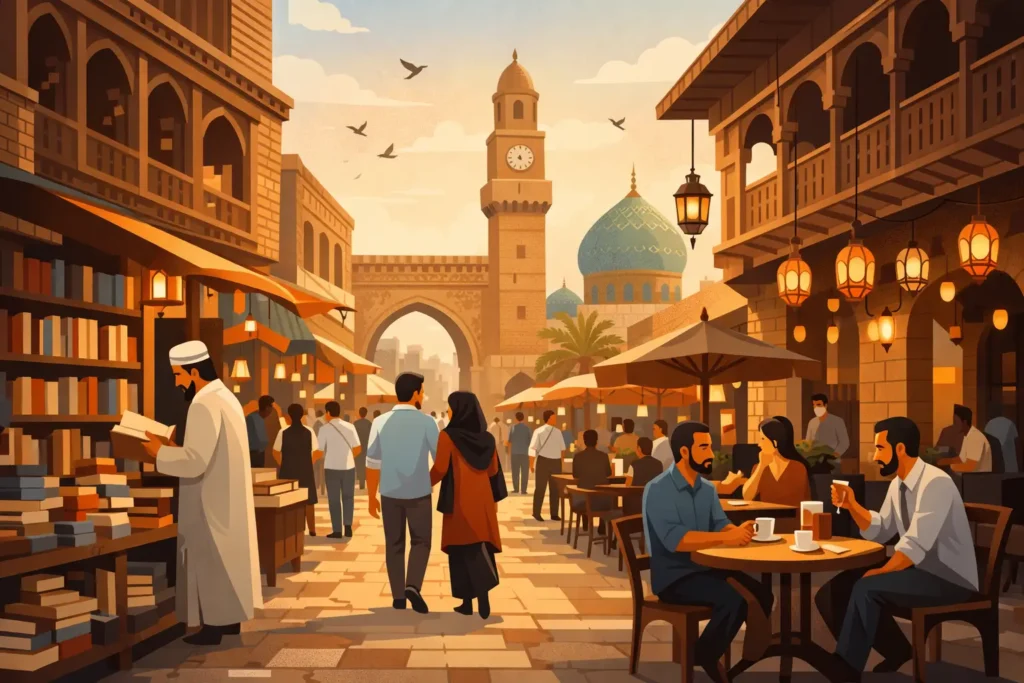
Many famous streets become symbols first and lived places second. Mutanabbi Street has avoided that fate. It is still used by readers, students, writers, academics, collectors and families. On its busiest days, particularly Friday, the street fills with bookstalls, browsing locals and visitors who come as much for the atmosphere as for any specific purchase.
That matters for travellers because the experience is not staged. You are stepping into a working cultural space, not a recreated heritage attraction. The appeal lies in the details – stacks of Arabic books spilling from tables, second-hand titles with handwritten notes inside, conversations about literature and politics carried out over tea, and the quiet pride with which booksellers speak about their stock.
For diaspora visitors, the street can feel especially personal. For international travellers, it often becomes one of the clearest reminders that Baghdad is a city of ideas as much as monuments.
Mutanabbi Street Baghdad guide: what to expect
The first thing to know is that timing shapes the experience. Friday is the best day to visit if you want to see the street at its liveliest. This is when the booksellers are most visible, the social energy is strongest, and the wider area feels like an open-air cultural gathering. If you prefer a quieter look, visiting on another day may offer more space to browse, but you will miss some of the famous atmosphere.
Expect a pedestrian-friendly environment, especially when the street is busy, with rows of booksellers and a mix of permanent shops and temporary stalls. Some specialise in Arabic literature, history, religion or academic texts. Others carry rare or older editions, school books, magazines and political writing. English-language books can sometimes be found, but they are not the core of the market. If you read Arabic, the experience becomes richer. If you do not, it is still rewarding because the setting itself tells a story.
You should also expect conversation. Iraqi hospitality often appears in simple ways – a greeting, a recommendation, a question about where you are from. People may be curious, especially if you are visibly visiting from abroad. Polite openness goes a long way.
The best way to visit
Mutanabbi Street is best approached slowly. Give yourself at least two to three hours, and longer if you enjoy books, architecture or street photography. This is not a place to rush through between other appointments.
Start in the morning. The light is better, the energy is fresh, and cafés begin filling with regulars. Walk the full length of the street before buying anything. Then double back and spend time at the stalls that catch your eye. Some booksellers have highly organised collections, while others operate with a kind of beautiful chaos that rewards patience.
If possible, visit with a local guide or knowledgeable resident on your first trip. That is not because the street is difficult, but because context adds depth. A guide can point out literary landmarks, explain the significance of nearby buildings, and help with conversations if you do not speak Arabic.
More than books: cafés, memory and atmosphere
A good mutanabbi street baghdad guide should make clear that the street is not only about shopping. It is also about sitting still. The nearby café culture is part of the experience, and the most famous stop is the historic Shabandar Café, long associated with writers, journalists and intellectual life in Baghdad.
Even if you are not a coffee enthusiast, take time to sit down. Order tea or coffee, listen, and observe. The pace shifts here. What seems at first like a crowded street becomes a place of layers – old Baghdad social traditions, literary memory, and the everyday ease with which culture is shared in public.
This is also where many travellers begin to notice something often missed in outside portrayals of Iraq: cultural confidence. Mutanabbi Street does not present heritage as something distant or sealed off. It remains part of ordinary urban life.
What to buy and what to look for
If you want a practical souvenir, books are the obvious choice, but not always the easiest. Rare editions may appeal to collectors, while illustrated books on Iraqi history, calligraphy, religion or architecture can make more accessible keepsakes. Some stalls also sell prints, notebooks and literary memorabilia.
Prices vary. A newer commercial title will be different from a worn, older volume or a hard-to-find edition. Bargaining may happen in some cases, but this is not a place to haggle aggressively. Respect matters more than getting the lowest possible price.
Look beyond what you can carry home. Handwritten inscriptions, old stamps, cover design and typography all reveal something about Iraq’s publishing history. For photographers and writers, these details are often as memorable as any purchase.
Practical tips for first-time visitors
Dress modestly and comfortably. Baghdad is a city where respectful presentation is appreciated, and practical walking shoes will help on a long visit. Friday can be busy, so carry only what you need and keep your belongings secure in the normal way you would in any crowded urban setting.
Photography is usually part of the experience, but use judgement. Bookstalls are visually striking, yet it is courteous to ask before taking close photos of sellers or seated customers in cafés. Public street scenes are one thing; personal space is another.
Cash is useful. Smaller purchases are easier when you can pay directly, and not every seller will have digital payment options. It is also worth carrying tissues, water and a mobile phone with enough battery, especially if you plan to continue exploring old Baghdad afterwards.
Language can be a bridge rather than a barrier. A few Arabic greetings are appreciated, but warmth and courtesy matter more than fluency. If you are visiting as part of a wider trip with Stay In Iraq, pairing Mutanabbi Street with nearby heritage areas makes for a fuller day in the capital.
Pairing Mutanabbi Street with the wider city
Mutanabbi Street makes the most sense when seen as part of central Baghdad rather than as an isolated stop. The surrounding area carries layers of Abbasid, Ottoman and modern urban history. Depending on access, timing and local arrangements, you may combine your visit with nearby heritage sites, riverside views or traditional markets.
That wider context matters. A single street cannot explain Baghdad, but Mutanabbi offers an unusually clear introduction to the city’s cultural character. It shows a capital that values learning, remembers its writers and still makes room for public intellectual life.
For some travellers, this will be one of the most meaningful hours of their trip. Others may prefer larger monuments or religious sites elsewhere in Iraq. That is the trade-off. If your interests are literature, urban culture, memory and everyday human connection, Mutanabbi Street will likely stay with you. If you are looking only for major landmarks, its quieter power may be easier to overlook.
When Mutanabbi Street is right for your trip
Not every traveller needs the same version of Baghdad. If you are short on time, you may have to choose between museum visits, religious landmarks, riverside areas and historic districts. Mutanabbi Street is especially worthwhile if you enjoy places where local life and heritage meet naturally.
It also suits repeat visitors. On a first trip, you may come for the atmosphere. On a second, you may return for a specific bookseller, a longer café stop, or the pleasure of recognising the rhythm of the street. That repeatability is part of its charm.
Come with curiosity rather than a checklist. Let the street introduce itself in fragments – a poem title, a bookseller’s recommendation, the sound of conversation drifting from a café, the sight of readers paging through old editions by the Tigris. In a city as layered as Baghdad, that is often how the most lasting travel memories begin.