
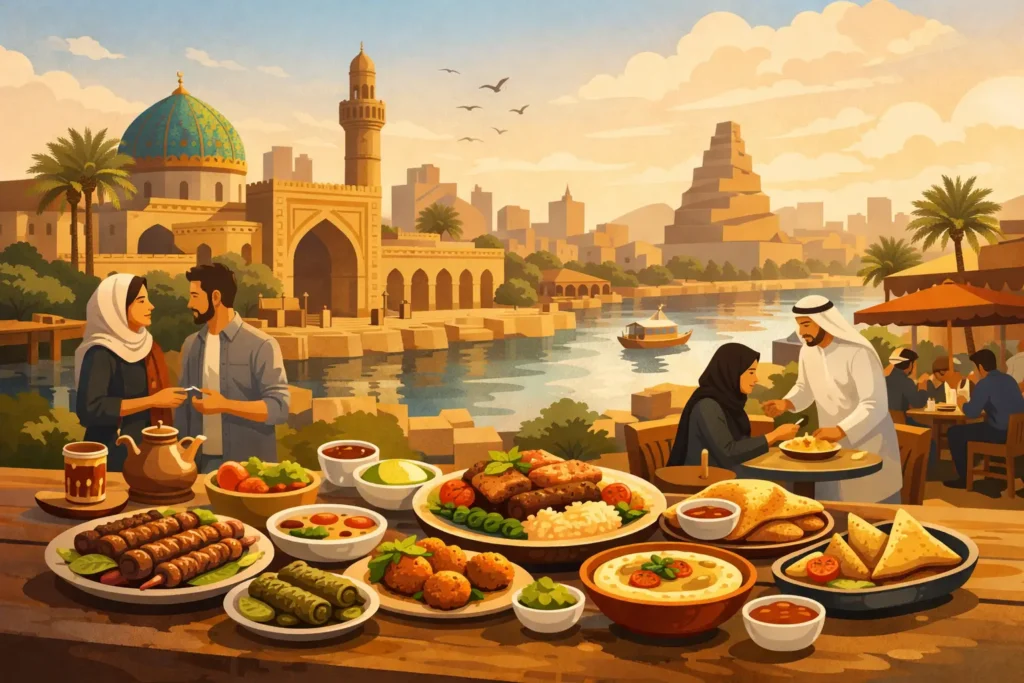
The first time you sit down for a proper Iraqi meal, one thing becomes clear very quickly – this is not food designed to be rushed. If you are searching for Iraqi food to try before your trip, start with the dishes that Iraqis themselves return to for comfort, celebration and hospitality. They tell you as much about the country as its shrines, marshes, old cities and riverfronts do.
Food in Iraq carries memory. It reflects Baghdad’s river culture, Basra’s connection to the Gulf, the agricultural wealth of the south, and the family traditions that shape everyday cooking across the country. For travellers, that makes eating well in Iraq more than a pleasant extra. It is one of the clearest ways to understand local generosity, regional identity and the rhythm of daily life.
Iraqi food to try first
If you only have a few days in Iraq, it helps to begin with dishes that are widely loved and relatively easy to find. Some meals are deeply tied to one city, while others appear across homes and restaurants in different forms. That variety is part of the appeal.
Masgouf
Masgouf is one of Iraq’s most recognisable dishes, especially in Baghdad. Traditionally made with carp from the Tigris or Euphrates, the fish is butterflied, seasoned and cooked slowly over open flames. The method matters as much as the ingredients. Rather than being heavily sauced, the fish develops a smoky, rich flavour that stays clean and distinct.
For many visitors, masgouf is not just something to eat but an experience to seek out. It is often enjoyed by the river, shared leisurely, and served with bread, onions, pickles and fresh herbs. If you want one dish that captures the social side of Iraqi dining, this is a strong place to start.
Dolma
Iraqi dolma deserves special attention because it is very different from the lighter versions some travellers may know from elsewhere. In Iraq, dolma often includes stuffed vine leaves alongside onions, peppers, tomatoes, aubergines and sometimes cabbage leaves, all packed with a fragrant filling of rice, herbs and spices. In some homes, meat is added, while in others the focus stays on the vegetables and the seasoning.
What makes Iraqi dolma memorable is its depth. It is savoury, gently tangy and unmistakably homely. It is also labour-intensive, which is why being served dolma can feel like being welcomed into a family occasion rather than merely offered lunch.
Kubba
Kubba, also written kibbeh in other parts of the region, appears in several Iraqi styles. It can be fried and crisp, soft and simmered in broth, or shaped differently depending on the city and household. The outer shell is usually made from bulgur or rice with minced meat, while the filling often includes spiced meat and onions.
This is one of those foods where preference becomes personal very quickly. Some travellers will favour the fried version for its texture, while others will prefer a soup-based kubba for something more delicate. Either way, it is a useful reminder that Iraqi cuisine is not one fixed menu but a collection of local traditions.
Quzi
Quzi is the sort of dish people often remember from festive meals. It usually features slow-cooked lamb served with rice, nuts, raisins and aromatic spices. Depending on where you eat it, the presentation may be grander or simpler, but the core idea remains the same – generosity on a plate.
For visitors, quzi offers a good introduction to the balance Iraqi cooking often achieves. It is rich without becoming heavy, fragrant without being overpowering, and built for sharing. If you are travelling during a celebration or gathering, you may well encounter it in a more ceremonial setting.
Everyday dishes worth ordering
Some of the best Iraqi food to try is not necessarily the most famous. Often, it is the meal people eat regularly, buy on the way home, or serve to guests without fuss. These dishes tend to give a more intimate picture of life in Iraq.
Tashreeb
Tashreeb is deeply comforting. At its simplest, it combines broth-soaked bread with meat and vegetables, creating a dish that is soft, savoury and satisfying. Lamb is common, but there are variations. The bread absorbs the broth and becomes part of the meal rather than merely an accompaniment.
This may not be the most photogenic item on the table, but it is one of the most revealing. Tashreeb speaks to older culinary habits, practical home cooking and the value placed on nourishment. Travellers looking for polished restaurant food may overlook it, but that would be a mistake.
Tepsi baytinijan
Tepsi baytinijan is an oven-baked dish often made with aubergine, potatoes, tomatoes, onions and minced meat, then served with rice or bread. The ingredients are familiar, yet the finished dish feels distinctly Iraqi. The vegetables soften into the meat and sauce, creating something hearty and deeply savoury.
This is a good dish to order if you want a fuller sense of home-style Iraqi cooking. It is not flashy, but it is generous and satisfying, especially after a long day of travelling.
Fasolia
Fasolia, a bean stew usually cooked with tomato and meat, is another staple worth trying. It is the kind of food that appears simple until you notice how much flavour has been built into it. Served with rice, it makes for a balanced and very approachable meal.
For first-time visitors who want to ease into Iraqi cuisine, fasolia is often an easy choice. It carries familiar elements while still feeling local and specific.
Bread, breakfast and the foods between meals
Iraqi cuisine is not only about grand dishes. Some of the most memorable moments come in the morning, at a bakery, or over tea between larger meals.
Samoon and fresh bread
Bread matters enormously in Iraq, and samoon is one of the shapes you will encounter most often. Slightly crisp outside and soft inside, it appears beside grilled meats, stews and breakfast spreads. A good bakery can become part of your travel memory as surely as any landmark.
Do not underestimate the pleasure of warm bread eaten simply, especially when paired with cheese, eggs, cream or preserves. In a country known for hospitality, fresh bread often arrives at the table as a quiet sign of care.
Geymar with honey or date syrup
For breakfast, geymar is one of the great treats. This rich clotted cream, often associated with Baghdad, is commonly eaten with bread and drizzled with honey or date syrup. It is indulgent, yes, but also rooted in everyday pleasure rather than novelty.
If you are used to lighter breakfasts, it may feel substantial. Still, for a traveller wanting to understand Iraqi mornings, it is absolutely worth trying at least once.
Falafel and casual street bites
Falafel is eaten across the region, but in Iraq it remains part of the daily food landscape and can make an excellent quick meal while moving between neighbourhoods. Depending on where you stop, it may be served in bread with salad, pickles and sauce, or alongside other small items.
Street-side food can be one of the easiest ways to eat affordably and observe local pace. The sensible approach, as in any destination, is to choose busy places with a steady turnover and freshly prepared food.
Save room for sweets and tea
No food journey through Iraq feels complete without something sweet and a glass of tea. Iraqi hospitality is often expressed as much through what appears after the meal as during it.
Kleicha
Kleicha is perhaps Iraq’s best-known biscuit or pastry, often filled with dates, walnuts or sweet spiced mixtures. It is especially associated with celebrations and family gatherings, but you can find it more widely too. The date-filled version is particularly worth trying, not least because dates are such an important part of Iraqi agriculture and identity.
Baklava and local confectionery
Baklava appears in Iraq in forms many travellers will recognise, but local sweet shops often offer a wider spread of pastries and syrup-soaked treats worth sampling. Quality varies, so it helps to buy from places with a strong local reputation. When it is good, it is excellent.
Chai
Iraqi tea is not an afterthought. Strong, dark and usually sweet, it accompanies conversation, welcomes guests and punctuates the day. You may be offered tea repeatedly, and accepting it often opens the door to the kind of small human exchanges that stay with travellers longest.
How to approach food in Iraq as a traveller
The best approach is curiosity paired with respect. Ask what a dish contains, especially if you have dietary requirements, but also be open to local recommendations rather than searching only for familiar options. In some places you will find polished dining rooms, while elsewhere the most memorable meal may come from a simple family-run spot.
Regional variation matters too. What you eat in Baghdad may differ from what stands out in Basra, Najaf, Mosul or the Kurdistan Region. That is part of what makes travelling through Iraq rewarding. The cuisine is unified by hospitality, but not flattened into sameness.
If you are planning a journey with Stay In Iraq in mind, food is one of the easiest ways to move from curiosity to connection. A shared plate of masgouf, a bakery stop at breakfast, or tea offered without ceremony can make the country feel immediately more personal.
Leave space in your itinerary for meals that are not scheduled too tightly. In Iraq, some of the most meaningful travel moments arrive at the table, slowly, generously, and often with an invitation to have just a little more.